<?xml version="1.0" encoding="utf-8"?> 

<feed xmlns="http://www.w3.org/2005/Atom"
  xml:lang="en-us"
  xmlns:xsi="http://www.w3.org/2001/XMLSchema-instance"
  xmlns:posse="https://posseparty.com/2024/Feed"
  xsi:schemaLocation="
    http://www.w3.org/2005/Atom https://raw.githubusercontent.com/docjason/XmlValidate/refs/heads/master/schemas/atom.xsd
    https://posseparty.com/2024/Feed https://posseparty.com/2024/Feed.xsd">
  <id>https://justin.searls.co/mails.xml</id>
    <title>justin․searls․co - Newsletters</title>
  <updated>2026-04-01T16:16:03+00:00</updated>
  <author>
      <name>Justin Searls</name>
      <email>website@searls.co</email>
  </author>
  <link href="https://justin.searls.co/" rel="alternate" type="text/html" title="HTML" />
  <link href="https://justin.searls.co/mails.xml" rel="self" type="application/atom+xml" title="Newsletters" />
  <category term="Software"/>
  <generator uri="https://gohugo.io/" version="0.153.4">Hugo</generator>
  <icon>https://justin.searls.co/favicon.ico</icon>
  <logo>https://justin.searls.co/img/wide_logo.png</logo>
  <rights>Copyright Justin Searls. All rights reserved.</rights>
  <subtitle>Where Justin Searls is content to post content.</subtitle>
  

  <entry>
      <id>https://justin.searls.co/mails/2025-12/</id>
      <title type="text">100% Oyster Meat</title>
      <link href="https://justin.searls.co/mails/2025-12/" rel="alternate" type="text/html" />
      <author>
          <name>Justin Searls</name>
          <email>website@searls.co</email>
      </author>
      <published>2026-01-04T00:22:23+00:00</published>
      <updated>2026-01-04T00:22:26+00:00</updated>
      <content type="html"><![CDATA[<p>As promised last month, this issue is just <a href="https://justin.searls.co/mails/2025-11/#searls-of-wisdom">oyster meat</a>. It's a new year and as good a time as any to hit reset and get this monthly newsletter back on its preordained beginning-of-the-month-ish delivery cadence. That makes this a quick turnaround after our <a href="https://justin.searls.co/mails/2025-11/">last issue</a>, so there's not much new to report. Good thing I asked you all to lower your expectations!</p>
<p>Let's see, since we last corresponded:</p>
<ul>
<li><a href="https://mikemcquaid.com/fun-with-feeds/">Mike McQuaid wrote that he's joined the POSSE Party</a>, so I <a href="https://justin.searls.co/links/2025-12-21-mike-mcquaid-has-joined-the-posse/">pulled a quote</a> and recruited him to help deal with <a href="https://github.com/searlsco/posse_party/graphs/contributors">maintenance and triage</a>. Another early adopter posted <a href="https://www.reddit.com/r/rails/comments/1psbh26/claudes_architectural_analysis_of_posse_party_by/">an architectural review of my codebase</a> to Reddit</li>
<li>I spent a few afternoons tweaking a <a href="https://justin.searls.co/tubes/2025-12-25-08h30m45s/">ChatGPT-powered Shortcut for Japanese study</a> and was impressed to find Shortcuts is sneakily <a href="https://justin.searls.co/shots/2025-12-24-08h21m27s/">more functional</a> than one might assume. Its new <a href="https://support.apple.com/guide/iphone/use-apple-intelligence-in-shortcuts-iph78c41eaf8/ios">Use Model</a> action allows users to <a href="https://justin.searls.co/takes/2025-12-21-14h18m50s/">tap into cloud-based Private Cloud Compute and ChatGPT</a> for <strong>free</strong>, which is a total game changer. Native app developers can only access on-device models, which makes Shortcuts a uniquely powerful tool in its own right</li>
<li>Aaron &amp; I kept the streak alive by executing the <a href="https://justin.searls.co/casts/feature-release-v48.1-2nd-annual-punsort/">2nd Annual Punsort</a> algorithm. I think his puns got less terrible or I got better at ranking them—either way, things seemed far less contentious than in our <a href="https://justin.searls.co/tubes/2025-01-07-18h36m56s/">first go-round</a></li>
<li>I did all four Disney parks in one day and live-<a href="https://justin.searls.co/clips/creating-static-instagram-stories-as-wisps/">wisped</a> the ordeal over <a href="https://justin.searls.co/takes/2025-12-29-08h22m10s/">12 hours, 16 rides, and 30,000 steps</a>. If you missed my photos and videos, you'll just have to get in the habit of checking <a href="https://justin.searls.co">my homepage</a> or <a href="https://instagram.com/searls">Instagram</a> every day, I guess! I got a couple remorseful emails from people looking to find my auto-deleting wisps/stories after they were, in fact, deleted. 💨</li>
<li>Becky gave me a Steam gift card for Christmas, and <a href="https://justin.searls.co/links/2025-12-31-12h22m54s/">this humorous trailer</a> immediately sold me on <a href="https://www.ballxpit.com">Ball x Pit</a>. I've since played it and can confirm it to be a Good Game: part Vampire Survivors, part Plants vs. Zombies, part Breakout.</li>
<li>A few assorted takes:
<ul>
<li>If you or a loved one are worried about losing your job to AI, <a href="https://www.maxberry.ca/p/how-to-not-be-replaced-by-ai">this essay</a> is what I've <a href="https://justin.searls.co/takes/2025-12-22-14h07m08s/">been pointing people to</a> lately</li>
<li>Macs have FileVault encryption enabled by default, which has always diminished their utility as home servers—if the power goes out, there goes your remote login access! They <a href="https://support.apple.com/en-us/124963">finally addressed this in macOS 26 Tahoe</a>: inbound SSH connections following a cold boot will now unlock and finish booting <a href="https://justin.searls.co/takes/2025-12-22-15h34m36s/">my FileVault-protected Mac Studio</a></li>
<li>What populist candidates promise and what they prioritize once elected are rarely in agreement. So it goes in Japan, as <a href="https://justin.searls.co/takes/2025-12-24-09h13m50s/">an anti-foreigner platform gives way to a policy agenda that will attract more foreigners by further weakening the yen</a></li>
<li>If you're running modern Apple hardware, I recently learned <a href="https://justin.searls.co/takes/2025-12-26-10h43m09s/">there's a setting to make sure Safari actually renders content at a &quot;ProMotion&quot; 120Hz refresh rate</a></li>
</ul>
</li>
</ul>
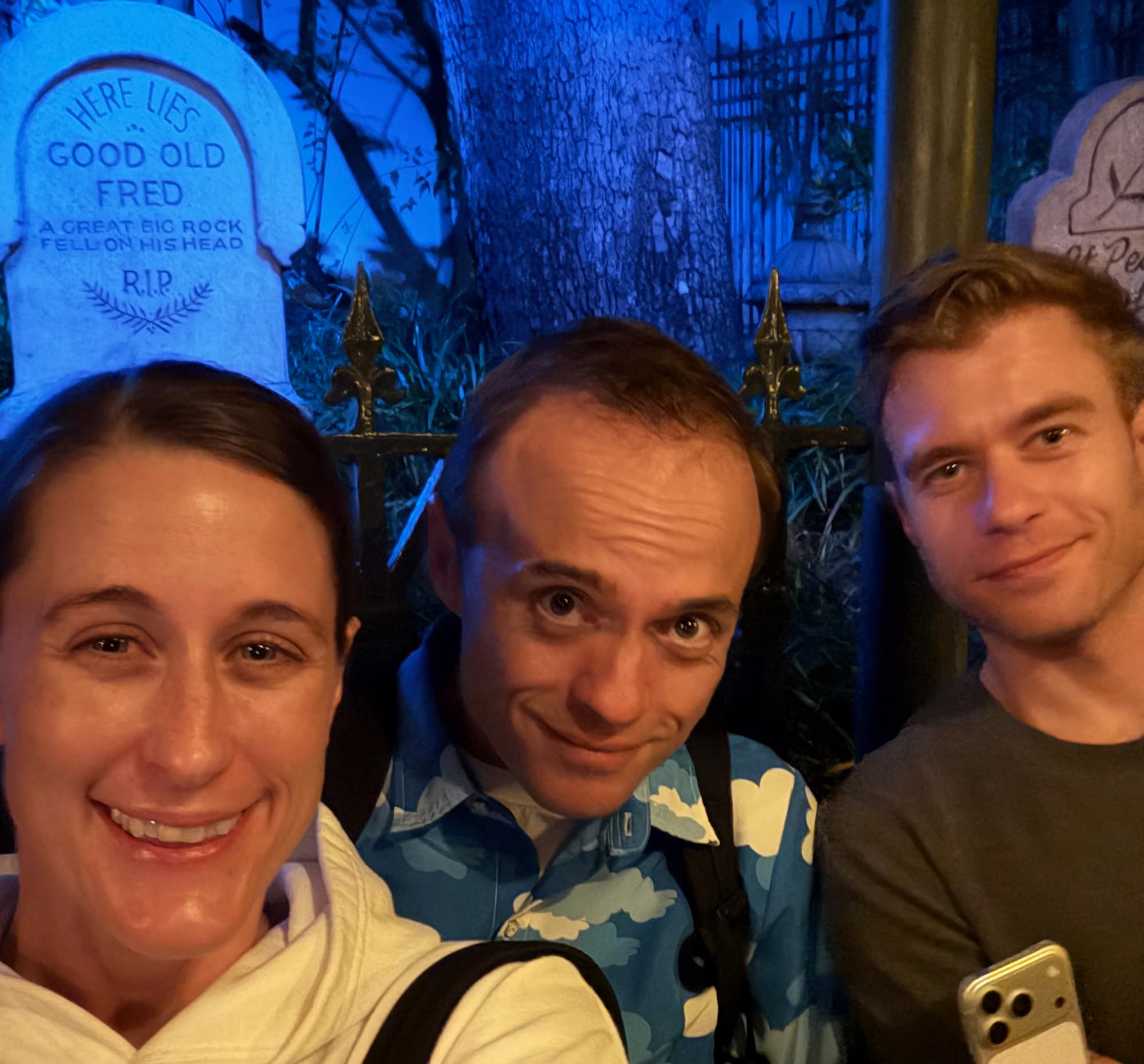
<p>For the second year in a row, us kids paid a visit to dad's second-favorite spot in Walt Disney World on Christmas Day:</p>
<p><img src="/img/social/mails/2025-12-1.jpg" alt="The Haunted Mansion tombstone reads, &quot;Here Lies Good Old Fred, a great big rock fell on his head. RIP&quot;"></p>
<p>Fortunately, gallows humor has always played in the Searls family.</p>
<p>Stay tuned for next month's note, as I'll have just gotten back from the storied land of Shizuoka following the next chapter of our <a href="https://justin.searls.co/mails/2025-05/">condo purchase journey</a>. We're still on track to close in July, but in mid-January I have the not-technically-mandatory opportunity to pick out the curtains and the drapes at a sort of mini trade show event held by the developer. Well, curtains, yes, but also air conditioners. And tile. And how to finish the balcony. And how many mirrors we want, and where, and whether to tint them in sepia tones. And which LED mood lighting package should line the toilet. Should I pay for them to seal a brand new Japanese wood floor or is that a scammy upsell?</p>
<p><a href="mailto:justin@searls.co">Reply</a> and tell me what to do, please—the decision overload is truly overwhelming.</p>
<p>Anyway, the next week of my life is going to be spent poring over a dozen product catalogs. Bridging the language and cultural divide is extremely slow going. It's a good thing I failed to predict how much work this condo would turn out to be, or I'd never have gone through it. If you catch me having any fun this month, yell at me and tell me to get back to work.</p>
<p>Speaking of bridging language and culture, keep reading for one more stupid thing.</p>
<p>Fun fact that I got wrong every time when we actually lived in Japan, and which might come in handy if you ever find yourself there around New Year's:</p>
<p><strong>Before</strong> the new year, the conventional anticipatory set phrase is 良いお年を (&quot;yoi otoshi o&quot;), which more or less translates to &quot;Have a good new year&quot;.</p>
<p><strong>After</strong> the dawn of the new year, people no longer say 良いお年を—and I can confirm that doing so will elicit a confused reaction from your local postal worker, next door neighbor, and favorite convenience store worker. Instead, the hot new thing to say is 明けましておめでとう (&quot;akemashite omedetou&quot;), which is yet another <a href="https://www.tofugu.com/japan/japanese-work-culture/">set phrase</a> celebrating the year's dawn.</p>
<p>Last night, while visiting a Mexican-American friend's open house, the other guests taught me that &quot;Feliz Año Nuevo&quot; means &quot;Happy New Year&quot; in Spanish. Fourteen attempts and 3 mezcals later, I finally nailed that one—before promptly forgetting it. Language is hard.</p>]]></content>
  </entry>

  <entry>
      <id>https://justin.searls.co/mails/2025-11/</id>
      <title type="text">Merry Divestmas</title>
      <link href="https://justin.searls.co/mails/2025-11/" rel="alternate" type="text/html" />
      <author>
          <name>Justin Searls</name>
          <email>website@searls.co</email>
      </author>
      <published>2025-12-23T00:19:36+00:00</published>
      <updated>2025-12-23T00:19:39+00:00</updated>
      <content type="html"><![CDATA[<p>Hey everybody, we've almost survived another year! Just ten days to go—I hope we all make it!</p>
<p>Looking back on the home stretch of 2025, this is all I have to report since our <a href="https://justin.searls.co/mails/2025-10/">last issue</a>:</p>
<ul>
<li>I built a <a href="https://justin.searls.co/clips/fit-a-5090-gaming-rig-in-a-backpack/">sexy new gaming PC</a> over 3 days, 120 teeny-tiny M3 screws, and at least ten cups of coffee</li>
<li>I got my <a href="https://en.wikipedia.org/wiki/Turbinate_reduction">first nose job</a>. I've always had a huge fucking nose, and I'm relieved to finally be able to breathe out of it</li>
<li>I talked about both of the above <a href="https://justin.searls.co/casts/breaking-change-v48-coil-whine/">on my podcast</a></li>
<li>I'm so sick of bracing for the AI bubble to pop, that I've decided to <a href="https://justin.searls.co/links/2025-12-08-the-ai-wildfire-is-coming/">look forward to it instead</a>. Buy popcorn futures, everyone 🍿</li>
<li>I <a href="https://posseparty.com/">released POSSE Party</a>, which I'll talk a bit more about later. Also these bits:
<ul>
<li>I spent a couple days <a href="https://github.com/searlsco/posse_party/tree/main/docs/account_setup">documenting the hell</a> that is other people's API keys.</li>
<li>I recorded a tutorial video in <a href="https://www.youtube.com/watch?v=73OBp4-AQDc">1</a>, <a href="https://www.youtube.com/watch?v=FT4234P7NGc">5</a>, <a href="https://www.youtube.com/watch?v=Pb8_jaOmMN4">10</a>, <a href="https://www.youtube.com/watch?v=08UwvMfF8Rg">15</a>, and <a href="https://www.youtube.com/watch?v=DQbmSDzSoKM">20</a> minute variations. It's a Choose-your-own-attention-span adventure.</li>
<li>The first stop on my promotional tour was <a href="https://www.youtube.com/live/YkMpfAnu6Z8">Aaron's livestream</a> for a tour of the codebase, which you can <a href="https://github.com/searlsco/posse_party">peruse on GitHub</a></li>
</ul>
</li>
</ul>
<p>The day of my surgery, Becky insisted on taking a picture of me after I was told to put on a hairnet but before the drugs kicked in. I was very anxious going into the operation and she was very supportive throughout.</p>
<p><img src="/img/social/mails/2025-11-1.jpg" alt="Me with my vanity hairnet"></p>
<p>As 2025 winds down, the Searls of Wisdom LT (which <a href="https://www.acronymfinder.com/Leadership-Team-(LT).html">stands for &quot;Leadership Team&quot;</a>, an acronym I'll be using from now on to amortize the time it took to write this parenthetical) has decided to evolve how it approaches our monthly newsletter operations. Change is hard for many of us, so in lieu of a normal essay about how my <em>feelings</em> inspired certain <em>thoughts</em> that led to valuable <em>insights</em>, I'm just going to explain what you can expect from this newsletter going forward before wishing you better luck next year and sending you on your way.</p>

<h2 id="merry-divestmas">Merry Divestmas</h2>
<p>Some time in June, my brother called me from the U.S. while I was riding a Shinkansen bullet train, at which point I realized I'd never actually taken a call while moving faster than 150 mph before. I remember a certain unease—unsure what the proper etiquette was—so I stepped into the hall between train cars to take it.</p>
<p>Coincidentally, I'd been chewing on a major decision I'd made in isolation (that is, without consulting the LT) over the previous few days that I'd been itching to run by him. But just as I was about to blurt out my news, he beat me to the punch:</p>
<p>&quot;I need to sell this fucking house.&quot;</p>
<p>Oof. Gut punch. It had been so great having him five minutes down the road the past few years. And I hadn't done nearly as good a job taking advantage of that proximity to hang out as I'd hoped to. For three or four seconds, I experienced a flood of fear and regret, which primed my mouth muscles to start making a case for why he should stay in his house for <em>my</em> sake. Fortunately, I caught myself and remembered that nobody elected me Guy Who Decides What Everyone Else Does With Their Life. (I ran a spirited campaign, but conceded gracefully in the interest of national unity.)</p>
<p>He explained his reasoning, and his plan made total sense. I won't share more—if he wanted you to know, you'd be reading his newsletter—other than to say he told me he was entering a season of divestment. Of unburdening himself. Of embracing a simpler life.</p>
<p>I've never regretted having or doing less, so I pivoted to supporting him however I could.</p>
<p>And that's how one-third of the closets in my house are now devoted to storing hyper-realistic Iron Man, Batman, Spider-Man, and Captain America costumes.</p>

<h3 id="posse-party">POSSE Party</h3>
<p>As I mentioned, my brother beat me to the punch with that phone call, because I had my own news I wanted to get off my chest.</p>
<p>For weeks, I'd been bouncing between decrepit, poorly-ventilated rural motels in what was turning out to be a hot-as-balls early Japanese summer. A few nights prior, I had a fever dream in which I'd successfully released <a href="https://posseparty.com">POSSE Party</a>, the SaaS product I'd been working on since January. Like all my dreams, it quickly spiraled into a nightmare. In the dream, I was inundated by time-consuming support requests that lacked any tractable solution—all while living under the constant threat of being banned by the social media platforms whose APIs the app depends on.</p>
<p>Still on the phone with Jeremy, I shared my own news.</p>
<p>&quot;I need to abort POSSE Party. If I release this as a product, the support burden will ruin my life.&quot;</p>
<p>His reaction? &quot;Well, yeah, that's been obvious from the start.&quot; <em>What the hell man, why didn't you say something?</em> &quot;I thought I did.&quot;</p>
<p>I hung up, my need for validation not yet sated. Still titillated by the experience of talking on the phone while traveling at 320 km/h, I FaceTime'd <a href="https://tenderlovemaking.com">Aaron</a> to get his take.</p>
<p>&quot;Aaron, I've realized that if I release POSSE Party it'll ruin my life.&quot;</p>
<p>&quot;No shit, dude.&quot;</p>
<p>Goddammit. Some friends. I don't know why I keep them on the LT.</p>
<p>Anyway, I'd publicly committed to releasing POSSE Party by the end of 2025 and I had hundreds of people on the waiting list. I genuinely believed it could give people ownership of their identity and creative work online. Using POSSE Party as a way to post to the social platforms without having to spend time scrolling their feeds myself has greatly improved my life, and I didn't want to deprive others the same opportunity by keeping it to myself. I just had to find a way to publicly release it <em>without</em> falling into the trap of assuming the liability of customer-facing support, whether express or implied.</p>
<p>It took a few months longer than I'd hoped, but I've finally released POSSE Party as a non-commercial, self-hosted app that's free for personal use. You can read more about it or watch one of my tutorial videos on how to set it up over at <a href="https://posseparty.com">posseparty.com</a> if you're interested.</p>
<p>And that's the end of the road for POSSE Party. I'll keep using it, and I'll keep improving it to whatever extent serves my interests. But I've divested myself of the perpetual burden that software-as-a-service typically entails. Boom, divested. I gotta admit, I feel a few pounds lighter. (But that also might be on account of the fiber supplements I've started taking recently.)</p>
<p>I'll take that lesson to heart as I undertake my next project. The magic of software is that it can continue working after you stop working on it, but keeping it that way requires intentional planning and intense discipline. Most software businesses fail mightily at this, and wind up being every bit as labor-intensive as running the equivalent physical machinery by hand.</p>

<h3 id="searls-of-wisdom">Searls of Wisdom</h3>
<p>I started this newsletter in the Spring of 2023. At the time, I was thinking through how to best transition out of full-time employment at <a href="https://testdouble.com">Test Double</a> and into a solo career of not working anymore. I started writing this newsletter as a bridge from my reputation as a semi-serious cofounder to my reclaimed identity as an itinerant shitheel.</p>
<p>I had these specific goals in mind:</p>
<ol>
<li>Make sure any of you who knew me only through my business had a way to find me after I'd stepped back from its day-to-day</li>
<li>Give myself an outlet to begin unwinding the metaphysical contortions I'd subjected myself to for the sake of my career</li>
<li>Improve my writing chops, which had always been choppy, but—lacking intentional practice for years—had grown noticeably choppier</li>
</ol>
<p>By those measures, I'd say this newsletter has accomplished (for me) what I had set out for it to do (for me). Along with <a href="https://justin.searls.co">justin.searls.co</a>, I've established an exciting new brand identity which, conveniently, happens to perfectly align with my legal first and last name. When I look at myself in the mirror, I once again see the irreverent free thinker I was at 19 or 20, before I was transformed by the insatiable pursuit of professional validation and financial success. And while it's hard to measure one's growth as a writer, I am once again comfortable distilling disparate observations and amorphous feelings into tidy narrative throughlines and cocksure conclusions—which is good enough for me.</p>
<p>The fact so many of you reply to my little essays and share the positive impact they've had is just icing on the cake. (That's not to diminish your feelings! A cake without icing is just a cancerous muffin, after all.) I'm genuinely glad so many people seem to enjoy following my work, if you can call it that.</p>
<p>But over the past six months, writing this newsletter has gradually transformed from a source of joy I eagerly anticipated each month and into a chore I've begun to dread. At its best, finishing a piece of writing brings the same sense of satisfaction as solving a challenging puzzle. But my increasingly serious and probing essays are starting to feel like a performance—a show that must go on, even when I'd rather be doing something else. And while I enjoy positive feedback as much as the next guy, it's as if each note of appreciation further obliges me to continue pumping out more content. I can sense I'm no longer writing for my own sake, but for yours. Lately, I've found myself pushing through these essays not to write something useful so much as to say something clever. Each month, I try to <em>outdo</em> myself. To what end? Nobody is asking me to do this.</p>
<p>So I'm going to stop.</p>
<p>Going forward, Searls of Wisdom is going to look a little different. I'll continue e-mailing you once a month—that much won't change. And sometimes, sure, it will come with one of my little essays. But most months it'll just be a list of bullet points linking you to other things I did that month. If I'm really strapped for time, you'll receive nothing more than a proof-of-life photo of me holding up that day's newspaper. I hereby divest myself of the self-imposed expectation to spend two days sweating a long-form essay that some unseen number of you will silently judge as sufficiently insightful.</p>
<p>I was going to format the previous paragraph in bold text, but if someone is already in the habit of skimming past these essays, why stop them? This announcement won't affect them, after all.</p>
<p>Next time I start something, I'm going to do a better job remembering that the things I create exist to serve <em>me</em>—not the other way around.</p>
<p>At the end of the day, if every oyster contained a pearl, then pearls would no longer be so precious. So don't be surprised when you crack open next month's newsletter and get nothing but oyster meat. 🦪</p>

<h3 id="what-will-you-divest">What will you divest?</h3>
<p>I'm a constitutionally commitment-averse person, and yet I find myself overwhelmed with commitments I've made and for which I have no one to blame but myself. Surely, I can't be alone in this.</p>
<p>So if there's anything for you to take away from this month's newsletter, maybe it will be a reminder to take stock of the shit you're holding onto unnecessarily. Maybe it's time to let go of a physical possession that's more work than it's worth. Maybe there are things you do at work that you don't enjoy doing and which nobody notices or appreciates. Maybe it's time to put your yappy, ungrateful chihuahua to sleep. And if you decide to drop your newborn off at the fire station, who am I to judge?</p>
<p>Merry Divestmas, everyone. 🚮</p>]]></content>
  </entry>

  <entry>
      <id>https://justin.searls.co/mails/2025-10/</id>
      <title type="text">I&#39;d do it all again</title>
      <link href="https://justin.searls.co/mails/2025-10/" rel="alternate" type="text/html" />
      <author>
          <name>Justin Searls</name>
          <email>website@searls.co</email>
      </author>
      <published>2025-11-28T00:18:28+00:00</published>
      <updated>2025-11-28T00:18:31+00:00</updated>
      <content type="html"><![CDATA[<p>Hello! We're all busy, so I'm going to try my hand at writing less this time. Glance over at your scrollbar now to see how I did. Since we last corresponded:</p>
<ul>
<li>Dropped in on the <a href="https://justin.searls.co/casts/merge-commits-ruby-ai-tldr-of-ai-dev/">Ruby AI podcast</a></li>
<li>Added a <a href="https://justin.searls.co/shots/2025-10-25-12h35m39s/">new cable</a> to the increasing number of cables plugging my face into my computer, which shipped with <a href="https://justin.searls.co/posts/how-to-downgrade-vision-pro-dfu-mode/">some pretty glaring issues</a>, some of which I <a href="https://justin.searls.co/casts/breaking-change-v45-developer-strap-on/">talked about</a></li>
<li>Found somebody else saying that, in the short term, <a href="https://www.wreflection.com/p/ai-dial-up-era">AI codegen is going to dramatically increase the demand</a> for software as the <a href="https://justin.searls.co/links/2025-11-04-software-is-supply-constrained-for-now/">supply constraint on programming eases</a></li>
<li>Made an open source library called <a href="https://searlsco.github.io/straight-to-video/">Straight-to-Video</a> that performs client-side remuxing and transcoding of videos, beating them into shape for upload via the Instagram, Facebook, and TikTok APIs</li>
<li>Hosted my brother after he sold his house, which (of course) coincided with nonstop power and Internet outages. Rather than do something about it, I <a href="https://justin.searls.co/casts/breaking-change-v46-adjusted-gross-intelligence/">complained into my microphone</a></li>
<li>Mourned the fact <a href="https://justin.searls.co/links/2025-11-10-rip-iphone-18-air/">iPhone 18 Air apparently got cancelled or delayed</a> to Spring 2027, continuing my losing streak of falling in love with Apple's least popular hardware</li>
<li>Learned <a href="https://justin.searls.co/casts/breaking-change-v47-turbinately-ill/">I have huge fucking turbinates</a>, even relative to my already huge fucking head</li>
</ul>
<p>My good friend <a href="https://www.instagram.com/kenpozek">Ken</a> took me to the Magic game <del>last night</del> some number of nights ago. It was a great game because we were losing very badly, and then it became very close, and then, right at the end—we won! The classic comeback narrative arc was fulfilled. Sports!</p>
<p><img src="/img/social/mails/2025-10-1.jpg" alt="Ken and I at the Magic game"></p>
<p>I was reflecting on life the other day, which is a thing I do more often now that I'm firmly in <a href="https://justin.searls.co/mails/2024-11/#the-third-phase-of-life">Phase 3 of my evil plan</a> to ride off into the sunset and gradually be forgotten by all of you.</p>
<p>My original plan for this essay would have pulled at the common thread that ties things like game design, derivatives trading, reality shows, and sports betting together. Unfortunately and unsurprisingly, it was taking me too long, and I'm now running out of time in November to give you a recap on what happened in October.</p>
<p>(By the way, don't be surprised if I just send you all a postcard for the December issue. I'm still new at running a monthly newsletter, and I'd prefer not to find out what happens when I fall more than a month behind. Feel free to demand a refund by replying to this message.)</p>
<p>So, anyway, like I said, my actual essay fell apart. Instead, I'm going to share a personal example of how a series of consequential decisions can paradoxically be both productive &amp; rational, while simultaneously being costly &amp; misguided.</p>

<h2 id="id-do-it-all-again">I'd do it all again</h2>
<p>It all started with one stray piece of unsolicited feedback.</p>
<p>In 2016, I was privileged to give <a href="https://rubykaigi.org/2016/presentations/searls.html">a keynote address</a> at Ruby Kaigi, which was held in the beautiful and intimidating <a href="https://www.icckyoto.or.jp/en/">Kyoto Convention Center</a>. It was a big deal for me professionally. I worked hard to create the best speech I could. I also used the occasion to riff a little bit in Japanese while on stage.</p>
<p>After the talk, I was riding high. Hundreds of new followers, summary blog posts from Japanese developers, and even some Japanese-language tech news coverage. My head was spinning. I'll never forget the overwhelm of trying to keep up with my mentions after getting off stage. Beyond a certain point, there were too many replies to individually translate each one—I ultimately gave up and just bulk-faved them all. In that moment, I felt as though I'd finally received all the validation I had been craving from the Ruby community for over ten years.</p>
<p>About an hour later, a Japanese friend approached me while I was still riding high. But instead of praising me or my achievement, he bluntly told me my Japanese wasn't good enough and that I should take my studies more seriously.</p>
<p>Oof.</p>

<h3 id="decision-1">Decision 1</h3>
<p>I started as someone who traveled to Japan. I was focused on nurturing friendships and engaging with the culture.</p>
<p>Being told my Japanese wasn't good enough—moments after having shown it off in front of a massive auditorium of people I respected—really, <em>really</em> stung. It stuck with me long after the ecstasy of having reached such a career milestone subsided. It was all I could think about for the rest of the trip. Even when I got back to the States, I couldn't shake it.</p>
<p>I came home determined to get that monkey off my back. I signed up for <a href="https://www.wanikani.com">WaniKani</a>, a SaaS app by the fine folks at <a href="https://www.tofugu.com">Tofugu</a> that uses mnemonic lessons and a <a href="https://en.wikipedia.org/wiki/Spaced_repetition">spaced repetition</a> flashcard game to teach Japanese kanji and vocabulary. I studied diligently for 30-60 minutes every day. It worked! In a bit over a year, I'd memorized over 2000 kanji and thousands more vocabulary words and phrases.</p>
<p>Like most modern educational software, WaniKani's design is oriented around a habit-forming game loop. It's fun to log in every day, level up by correctly answering flashcards, and (outside the app) discover that you're suddenly able to read things that were previously inscrutable.</p>

<h3 id="decision-2">Decision 2</h3>
<p>I was now someone who studied Japanese. I was focused on clearing my reviews every day and reaching level 60 on a web site.</p>
<p>As I approached the end of WaniKani's curriculum, I'm ashamed to say I was more interested in tightening its game loop than deploying my newfound skills to actually communicate with humans. To that end, I had been building a to-do list—a year's worth of shower ideas detailing how I'd improve the tool if I had the chance.</p>
<p>A few of the bigger items on that list:</p>
<ul>
<li>Connect a <a href="https://www.edrdg.org/jmwsgi/srchformq.py?svc=jmdict">larger dictionary</a>, so I could start studying <em>any</em> arbitrary word I encountered outside the app</li>
<li>Provide a better mobile experience, so I could study on the go without fear of losing my progress when the connection dropped</li>
<li>Facilitate memorization of <em>production</em> of English terms into Japanese—as opposed to the translation of Japanese terms into English—so I could better think of whatever Japanese word I needed in conversation</li>
</ul>
<p>As is my wont, the instant I imagined a better software tool, I dropped everything to build it myself. So, from the tail end of 2017 and through most of 2018, I dedicated my free time to building an app called KameSame. It synced users' WaniKani progress, allowed studying of both production and recognition skills, introduced its own XP-based leveling system, incorporated the ability to search and add items from other dictionaries. It also included a boatload of other nice-to-haves like synonym detection, verb and adjective conjugation support, and AI-generated pronunciation recordings.</p>
<p>I released the app for free and shared it on a few forums. It quickly picked up an arena's worth of <em>extremely</em> active users. By last count, <a href="https://www.kamesame.com">KameSame</a> had over 20,000 users studying over 5 million flashcards. Keeping up with support requests and maintenance was time-consuming, but it was no match for my own voracious appetite to keep bolting on additional features. When I find imperfections in other people's software, there's little I can do but accept them (beyond contacting support or posting a salty take). But, because I had created KameSame for no one's satisfaction but my own, whenever I detected so much as a <em>scintilla</em> of UX friction, Justin-as-developer would take over for Justin-as-student and immediately <em>stop studying</em> to go fix it. Instead—ostensibly for the sake of my own learning—I would interrupt my reviews for hours or days to go work on the tool.</p>
<p>As KameSame began to look less like a hobby project and more like a real product, I started treating it that way. My own learning? That fell off a cliff.</p>
<p>But what was I supposed to do when I found a bug? Just let it be? Because that's how you get ants.</p>

<h3 id="decision-3">Decision 3</h3>
<p>I was now someone who maintained an app for studying Japanese. I was focused on adding features, fixing bugs, and growing its user base.</p>
<p>In a strange way, my hobby project wound up becoming integral to my <a href="https://testdouble.com">real job</a>, as well.</p>
<p>Around the time I gave that keynote in Kyoto, I was humbled to be receiving invitations to speak at conferences all around the world. Being on stage in front of thousands of people was a great way to build awareness for Test Double and our services, so I defaulted to saying yes to every opportunity. I never particularly enjoyed the stress of preparing talks. I truly dreaded the grind of every business trip. And it had begun to feel soul-sucking that my primary work product had shifted from building stuff to competing for the attention of others.</p>
<p>But as I reached the peak of my speaking career, there was just one problem: I was running out of things to say.</p>
<p>See, I had been fortunate to meet many of my heroes—people in the industry I had looked up to—as they entered the later stages of their careers. They still showed up to conferences. They still gave talks. They typically repeated the same presentation everywhere they went. They often ad-libbed at great length, with little respect for conference schedules or attendees' bladders. I found all that pretty off-putting, but nobody else seemed to be complaining.</p>
<p>The root cause of this behavior gradually became clear to me. These men had transitioned from practitioners to personalities, and they'd become woefully detached from reality as a result. They were clearly drawing from firsthand experiences that were 5, 10, or 20 years out of date. I don't know if anyone else noticed, but I sure did. By wasting people's time and hogging a speaking slot that could have gone to someone hungrier and more relevant, I ended up losing respect for many of them.</p>
<p>Still, those heroes taught me one final lesson: when I didn't have anything novel or compelling to say, I should pass on the opportunity. Better to leave room for somebody else. When organizers asked me to play the hits, I'd reply with little more than a link to our YouTube channel.</p>
<p>This may have been the right decision, but it proved absurd as a marketing strategy. When I wasn't meeting new people or nurturing existing relationships, our consulting sales suffered. (I wasn't kidding when I said that running out of things to say was a problem!) I didn't love that dozens of people's livelihoods depended on my continued ability to fire hot takes and drop truth bombs, but that was indeed the bed I had made for myself.</p>
<p>To make matters worse, by 2017 it had been at least four years since a client had paid me to write real code for a real system. I simply didn't have enough time to add client work to the sales, marketing, recruiting, and operational demands of a rapidly growing business. Good problem to have, but I could also feel myself losing touch. At some point, I realized KameSame could serve as a solution by providing me a way to stay closer to the ground.</p>
<p>My passion projects had always inspired the things I shared in public, but this was the first time I found myself combing through my personal box labeled &quot;fun&quot; with the express intention of strip-mining it for marketing content at work.</p>
<p>By building a helpful tool used by lots of people, I had gained relevant experience with the trending tools and techniques of the day after all. By continuing to invest in the app over a long time horizon, it had naturally grown more complex and mature, better resembling our clients' real-world code—and forcing me to live with the technical debt I'd gradually accrued. I went to work translating the nights and weekends I'd spent building KameSame into fresh marketing messages for Test Double.</p>
<p>Over a period of several years, I was able to harvest plenty of fruit from the KameSame tree: open source libraries (like <a href="https://github.com/standardrb/standard">Standard Ruby</a>!), blog posts, and hot takes spanning topics like whether React was bad (it was) or Webpack was bad (it was) or snapshot testing was bad (it was, too).</p>
<p>But in my mind, all of this content was laddering up to a capstone presentation that I wanted to give about the hidden virtues of building a whole-assed software product as a one-person team. I was soon blessed with the curse of my submission being accepted for both <a href="https://rubykaigi.org/2019/">RubyKaigi</a> and <a href="https://www.youtube.com/playlist?list=PLE7tQUdRKcyaOq3HlRm9h_Q_WhWKqm5xc">RailsConf</a> in Spring 2019.</p>
<p>From there, I did what I always did in the run-up to giving a conference talk: obsessively prepare a meticulously crafted deck of hundreds of slides, replete with custom artwork and hand-tweened animations.</p>

<h3 id="decision-4">Decision 4</h3>
<p>I was now someone who created marketing content inspired by an app I maintained. I was focused on promoting a vision for how software should be written in the interest of remaining top-of-mind in a crowded market.</p>
<p>When companies are small, founders are forced to be generalists, as there's nobody else to do the shit work. As companies grow, founders necessarily specialize. By the late 2010s, my role had narrowed to sales &amp; marketing. My notoriety had been enough to keep 50 consultants busy, but as we inched towards our 100th hire, our growth had begun to outstrip my individual reach. Keeping the business fed with new opportunities had become my full-time focus, and 40 hours a week was no longer cutting it.</p>
<p>The pressure I felt from those stakes was, at times, overwhelming. I poured all of it into creative projects like this talk. The rest, I poured into cocktail glasses.</p>
<p>By the time I was rehearsing the talk that had become <a href="https://testdouble.com/insights/the-selfish-programmer">The Selfish Programmer</a>, do you think I was still studying Japanese? Get the fuck out of here. I didn't even have time to keep up with my app's support requests—I was too busy building a slide deck about how great it was!</p>
<p>And then, finally, I gave the talk. It might be my all-time favorite. It was definitely my most ambitious.</p>
<p>Maybe all that work ultimately led to a sale. I don't know, it doesn't work like that. Someone told me once that &quot;the thing about marketing is that only half of it works, and you don't get to know which half.&quot;</p>
<p>At that point, I felt empty. I was deeply exhausted and unsatisfied with the life I was living. My side projects and creative endeavors, which had always been a private respite from the drudgery of existence, had themselves become tangled up in the drudgery.</p>
<p>I admit to not knowing <em>exactly</em> what &quot;burned out&quot; means, but that's probably what many of you are imagining right now. That isn't really it, though.</p>
<p>It was more like the recognition that you've reached the natural end of a relationship. Not with a person, but rather with the only business I'd ever had a hand in founding.</p>
<p>The company itself had never been my passion. The company had instead been a vehicle whose design supported the pursuit of my passions. And it was around this time, following the positive-but-insufficient reception to my creative work, that I realized the business had grown beyond that design. Letting the things I loved doing be merely things I loved doing was no longer a viable path to our continued success. For the first time since we started, the business didn't just demand more from me, it demanded something substantially <em>different</em>. And I wasn't prepared to become the person who could give Test Double what it needed.</p>
<p>It was then that I started imagining what would need to change for the company to succeed after I was gone.</p>

<h3 id="popping-the-stack">Popping the stack</h3>
<p>At every step, I knowingly and willfully did all this to myself:</p>
<ol>
<li>I perverted my creative passion to satisfy a sales imperative, because…</li>
<li>…I'd allowed a personal project to become my last source of relevancy, because…</li>
<li>…I'd become obsessed with finding a better way to memorize Japanese, because…</li>
<li>…some language-learning software had addicted me to its game loop, because…</li>
<li>…my feelings were hurt when I was told my Japanese wasn't good enough, because…</li>
<li>…I'd co-founded a business whose success depended on what other people thought of me.</li>
</ol>
<p>It's been over five years since the end of this story, and I'm still actively working to reclaim pieces of myself. Found one this morning.</p>
<p>And yet, as the tired movie cliché goes: I'd do it all again. I truly don't regret a thing.</p>
<p>In fact, because I didn't set out to share this story with you today, it's also my first time hearing it. The above represents a novel weaving together of a collection of facts and memories that have been swimming around my head for years.</p>
<p>Is what I just wrote true? No more or less than any of the other stories I've told to make sense of the decisions that brought me to this point. In tracing every step of the path that got me here, my dominant emotional response has been one of gratitude. I'm grateful for all these experiences, and I'm grateful for the opportunity to be able to take the time to write about stuff like this. And I'm grateful that you read it and might find in it something to apply in your own life.</p>
<p>(Sorry for being 25 days late in sending this, though. No excuses. I do feel badly about that. Won't happen again. Unless it does.)</p>]]></content>
  </entry>

  <entry>
      <id>https://justin.searls.co/mails/2025-09/</id>
      <title type="text">The Generative Creativity Spectrum</title>
      <link href="https://justin.searls.co/mails/2025-09/" rel="alternate" type="text/html" />
      <author>
          <name>Justin Searls</name>
          <email>website@searls.co</email>
      </author>
      <published>2025-10-21T00:17:59+00:00</published>
      <updated>2025-10-21T00:18:02+00:00</updated>
      <content type="html"><![CDATA[<p>It's me, your friend Justin, coming at you with my takes on September, which are arriving so late in October that I'm already thinking about November. To keep things simple, I'll just try to focus on the present moment for once.</p>
<p>Below is what I apparently put out this month. I'm sure I did other shit too, but none of it had permalinks:</p>
<ul>
<li>Added <a href="https://tot.rocks/">Tot</a> to my (very) short list of apps I use every day, finding it helps me <a href="https://justin.searls.co/links/2025-09-18-tot-is-a-great-coding-agent-companion/">manage the ephemeral text</a> needed to juggle multiple coding agents</li>
<li>Cut only one <a href="https://justin.searls.co/casts/breaking-change-v44-cant-get-it-up/">major release</a> of the podcast, but did apply two <a href="https://justin.searls.co/posts/whats-the-hot-fix/">Hotfixes</a> with <a href="https://justin.searls.co/casts/hotfix-v44.0.1-ignore-all-previous-instructions/">José Valim</a> and <a href="https://justin.searls.co/casts/hotfix-v44.0.2-if-you-dont-like-it-quit/">Mike McQuaid</a></li>
<li>Iterated on <a href="https://justin.searls.co/links/2025-10-15-good-coding-agent-advice/">how I work with coding agents</a>. At this point, it is extremely rare for me to write code by hand</li>
<li>Coaxed said AI agents into building me a tool that <a href="https://justin.searls.co/posts/how-to-automatically-add-chapters-to-your-podcast/">automatically adds chapters to a podcast</a> based on the presence of stereo jingles, which I thought was a clever idea (<code>brew install searlsco/tap/autochapter</code>)</li>
<li>Created a GitHub badge to disclose/celebrate software projects that are predominantly AI-generated <a href="https://justin.searls.co/shovelware/">shovelware</a></li>
<li><a href="https://justin.searls.co/takes/2025-09-22-16h50m48s/">Marked one year</a> since &quot;exiting&quot; the Ruby community by giving my last conference talk, then proceeded to <a href="https://justin.searls.co/posts/why-im-not-rushing-to-take-sides-in-the-rubygems-fiasco/">entangle myself</a> all <a href="https://justin.searls.co/links/2025-10-09-people-jumped-to-conclusions-about-this-rubygems-thing/">over again</a></li>
<li>Bought the iPhone Air <a href="https://justin.searls.co/posts/why-i-bought-the-iphone-air/">because I thought I'd love it</a>. Now that I've had it a month, I'm pleased to report it's exactly what I wanted—probably the happiest I've been with a phone since the iPhone 12 Mini</li>
</ul>
<p>By the way, if you've heard things that make you wonder why anyone would want the iPhone Air (e.g., it looks fragile, it's slower, it only has one camera, it gets worse battery life), this picture was all I needed to stop caring about any of that:</p>
<p><img src="/img/social/mails/2025-09-1.jpg" alt="dat chonk"></p>
<p>I lift weights, so I know I am literally capable of holding a half-pound phone all day, but I personally just couldn't abide the <em>heft</em> of the iPhone 17 Pro. Carrying it feels like a chore.</p>
<p>To be honest, over the last month I mostly stuck to my knitting and kept my head down trying to get <a href="https://posseparty.com">POSSE Party</a> over the line. The experience has been a textbook case of how a piece of software can be 100% &quot;done&quot; and &quot;working&quot; when designed for one's own personal use, but the minute you decide to invite other people to use it, the number of edge cases it needs to cover increases tenfold. Not enjoying it.</p>
<p>Another reason this newsletter is arriving late is that for two days I completely lost myself in OpenAI's video-generation app, <a href="https://sora.chatgpt.com">Sora</a>. It's very impressive and terrifying! I posted some <a href="https://justin.searls.co/clips/my-top-10-sora-clips-on-day-one/">examples of my &quot;work&quot;</a>, much to the confusion of both my hairstylist and Whatever God You Pray To. I also wrote some thoughts on what tools like Sora might mean for the <a href="https://justin.searls.co/posts/is-sora-the-future-of-fiction/">future of visual storytelling</a>, if you're interested.</p>
<p>Interestingly, Sora is designed as a social media app. Its obvious resemblance to Instagram and TikTok is striking. As someone who banished social networking apps from my devices years ago, I (and my wife/accountability partner) was immediately concerned that I was so sucked in by it. But where those platforms addict users into endless passive consumption of content and advertising, Sora's &quot;SlopTok&quot; feed couldn't be less interesting. After you sign up, create your avatar, and follow your friends, <strong>it's all about creating your own videos</strong>. There is functionally <em>no reason</em> for anyone to visit their feed. Whatever appeal other people's videos might have is dwarfed by the revolutionary creative potential of typing a sentence and seeing your blockbuster movie idea come to life, with you and your friends playing the starring roles.</p>
<p>I guess that explains why I spent so much time thinking about AI and its relationship to creative expression this month. I manually typed that just now, by the way. And an hour ago, I was waffling over whether to manually or generatively(?) fix a bug on my blog. And now I'm typing this sentence right after command-tabbing back into my editor because the realization that everybody is always in the &quot;starring role&quot; on Sora gave me the idea to generate a series of videos where my avatar merely lurks in the background. It is creepy as hell and fantastic.</p>
<p>That distracted impulse to go make a 10-second movie mid-paragraph raises a question: why do I so thoughtlessly reach for AI to generate videos, but agonize over whether to use it to write code? And what does it say that I categorically refuse to let LLMs write these essays?</p>
<p>Greetings, because that is today's topic.</p>

<h2 id="the-generative-creativity-spectrum">The Generative Creativity Spectrum</h2>
<p>Add creativity to the long list of things I've had to fundamentally rethink since the introduction of generative AI. Up until that singular moment when Stable Diffusion and GitHub Copilot and ChatGPT transformed how people create images, code, and prose, I held a rather unsophisticated view of what it meant to be creative. If you'd asked me in 2021 to distill the nature of creativity, I would have given you a boolean matrix of medium vs. intent. I'd probably hammer out three bullets like these:</p>
<ul>
<li><strong>Writing:</strong> drafting a policy document at work is not creative, but writing an essay like this one is creative</li>
<li><strong>Coding:</strong> tweaking a hundred integration tests in order to upgrade a dependency is not creative, but making an <a href="https://github.com/searls/emoruby">absurdist emoji-based programming language</a> is creative</li>
<li><strong>Visuals:</strong> composing a chart or illustration to make a point in a presentation is not creative, but <a href="https://sora.chatgpt.com/p/s_68f2bb99e26c8191a2f30a9dda59469d">painting a fresco of a chihuahua in heat</a> is creative</li>
</ul>
<p>And I probably would have felt good about those heuristics, as they represented the extent of my thinking on the matter. (Or on chihuahuas, for that matter.)</p>
<p>But as AI tools have become so distressingly competent in these three short years, many of us have had to renegotiate our relationship to creative and artistic endeavors. Why, for example, am I so happy to throw caution to the wind and spend two days generating stupid videos in Sora without the briefest hesitation or twinge of guilt? Why am I so torn about coding agents, simultaneously feeling both excitement and sorrow? Why am I so protective of my writing, going out of my way to avoid LLM-based writing tools for any purpose beyond checking my spelling and grammar?</p>
<p>I spent some time noodling on this, and here's where I landed: <strong>whether I embrace or reject an AI's assistance depends on whether the creative act's value to me is internal or external.</strong></p>
<p>Below is my best attempt to diagram generative creativity as a spectrum:</p>
<p><img src="/img/social/mails/2025-09-2.jpg" alt="A horizontal line showing &quot;Internal Expression&quot; at the left and &quot;External Output&quot; to the right, with &quot;Creative Processing&quot; anchored to the left side, &quot;Creative Work&quot; at the center, and &quot;Creative Play&quot; anchored to the right"></p>
<p>Breaking this illustration down:</p>
<ul>
<li><strong>Creative Processing:</strong> The left side represents activities where creativity's benefit is internal (e.g., processing intimate emotions, unlocking key insights). To use AI for activities on the left would rob them of all their value</li>
<li><strong>Creative Play:</strong> The right side is for creative activities whose value depends on what it does for other people (e.g., communicating a concept, getting paid to update a corporate logo). Using AI for these tasks is a no-brainer, because you'll get more shit out the door faster than ever</li>
<li><strong>Creative Work:</strong> The murky middle is reserved for activities caught in a sort of limbo between their internal and external value (i.e. practicing a skill that both pays the bills and offers a sense of purpose). What the hell do we do with these? Embracing AI effectively trades increased capability and productivity for decreased understanding and fulfillment</li>
</ul>
<p>Below, I'll lean on a few examples from my own life to navigate the spectrum in more detail. Depending on how you personally express creativity, an activity that's at one end of my spectrum may be at the opposite end of yours—fear not, that's a good thing! Different creative acts mean different things to different people in different contexts.</p>
<p>Let's start by exploring the use of AI to create visuals like images and video.</p>

<h3 id="generating-visuals-with-ai">Generating Visuals with AI</h3>
<p>Note that we're discussing &quot;visuals&quot; broadly and not &quot;visual artwork&quot; specifically, here. Not all visuals are art, and not all art is visual. Plenty of visuals effectively exist as glanceable, information-dense <em>communication</em>, but hardly register as art (e.g., reaction memes, social image thumbnails, most of your TikTok/Instagram feed).</p>
<p>I took drawing classes as a kid. A <a href="https://www.markkistler.com">well-known illustrator</a> actually came to my school and did a lesson for us. I bought <a href="https://www.amazon.com/Mark-Kistlers-Imagination-Station-Televisions/dp/0671500139">his book</a> and spent an entire summer practicing. And for all my hard work, I was rewarded with absolutely fuck all. All those hours of practice and I rarely made it past step 1 of each exercise (forget the rest of the owl, I couldn't draw two circles right). Years later, I saw the author again at a bookstore event and explained my predicament, asking his advice. He kindly suggested that maybe drawing wasn't for me.</p>
<p>Ever since, I've felt creatively hobbled by my incompetence at visual communication. It was only through sheer force of will that I was able to produce so many Keynote presentations containing 400–500 slide builds—maybe this additional context will help you understand why those talks always took me multiple months to prepare.</p>
<p>Nevertheless, I'm a highly visual person. Ideas often come to me as images and then I work backwards into language. I think of a dozen things each day that would be better communicated with a picture or video than a verbal explanation or analogy. For most of my life, I lacked the time and skill to express myself visually as often as I would like.</p>
<p>Last week, <a href="https://theoatmeal.com/comics/ai_art">a comic on The Oatmeal</a> went viral for the artist's pointed case against generative AI. I found myself sympathetic to the human but not his argument, because it portrayed the same one-dimensional view of creativity I described earlier:</p>
<blockquote>
<p>&quot;Even if you don't work in the arts, you have to admit you feel it too—that disappointment when you find out something is AI-generated&quot; – Matthew Inman</p>
</blockquote>
<p>And here's the thing: <strong>I <em>don't</em> have to admit I feel this way</strong>. Pictures and paintings don't do anything for me emotionally or expressively. Never have. Perhaps my childhood development was stunted or maybe I'm put together wrong, but visual artwork has never frothed my loins. If paintings are hiding some secret loin-frothing gear, nobody showed me how to shift into it. In fact, I wish I could look at an AI-generated image and feel disappointment. At least then I'd feel <em>something</em>.</p>
<p>Instead, my relationship with visual creativity is entirely as a low-stakes communication medium. It hides no deeper meaning. It expresses no emotion. <strong>Because visual art serves no internal purpose for me, my only use for it is as a communication medium.</strong> That frees me to create and experience images and videos as pure and simple fun. It's truly joyful for me, even if it's all slop. To be honest, since Sora came out, I haven't had so much silly fun playing with my computer since I was maybe twelve years old.</p>
<p>That's why my use of tools like Sora to communicate concepts sits at the far right side of the spectrum as &quot;Creative Play&quot;:</p>
<p><img src="/img/social/mails/2025-09-3.jpg" alt="On the spectrum between &quot;Internal Expression&quot; and &quot;External Output&quot;, an emoji of a painting has been placed on the right side as an example of &quot;Creative Play&quot;"></p>
<p>If you're a visual artist, you probably feel differently. And if that's the case, then your creations serve a different purpose to you than mine do to me. I have deeper creative needs too, I just get them met elsewhere.</p>

<h3 id="generating-code-with-ai">Generating Code with AI</h3>
<p>Something that means more to me than pictures is code. Learning to program at a formative age taught me how to think clearly, how to combat overwhelm, and how to contribute something of value to others.</p>
<p>In November 2022, I had toodled around with &quot;AI&quot; coding tools a bit here and there, but—given that it would be a month until ChatGPT was released—the scope of their potential hadn't really clicked with me yet. Having heard so much buzz from inside the Copilot team, however, <a href="https://testdouble.com/team-directory/todd-kaufman">Todd</a> and I decided to do one last(?) sales trip together to visit GitHub, one of our all-time favorite clients. We attended their <a href="https://github.blog/news-insights/product-news/everything-new-from-github-universe-2022/">Universe event</a> in San Francisco, and GitHub's (well, Microsoft's) message was clear: they were betting the company on this AI shit.</p>
<p>I was skeptical, but signed up for GitHub Copilot anyway. I enabled the feature and forced myself to stick with it. A few months later, I did a limited screencast series called <a href="https://youtube.com/playlist?list=PLIuJbrOVyGjkRj7UM_whr-CPoqcXTOsZa">Searls After Dark</a>, in which I live-coded a basic LLM chat app. Because I had GitHub Copilot turned on, if you go back and watch those videos, you'll learn two things: Copilot's autocomplete suggestions were almost universally terrible, and nearly every bug and derailment I experienced was caused by Copilot distracting my train of thought. Over the course of ten episodes, I got a dozen e-mails from viewers pleading with me to turn off GitHub Copilot, because it was making <em>them</em> angry.</p>
<p>Those viewers were right that v1.0 of &quot;spicy autocomplete&quot; was too distracting to be useful. But its (very) occasional flashes of brilliance, paired with the knowledge it could only get better from here, convinced me to stay plugged into each new iteration of AI code generation tooling. That way, I'd be prepared to pounce as soon as the tools reached the point of being worth my time.</p>
<p>It's been a bit stop-and-go, but I've been working on this app called <a href="https://posseparty.com">POSSE Party</a> all year. Because I keep picking it up and putting it down, these short bursts of development have created a slideshow illustrating how quickly these tools are moving:</p>
<ul>
<li>In January, I wrote the foundation of the application, the static marketing pages, and the first several platform integrations entirely by hand. I had GitHub Copilot autocomplete enabled, but rarely accepted anything it suggested</li>
<li>In June, I built the next 5 integrations and a basic user interface in a hybrid model, using a combination of <a href="https://cursor.com">Cursor</a>'s superior autocomplete and its nascent agent-ish <a href="https://www.augmentedswe.com/p/how-to-use-cursor-agent-in-yolo-mode">YOLO mode</a> with the Claude Sonnet 3.7 model. This was more productive than coding without AI assistance, but was <a href="https://justin.searls.co/posts/why-agents-are-bad-pair-programmers/">hobbled by Cursor's asymmetric pair-programming style</a>, which required me to rapidly review each tiny change and rush to prompt it with the next bite-sized task</li>
<li>It's now October, and I've moved on to <a href="https://justin.searls.co/links/2025-10-15-good-coding-agent-advice/">GPT-5 and a fully-autonomous Codex CLI agent</a>. Today, it's rare for me to code anything by hand, because <strong>agents are just good enough to be good enough.</strong> Tuesday of this week was notable, because I spent the entire day eschewing agents in favor of <a href="https://domm.plix.at/perl/2025_10_braincoded_static_image_gallery.html">brain coding</a> a complete rewrite of my Instagram adapter—it almost felt nostalgic</li>
</ul>
<p>To experience such a dramatic transformation firsthand in only nine months' time is nothing short of remarkable. Programming as I've known it for most of my life will never be the same. Yes, I'm still allowed to write code by hand, and yes, these agents aren't half as smart as me, but they make up for it with a productive <em>relentlessness</em> I could never compete with. And the tools are only going to get better.</p>
<p>All of the above can be true, but it doesn't mean I have to be happy about it.</p>
<p>If you follow my work closely, you've probably seen or heard or <em>felt</em> me complaining about how much I hate the experience of working with AI coding agents. The routine disappointment when agents don't do what I want. The frustration of repeating myself when they refuse to incorporate my feedback. The frazzled stress following a long day bouncing between a half-dozen chat windows.</p>
<p>I'm no stranger to the creative process being excruciating, but coding with agents feels less like I'm thinking deeply to solve problems as a programmer and more like I'm wasting all day in Slack and Zoom as a manager.</p>
<p>But what the hell am I supposed to do? I'm haunted by the knowledge that I'm going 2-3x faster than I otherwise could, and maintaining a similar level of quality. I'm mournful of the fact that going back to a peaceful, engaging, and rewarding workflow of programming by hand would drastically reduce my productivity.</p>
<p>Under my previous one-dimensional concept of creativity, building a new app is undeniably and straightforwardly a creative endeavor. Working with coding agents has given me cause to reevaluate my programming efforts along this new generative creativity spectrum, however. I don't have a job, so I could just say &quot;fuck it&quot; and code strictly for the intrinsic benefit of learning and overcoming challenges. At the same time, I don't sit at a computer all day for my health, so I could just vibe code the tools I need and only concern myself with their extrinsic utility. And in truth I spend a little bit of time programming at both of those extremes.</p>
<p>But upon reevaluating my decades-long relationship with my craft through this new lens, it's become clear that programming sits in the middle of the spectrum as &quot;Creative Work.&quot; I wouldn't bother writing a program if it weren't for whatever useful thing I needed it to do. At the same time, I rely on programming to fulfill a sense of vocation and to keep my mind sharp.</p>
<p><img src="/img/social/mails/2025-09-4.jpg" alt="On the spectrum between &quot;Internal Expression&quot; and &quot;External Output&quot;, an emoji of a programmer has been placed in the center as an example of &quot;Creative Work&quot;"></p>
<p>This newfound awareness that I suddenly have to compromise between internal enrichment and external productivity explains why I feel so uneasy in this new era. I honestly hope this isn't the final shape of the AI codegen landscape, but for now that's where things seem to be landing and that's where I sit.</p>

<h3 id="generating-writing-with-ai">Generating Writing with AI</h3>
<p>One place where I don't have any reason to compromise, however, is my writing. I categorically do not use AI to generate anything I include in this newsletter or post to my website.</p>
<p>The reason I don't generate prose isn't that LLMs are bad at writing like I do (although they are). If that were the only thing holding me back, presumably I'd eventually reach the point—like I did with code—of handing the wheel to ChatGPT and shifting my task to steering an LLM along my outline and toward my intended conclusion. No thanks.</p>
<p>The actual reason I would never generate these essays is because the act of writing itself is what brings me value. The benefit exists <em>entirely</em> between my ears in the form of deliberate introspection and self-discovery.</p>
<p>Not only does writing make me no money, but essays like these offer me no extrinsic utility after I've written them. My purpose for writing (besides as a way to keep dear friends like you aware of my continued existence) is buried deep in the soil of my mind. The toil of wrestling with conflicting ideas and resolving inner conflict is what unearths this value, organizes it, polishes it. Publishing a piece simply places the resulting artifact in a display case above ground and in clear view.</p>
<p>Writing for this purpose is slow and painful. A third reason it took me so long to write this month's essay is that I extremely did not feel like doing it. But like brushing my teeth and eating my vegetables, I know it's good for me. I'm a financially secure, functionally retired 40-year-old and yet I assign myself this homework each month to ensure I'm always grappling with deeper questions than I otherwise would in the course of my daily routine.</p>
<p>If you've been reading this newsletter for a while, one thing you don't see is the fact that nearly every essay ends up being about a topic or making a point that is wholly different from what I'd originally intended. Here's how it goes. I'll have an idea and add it to a list. Some morning when I'm otherwise between projects, I'll grab my notepad and write a few pages over an hour or two. Later, I'll grab an iPad and type out six hundred words before realizing I lost track of my point halfway through. I'll go for a run, then tinker all afternoon to pound those words into a reasonable rhetorical structure. By dinner time, I'm exhausted and staring at two thousand words that somehow fail to convey the simple idea I had started with. &quot;<em>Well, fuck,</em>&quot; I'll inevitably think to myself every goddam time, &quot;<em>I hate this. I'm extremely bad at this.</em>&quot;</p>
<p>Writing is not fun and I love it.</p>
<p>But then, whether that night or in the shower the next morning and amid the simmering anguish in the back of my mind, somewhere beneath my crisis of confidence, I will <em>hear</em> something happening inside of me. It's as if a brass puzzle box hidden away in my psyche began to make a clicking sound. Its interlocking gears start turning. As I listen closer, I hear the satisfying plunk of pinions pushing into tumblers, as if unlocking a conclusion I never consciously set out to make.</p>
<p>What's in the box? It depends. It could be a sense of calm following the loss of a loved one. Or a deepened acceptance of some small part of myself. Or a renewed resolve that I've been right all along, and it is indeed the children who are wrong.</p>
<p>What's counterintuitive about my relationship with writing is that the text on the page <em>isn't</em> the key to opening the treasure chest. In fact, the sum of what I write isn't a solution to anything. This essay, or that blog post, or the last over-torqued e-mail I wasted a whole afternoon on is merely an echo of a solution. <strong>What actually unlocked the puzzle box was the struggle itself.</strong> Think of your favorite song. The magic is not hiding somewhere in the sheet music—its impact is only felt through the act of playing it. Over the years, this torturous misery of writing has occasionally caused my brain to fire the right neurons in the right order and at the right tempo to eventually lead my conscious self to watershed moments that have profoundly impacted my life.</p>
<p>In case it isn't already obvious, and because I'm a completionist who can't leave an illustrative figure unfinished, for me, writing sits at the left end of the generative creativity spectrum as a form of &quot;Creative Processing&quot;:</p>
<p><img src="/img/social/mails/2025-09-5.jpg" alt="On the spectrum between &quot;Internal Expression&quot; and &quot;External Output&quot;, an emoji of a hand holding a pen has been placed on the left as an example of &quot;Creative Processing&quot;"></p>
<p>For you, maybe your creativity processing occurs while you play the accordion. Or practice calligraphy. Or design choreography. Or maybe you don't process creatively at all. There are no wrong answers.</p>

<h2 id="the-career-of-creativity">The Career of Creativity</h2>
<p>I am aware I have ignored the elephant in the room.</p>
<p>What about people who make their living off creative work?</p>
<p>There are several ways to tackle this question. The one-dimensional paradigm of creativity can only provide one of two unsatisfying answers:</p>
<ul>
<li>They are fucked</li>
<li>They are not (or should not be) fucked</li>
</ul>
<p>Virtually everything I've seen written about the impact generative AI will have on creative careers starts with one of these conclusions and then dresses it up with rationalization, justification, and exhortation. Limited to this framing, I guess my best answer is, &quot;they are fucked and that is very sad.&quot;</p>
<p>However, if the answer were really that simple, then people in creative jobs would be succeeding or failing together as a single monolithic demographic. But that's not what seems to be happening. Instead, I know some creatives who are absolutely thriving right now. I know some who are out of work and in dire straits. Others are getting by, but as employer expectations shift and roles change, they're reckoning with what feels like a personal loss.</p>
<ul>
<li><strong>External Value:</strong> If you show up to work to crank shit out, aim to please by creating whatever's asked of you, and use the word &quot;content&quot; to describe the things you make, you're probably as happy as a pig in shit right now. The absolute explosion of tools allowing you to branch into new media and to supercharge your productive output are likely already setting you apart from your colleagues. Your value to The Market is likely to be seen now more than ever, and that's in spite of the deluge of slop that's consuming the web and the publishing industry</li>
<li><strong>Internal Value:</strong> If you managed to make a living by painstakingly producing labors of love that primarily served to meet your own needs, then I hate to say it, but you were lucky to have <em>ever</em> gotten paid for it in the first place. As demand for creative professionals decreases and expectations for individual output increases, the return on investment for this kind of work—unless you're some kind of genius or celebrity—will probably never again be enough to earn a living wage</li>
<li><strong>Everybody Else:</strong> If you're somewhere in the middle on this—getting paid for output that meets an external purpose but from which you also derive some internal value—you're probably as torn as I am about what the fuck to do about programming. Some people are responding to the potential diminishment of that intrinsic benefit as a threat: they're fighting back, refusing to adopt new tools, and getting added to a list of who to let go during the next round of layoffs. Others, meanwhile, see this as an opportunity—that by increasing their productive capacity, generative AI can dramatically increase the scope of their creative ambitions. Which side you'll land on is ultimately your choice</li>
</ul>
<p>Even though I write for me and not for you, I'm grateful that you read this. I'd also be glad to hear how this essay made you feel and what you think about all this. Shoot me <a href="mailto:justin@searls.co">an e-mail</a> if you have a minute. And if you'd like me to discuss some aspect of this on <a href="https://justin.searls.co/casts/">the podcast</a>, write in to <a href="mailto:podcast@searls.co">podcast@searls.co</a>. 👨‍🎨</p>]]></content>
  </entry>

  <entry>
      <id>https://justin.searls.co/mails/2025-08/</id>
      <title type="text">Visionaries, Entrepreneurs, and Innovators</title>
      <link href="https://justin.searls.co/mails/2025-08/" rel="alternate" type="text/html" />
      <author>
          <name>Justin Searls</name>
          <email>website@searls.co</email>
      </author>
      <published>2025-09-11T00:00:00+00:00</published>
      <updated>2025-10-20T10:51:25-04:00</updated>
      <content type="html"><![CDATA[<p>Hope you're having a lovely September so far. Hard to believe it's almost Fall! Always love seeing the first signs of the end of Summer—I refer, of course, to <a href="https://www.youtube.com/watch?v=H3KnMyojEQU">Apple's annual iPhone event</a>.</p>
<p>In case you don't subscribe to my every waking moment, some highlights of stuff I put out over the last month:</p>
<ul>
<li>Shared some of <a href="https://justin.searls.co/posts/how-to-generate-dynamic-data-structures-with-apple-foundation-models/">what I've learned</a> about using Apple's on-device LLM API</li>
<li>Suggested a new <a href="https://justin.searls.co/posts/star-wars-the-gilroy-order/">Star Wars watch order</a></li>
<li>Opined about why <a href="https://justin.searls.co/links/2025-08-22-why-i-wasnt-cut-out-for-management/">I wasn't cut out for management</a></li>
<li>Recorded two normal podcasts (<a href="https://justin.searls.co/casts/breaking-change-v42-free-as-in-remodel/">v42</a> and <a href="https://justin.searls.co/casts/breaking-change-v43-the-slop-economy/">v43</a>) as well as an <a href="https://justin.searls.co/casts/hotfix-v42.0.1-ignore-all-previous-instructions/">interview with Scott Werner</a></li>
<li>Repeated my tireless appeal to <a href="https://justin.searls.co/posts/this-blog-has-a-comment-system/">get folks blogging again</a></li>
<li>Gave up on <a href="https://www.anthropic.com/claude-code">Claude Code</a> (which Anthropic has <a href="https://www.reddit.com/r/ClaudeAI/comments/1nc4mem/update_on_recent_performance_concerns/">now admitted they made dumber</a> for over a month) in <a href="https://justin.searls.co/shots/2025-09-03-08h12m36s/">favor of OpenAI Codex</a>—specifically, <a href="http://github.com/just-every/code">this fork</a></li>
<li>Published a <a href="https://github.com/searlsco/imsg">command-line tool called imsg</a> for exporting iMessage archives</li>
<li>From that, I documented a <a href="https://justin.searls.co/posts/how-to-distribute-your-own-scripts-via-homebrew/">how-to guide</a> on distributing scripts via homebrew</li>
<li>Did an hour-long <a href="https://justin.searls.co/casts/feature-release-v43.1-iphone-17-event-review/">review and buyer's guide of the aforementioned iPhone event</a> (pre-orders go up Friday morning at 8 AM Eastern!)</li>
</ul>
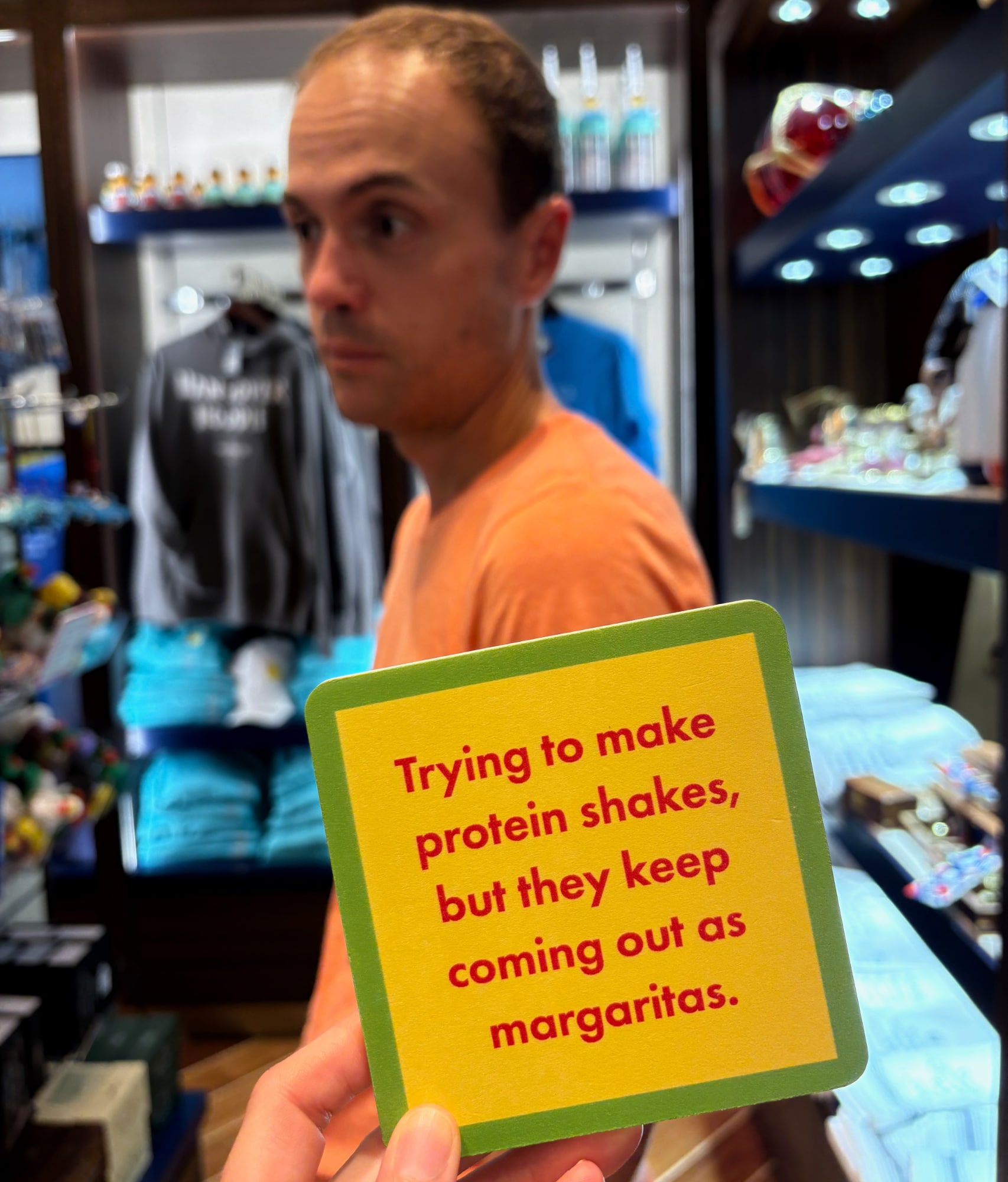
<p>Every month, I scroll through the last month of photos for one to include in this newsletter. Not many pictures this month, so here's a little surprise Becky left me that showed up in our <a href="https://support.apple.com/en-us/118229">iCloud Shared Photo Library</a></p>
<p><img src="/img/social/mails/2025-08.jpg" alt="How dare you assume this coaster saying that I add liquor to my protein shakes is true even though it is"></p>
<p>I feel personally attacked. And thirsty.</p>
<p>Today, I'm writing you about my favorite topic: capitalism. Or, more specifically, I'm here to shed a little light on a few &quot;special&quot; kinds of people who tend to be highly-valued in the economy but who are often portrayed as stereotypical caricatures. Each is as stubbornly human as the rest of us. Each possess an unusual blend of attributes that make them well-suited for the current epoch. My consulting career brought me face-to-face with more than my fair share of these people. The experiences I reflected back on while writing this were sometimes interesting, sometimes impressive, and rarely both.</p>
<p>Forced to categorize the most impactful people I've observed and encountered at work, I'd break it down into three archetypes: visionaries, entrepreneurs, and innovators. Each persona combines tremendous capability with comparatively bewildering blind spots. The business world holds these folks up as paragons of Employee Virtue. Not because they are perfect, but because their unique traits—when harnessed appropriately—can produce unparalleled results. And because the people doing the hiring always have faith in their own ability to harness the people they hire, candidates who fit these molds are often hired on the spot, bypassing any standard process. Most employees are employed by a business, whereas these employees <em>happen to</em> a business.</p>

<h2 id="visionaries">Visionaries</h2>
<p>Investors can't resist the siren song of visionary leaders who are <strong>preoccupied with growth</strong>. Visionaries want to achieve massive scale, can sustain obsession over decades, and believe in their own ability to change the world. Remember how Steve Jobs said he wanted to make a dent in the universe? That's the vibe. Audacious founders armed only with a half-cocked idea and delusions of grandeur have raised more in funding than you or I will earn from a lifetime of productive labor.</p>
<p>Beyond Wall Street, the general public also valorizes the growth-obsessed, because visionaries' irrational optimism reads as endearingly plucky in an underdog. But once that dog catches the car and begins to steer it from behind, those same traits become terrifying for us as passengers. To wit, you probably feel differently about Zuckerberg, Bezos, and Musk today than when you first learned about them. But the billionaires haven't changed at all. Our perspective of them is what shifted. They merely represent the natural end game for people wired to believe that more is never enough.</p>
<p>Of course, hating the ultra wealthy is nothing new. More recent, though, is a prevailing suspicion of growth for growth's sake, especially as the externalities of unregulated growth are becoming harder to avoid. My former colleague and mentor <a href="https://www.amazon.com/stores/Daryl-Kulak/author/B001IQWCVU">Daryl Kulak</a> would often counter clients pushing for unrestrained growth with, <strong>&quot;we actually have a word for something that grows forever: cancer.&quot;</strong> As much as the economy might love those with an unbridled ambition to grow, the rest of us can pretty easily spot the downsides. And while every visionary's light shines brightly, most are inevitably snuffed out—there's only room for so many winners.</p>

<h2 id="entrepreneurs">Entrepreneurs</h2>
<p>Think of a world-renowned business. Any business, doesn't matter which. That business would have ceased operations long before you'd ever heard of it were it not for some number of entrepreneurial employees <strong>predisposed to action</strong> over deliberation. When an issue arises, they add it to their plate. When someone else drops a ball, they can be counted on to catch it. When others deliberate endlessly, or stick their head in the sand, or waste time playing the blame game, they get shit done. They're sharks: if they stop moving, they die.</p>
<p>The action-oriented are not constrained by the bullet points on their job description. Hell, they probably hadn't finished reading the job description before picking up the phone and asking for the job. People driven to action make for appealing candidates not because they're confident &quot;alpha&quot; types per se, but because they talk in terms of what they <em>will actually do</em> to solve a problem as opposed to how they'll merely think, plan, or coordinate their way through it. Small businesses need them, because there's always far more shit to do than they can deal with. Large businesses need them, because their calcified bureaucracies prevent anything getting done otherwise. Struggling to visualize these people? <strong>Think of the guy who says, &quot;ask forgiveness not permission,&quot; but who—come to think of it—has never actually apologized to anyone.</strong></p>
<p>Of course, it's possible to over-index on action.  There are plenty of times when the best course of action is to take no action at all. (Unsurprisingly, entrepreneurs tend to get trapped in the urgent half of the <a href="https://en.wikipedia.org/wiki/Priority_Matrix">priority matrix</a>.) Large and novel problems often demand mindful introspection, time-consuming research, and careful deliberation—none of which come naturally to someone wired to equate the size of a problem with its urgency. Beyond being prone to strategic myopia, entrepreneurs can struggle to delegate effectively. For example, suppose you hire somebody to do something you've been doing for years. Naturally, they'll have less experience and they'll be slower and worse than you at first. But patience and failure are anathema to most entrepreneurs. It takes every ounce of energy to stop themselves from grabbing the steering wheel the moment anyone takes a wrong turn. And when they do grab the wheel, the new hire <em>does</em> learn something: stay in your lane and out of that guy's way. Don't think for yourself. Defer decision-making to the boss. Hyper-productive people often complain that nobody else ever picks up the slack, but their own behavior is usually to blame.</p>

<h2 id="innovators">Innovators</h2>
<p>Another word that can make you a lot of money is innovation. People with an <strong>insatiable creative drive</strong> are always in demand, because there will always be new problems to solve and opportunities to seize. In this sense, &quot;innovative&quot; means more than throwing out a good idea in meetings every now and then. Innovators represent a fusion of creativity, proficiency, and pragmatism. There are plenty of incredibly-skilled creatives out there who don't build stuff. And there are plenty of highly-motivated builders who aren't the least bit creative. But when you combine all three elements, watch out.</p>
<p>The most innovative people I've worked with were absolute pains in the ass to deal with in the moment, and generally only appreciated by their colleagues in the past tense. That's because it would never cross the mind of an innovator to pay an ounce of respect to whatever plan is handed them. They bristle at any line of reasoning that doesn't perfectly mirror their own, and adamantly refuse to take a single step down a path they believe to be wrong. They stubbornly push back until they get a satisfactory answer to a thousand &quot;Why&quot; questions, with notably less interest in &quot;Who,&quot; &quot;What,&quot; &quot;When,&quot; and &quot;Where.&quot; As soon as they grasp the bigger picture, they run off in a direction of their own choosing. They can be wonderful collaborators to whoever is willing to get on board—and better to just go along with them, as they tend to out-hustle and outflank everyone else.</p>
<p>But by constantly coloring outside the lines, innovators are frequently seen as agitants. They disrupt the calm of their colleagues. Few organizations know how to incorporate itinerant change agents—the value they provide isn't well captured by most annual review rubrics. But sometimes, innovators manage to overcome this and capture lightning in a bottle and accomplish something nobody thought possible. And success seems to do a funny thing to people's memory, as everyone else is suddenly quick to brag and share war stories of working with them.</p>
<p>Innovators may lack as many telltale character flaws, but many share the same blind spot: whatever they're building, they don't care about the thing itself. That's because they're not in it for the outcome, they're chasing an <em>experience</em>—the practice of creating something no one has ever seen before. Lost in the act of creation, their relentless drive makes them like unguided missiles, ones that leaders can aim at whatever target they wish. In the early 2010s, I had the opportunity to grill engineers working at companies like Lyft, Airbnb, and GrubHub about the potential downstream harms their apps might eventually wreak. I never stopped being surprised at how little any of them had ever thought of it. The real-world impact of their work, good or bad, simply wasn't the point.</p>

<h2 id="the-innovators-other-dilemma">The Innovator's Other Dilemma</h2>
<p>Of the three, I identify most as an innovator. It surprises people, but I've genuinely never cared about a single thing I had a hand in creating once I was done building it. After something's built, it no longer has anything of value to offer me. Whether it goes on to be used by a billion people or no one at all, I won't feel any differently. (I'd still reserve the right to boast at cocktail parties in the case of the former, however.)</p>
<p>There is one thing that doesn't sit well with me after writing this, though. The fact I've never cared about the things I've built means I've spent a lot of time building a lot of things that never mattered to me. Since striking out on my own in January 2024, I assumed the freedom to choose my own projects would allow me to identify work that really mattered to me. And I have! I've got a whole list and everything. Stuff that could change my life and others' lives for the better.</p>
<p>So far, I've taken all that time and freedom, and gone out of my way to build literally anything else with it. Not because I'm afraid of building those genuinely worthwhile things, but because those things' worthwhileness doesn't register as a valid criterion in my brain. The moment I sit down to work, my attention will be immediately captured by an unrelated problem and I won't be able to get it out of my head until it's either solved or supplanted by an even more daunting challenge. I won't let the day rest until I've proven to myself that it can be done. I can seemingly prove my ability to do anything <em>except</em> whatever it is I've consciously decided to do.</p>
<p>It's a strange, uncomfortable thing to sit with. Freedom often presents as a paradox. Maybe for an innovator, freedom to keep tinkering comes at the cost of a sort of aimlessness. A natural consequence when the motivation to tinker is for the act of tinkering itself.</p>
<p>I do have to say, though, that building meaningless stuff is a great way to pass the time. Realizing that's all I'm doing is hard, however. That I'm just passing time. When I get lost in my work, hours melt off the clock. Days pass in a blur. <a href="https://en.wikipedia.org/wiki/Four_Thousand_Weeks:_Time_Management_for_Mortals">Precious weeks</a> elapse. Seasons come and go—which, mercifully, doesn't mean much in Florida.</p>
<p>But if nothing changes this trajectory, will I regret it decades from now? Is this a problem I should be solving, and if so how? More rigor and discipline? More essays about my broken nature? More New Year's resolutions?</p>
<p>Who's to say.</p>
<p>At least I have a lot of experience deciding things don't matter to me. Perhaps that'll come in handy down the road.</p>]]></content>
  </entry>

  <entry>
      <id>https://justin.searls.co/mails/2025-07/</id>
      <title type="text">Connect 4</title>
      <link href="https://justin.searls.co/mails/2025-07/" rel="alternate" type="text/html" />
      <author>
          <name>Justin Searls</name>
          <email>website@searls.co</email>
      </author>
      <published>2025-08-07T00:00:00+00:00</published>
      <updated>2025-10-20T10:51:25-04:00</updated>
      <content type="html"><![CDATA[<p>I just realized that Christmas in July must have been held somewhere, and I missed it. Damn.</p>
<p>Regardless, the blog was busy since we last checked in:</p>
<ul>
<li>There's some <a href="https://justin.searls.co/posts/adding-swift-format-to-your-xcode-build/">Xcode</a> <a href="https://justin.searls.co/posts/i-made-xcodes-tests-60-times-faster/">stuff</a> for Apple people, as well as the nostalgia of <a href="https://justin.searls.co/shots/2025-07-16-15h10m35s/">finding the order confirmation</a> of my very first Mac, a 12&quot; iBook G4</li>
<li>We got in some good thoughtlording with a <a href="https://justin.searls.co/links/2025-07-29-upside-down-development/">software design thinkpiece</a>, an <a href="https://justin.searls.co/links/2025-08-03-there-is-no-ai-in-team/">organizational design thinkpiece</a>, and an <a href="https://justin.searls.co/posts/letting-go-of-autonomy/">AI thinkpiece</a></li>
<li>Reflections on how <em>bang-on</em> my favorite <a href="https://justin.searls.co/posts/there-will-come-soft-rains-a-year-from-today/">apocalyptic short story set in 2026</a> turned out to be</li>
<li>A couple podcasts, too (<a href="https://justin.searls.co/casts/breaking-change-v40-go-home-claude-youre-drunk/">1</a>, <a href="https://justin.searls.co/casts/breaking-change-v41-liquid-glasshole/">2</a>)</li>
</ul>
<p>Also since I last wrote you, they held the final <a href="https://railsconf.org">RailsConf</a>, an event and community that had a huge impact on my career. I was honored that Aji Slater <a href="https://www.youtube.com/watch?v=T-lqK2SR8vk">summarized my 2017 keynote</a> on stage, even though I don't own a single pair of white pants:</p>
<p><img src="/img/social/mails/2025-07.jpg" alt="I wasn't at the final RailsConf in person, but I was there in spirit/Keynote"></p>
<p>As it happens, I've been chewing on a lot of the same themes I discussed back in that <a href="https://www.youtube.com/watch?v=rm8RYzrVkFA">How to Program</a> talk, because the current AI-induced industry shakeup we're experiencing has underscored the importance of taking ownership over how we work. And although I didn't plan this in advance, that's kind of exactly the topic I'm writing about today.</p>
<p>Of course, when I talk about work, I mean it in a quite expansive sense. For most intents and purposes, I retired at the end of 2023. I contend that I still <em>do stuff</em>, but increasingly nothing about my day resembles a traditional job. There is, however, one exception: I now have more meetings on my calendar as a retiree than I did as a full-time employee.</p>
<p>Today, I'll share the unlikely story of how my calendar started filling up again and the even unlikelier reality that I'm completely okay with it (happy, even).</p>
<p>There are many different ways to feel about the word &quot;process&quot;:</p>
<ul>
<li>
<p><strong>Some are indifferent.</strong> They show up each day, follow the herd, and are content with checking boxes. If a process wastes time, blurs focus, or causes friction—that's on whoever designed and implemented the process, not them</p>
</li>
<li>
<p><strong>Some are stifled.</strong> They have their preferred way of doing things and will judge a process not on its own merits, but as the sum of deviations it takes from <em>their</em> way of doing things. They often opt into flat organizations with a light touch, hoping others will stay out of their way</p>
</li>
<li>
<p><strong>Some are obsessive.</strong> Without a clear and comprehensive process in place that covers every conceivable contingency, they fall to pieces. Once they get acclimated, any talk of changing the process—or, God forbid, eliminating it—spikes their blood pressure and triggers a threat response</p>
</li>
<li>
<p><strong>Some are pragmatic.</strong> They can thrive with a heavy-handed process or no process at all. What matters is that whatever is expected of them is a good fit for <em>today's</em> problems. What's more, they want a say in the continued evolution of the process itself, just as they would in the maintenance of any other tool on the worksite.</p>
</li>
</ul>
<p>Managing a company that welcomes and tolerates all four of these dispositions would be a complete pain in the ass, and I don't recommend it. The indifferent won't leave unless they win the lotto or you fire them. The stifled can play ball in external-facing roles and at early-stage companies, but will generally be more trouble than they're worth at a larger scale. Obsessives are a bad fit for startups—feeling neglected in the early stages and overwhelmed by reorgs and scaling churn in the middle stages—but are right at home in bureaucratic and staid late-stage companies. One might assume pragmatists can fit in anywhere, but in reality they're the canaries in the coal mine—if your organization doesn't have its shit together, results-oriented people will get bored and go work somewhere that does.</p>
<p>Give me a team made up of nothing but process pragmatists and we can scale horizontally as a flat organization far beyond the point most others would collapse in on themselves. In fact, I have a suspicion that most organizational design memes like &quot;self-organizing&quot;, &quot;agile&quot;, &quot;lean&quot;, and &quot;squads&quot; were initially coined by pragmatists who innovated custom processes for their unique situations. Things went well for them, they wrote a blog post or book about their experience, and then they moved on.</p>
<p>Those books were then bought by obsessives shopping for a reputable off-the-shelf process, and who went on to adopt that process as their ideology despite never really &quot;getting&quot; it. They'd codify and gate-keep the process, organize conferences, conduct trainings, and administer certification programs… before inevitably splintering into distinct religious sects. Because obsessives are the only ones who care so damn much about process, the rest of us are happy to delegate it to them. <strong>As a result, we tend to conceive of <em>what process is or can be</em> on the terms of those who have an unhealthy obsession with it.</strong> (If you're already bored reading this, thank the world's feckless middle managers—and their projection of false authority masking unresolved anxieties—for ruining &quot;process&quot; for the rest of us.)</p>
<p>If someone gives you a process to follow and doesn't leave room for you to apply it to your particular situation, they're doing both you and themselves a disservice. The only way to ensure a system or process will reliably achieve its desired outcomes is if the people following it deeply understand and buy into how it's supposed to translate their actions into those outcomes. And the best way to foster that understanding and buy-in is for the people executing the process to have a hand in its creation and evolution. <strong>Good process design is like an inside joke: you just had to be there.</strong></p>
<p>Sure, there will be constraints the process will have to accommodate—customer demands, industry regulations, inflexible software tools—but there is no escaping it: you're the one who owns how you think through and approach your work. Your brain cannot be outsourced. There's a widespread delusion we can adopt a famous company's &quot;playbook&quot; as a starting point, customize it to our liking, and achieve the same success they did. But a methodology's effectiveness depends on its practitioners' sense of ownership as they continuously adapt it to their unique context. Whatever mechanical steps and procedures emerge are an artifact of the thing, not the thing itself. Adopting some other company's system like <a href="https://basecamp.com/shapeup">Shape Up</a> or <a href="https://blog.crisp.se/wp-content/uploads/2012/11/SpotifyScaling.pdf">Spotify Squads</a> would be like stealing another family's photo album and rewriting your own names into the captions.</p>
<p>But this issue of Searls of Wisdom is not here to tell you how to design and implement custom processes to scale your business. (If you want to pay me to tell you anyway, <a href="mailto:justin@searls.co">knock yourself out</a>.) All I'm here to say is that every organization owns their process, that few among us understand this to be part of the job, and that the people excited about process for the sake of process are the last ones we should trust with it.</p>

<h2 id="connect-4">Connect 4</h2>
<p>Okay, we are in desperate need of a concrete example. I'd like to tell the story of a process that was designed to address real problems, how it was iterated and improved upon, and why it's not for you.</p>
<p>Today, I serve as chairman of a multi-national conglomerate of several businesses. Each day, I toil away in a co-working space (my house) alongside the CEO of one of our portfolio companies (my wife, Becky).</p>
<p>As is right and good, we began our individual endeavors without any preconceived process. We showed up, we did our work, and then things would go as well or as poorly as they were going to. We didn't impose any structure on ourselves.</p>
<p>A few months in, it became clear we were operating on wildly different wavelengths. Working different hours. Frequently interrupting each other. Stepping on each other's toes. She wanted more connection throughout the day. I wanted more coordination to ensure things got done.</p>
<p>We initially tried to solve this ad hoc by simply showing up to work differently. I attempted a mindset shift called, &quot;be a nice person,&quot; which lasted for a day or two. Since that didn't work, I leaned on what my career had taught me: if good intentions and sheer force of will aren't enough, it's likely a sign the underlying problem is systemic. And systemic problems demand systemic solutions.</p>

<h3 id="iteration-1-a-recurring-calendar-event">Iteration 1: a recurring calendar event</h3>
<p>So we spun up our first process: every morning at 7:30, we'd come downstairs for &quot;Coffee Time.&quot; We'd sync our schedules by starting the day together, each pouring a coffee and sitting by each other in the living room or out on the lanai.</p>
<p>Coffee Time successfully aligned our working hours, but it created all-new problems. It wasn't a meeting so much as a scheduled coexistence, so I'd work on my computer while Becky would read. One of us would try to strike up conversation or discuss plans for the day, which the other would experience as an interruption. Any given instance of Coffee Time might last 5 minutes or run for 2 hours.</p>
<p>It almost always ended with one or both of us feeling mildly irritated.</p>

<h3 id="iteration-2-ground-rules">Iteration 2: ground rules</h3>
<p>Since Coffee Time clearly needed more structure to achieve its desired outcome, we added a constraint: no devices. We'd sit our asses down at the appointed time and place, sip our coffee, and be forced to talk to each other.</p>
<p>One member of our team is an optimistic, energetic morning person and loved this process tweak.</p>
<p>Others, who shall remain nameless, struggle to engage in conversation first thing in the morning and that's why this change fucking sucked.</p>
<p>See, I get my best creative work done right after waking up, before something—like freeform conversation—can derail me and <a href="https://ashore.io/journal/crossover-creativity/poisoning-the-day">poison my day</a>. As a result, Coffee Time represented a high-wire act of my own design: one wrong move and I might lose a whole day's productivity.</p>
<p>This misalignment frequently manifested in conflict. Becky sought unhurried and relaxed connection. I sought to get it over with ASAP so I could go back to my work. We gradually stopped showing up. <strong>Coffee Time went the way of so many recurring calendar events: nobody bothering to attend but nobody with the courage to delete it.</strong></p>

<h3 id="iteration-3-">Iteration 3: 🔥🔥🔥</h3>
<p>The Coffee Time calendar event just sat there for literal months. I lost track of how many times my watch buzzed only for me to ignore it.</p>
<p>When you lose faith in a process you helped establish, it's a special kind of demoralizing. I felt a tinge of shame every time the calendar notification popped up. The event's ongoing existence crowded out any space for a better solution to emerge.</p>
<p>Most people lack the courage to discard pre-existing documents, policies, and processes. Getting rid of practices that everyone agrees are self-defeating or even harmful is nevertheless unusual. When we talk about businesses being slow and inflexible in the face of change, we often think of <em>big</em> companies—but the problem is really with <em>old</em> companies (and most big companies just happen to also be old). The longer they've been in business, the more layers of process and policy sediment pile up. The people who were in the room then aren't in the room now, so past decisions are treated by today's people as untouchable dogma. And unless periodic reset &amp; renewal is reinforced somehow, the institution will gradually calcify and become vulnerable.</p>
<p>Anyway, I lack such inhibitions, so I deleted the Coffee Time event one day. Surely, there existed some better way of cohabiworking, but an unstructured appointment nobody shows up for probably wasn't the answer.</p>

<h3 id="iteration-4-structure">Iteration 4: Structure</h3>
<p>Literally the day after I deleted Coffee Time, I had an idea.</p>
<p>I pitched a new meeting: &quot;Connect 4.&quot; It would be designed to meet both of our needs. Becky wanted to establish connection and kick off each morning in harmony with one another. I wanted to ensure we coordinated our activities and had the ability to hold one another accountable. It would also give us an opportunity to offer each other our support, whatever that might look like from day to day.</p>
<p>I scribbled four quadrants onto a legal pad and titled it &quot;Connect 4&quot;. Each morning, we would take turns, each sharing three things:</p>
<ul>
<li><strong>Biggest feel.</strong> Name one overriding emotional or physiological feeling. Let the other know what version of yourself they're working with today</li>
<li><strong>Biggest goal.</strong> If you could accomplish just one thing, what would it be? When you look back, what do you want today to be remembered for?</li>
<li><strong>Biggest want or need.</strong> We're not just here to get shit done—we're here in pursuit of a life well-lived. What does that look like today?</li>
</ul>
<p>After reflecting and sharing our answers to the above questions, there was one last step. (I needed a fourth thing so I could call the meeting &quot;Connect 4&quot;.) So, after we'd both had our turns to speak, we would pose a question to the other: <strong>&quot;What can I do to support you today?&quot;</strong> It was important we offer support by way of a question, as opposed to guessing what the other needed (which would be presumptive) or directly stating the support we wanted (which could be interpreted as an imposition). If I ask Becky how I can support her and however she answers isn't something I'm thrilled about doing, that <em>I asked for it</em> makes it more likely I'll follow through. Little touches like this are a great example of structure reflecting purpose.</p>
<p>That's it. Three quick things plus one question. Achievable in ten minutes. We both get our needs met.</p>
<p>I resisted introducing something like Connect 4 for over a year, because it felt stupid to kick off my retirement by signing up to do daily <a href="https://en.wikipedia.org/wiki/Stand-up_meeting">standup meetings</a> with my wife. But once we got going, it didn't feel that way at all. Because the process solved real problems that we'd actually been struggling with, there wasn't anything to complain about.</p>

<h3 id="iteration-5-the-ceremony">Iteration 5: the ceremony</h3>
<p>Connect 4 immediately proved more valuable than our previous attempts at starting each day on the right foot, but it also would not have materialized without them. It's important not to be too hard on yourself if your initial solution fails to solve the problem—something can only be improved once it actually exists.</p>
<p>Still, Connect 4 wasn't perfect:</p>
<ul>
<li>Originally, Connect 4 was only scheduled on weekdays, but we gradually found the days we didn't sync suffered for it, so now we do it seven days a week</li>
<li>We'd sometimes derail things by going on long tangents, so we began to (kindly) defer those conversations until we'd gotten through our Connect 4 updates</li>
<li>Conversation regularly unearthed deeper issues that warranted more time than a quick check-in would allow, so we began scheduling ad hoc follow-up meetings as needed</li>
</ul>
<p>There was one other lingering problem that persisted for a few months before we identified and addressed it. See, despite having a scheduled start time, the reality of being two self-employed people working from home meant it wasn't uncommon for one of us to get into flow and fail to show up on time. This, in turn required the other to go and collect the other, interrupting them. And when one person has to <em>call</em> the meeting, they become the de facto person to <em>run</em> the meeting. This can introduce or reinforce a <a href="https://www.youtube.com/watch?v=opcChKBAhrE">vertical dynamic</a>, which is counterproductive to building a sense of mutual respect and commitment.</p>
<p>To solve for this—and one wonders whether this is how church bells got invented—I took a sound bite of <a href="https://podcast-cdn.searls.co/misc/family-mart-chime.mp3">the Family Mart chime</a> and configured HomeKit to automatically play it at 8:30 AM in every room of the house. This way, neither of us has to call the meeting—the meeting calls itself. We separately stop what we're doing and attend it of our own volition, as peers.</p>
<p>Some will read the above and think it's too insignificant a thing to bother with, but people fail to realize this sort of reaction is what leads to our lives feeling so cluttered and overwhelming. Insignificant things pile up. If you choose to ignore a small pebble in your shoe, no one's going to award you a prize for learning to live with it. Not letting life's little irritants bother you may sound laudable, but if you forget about that pebble you might later fail to identify it as the cause of your postural problems, or your joint pain, or your short temper.</p>
<p><strong>Don't make the mistake of equating the apparent size of a problem with its potential impact</strong> when assessing whether it's worth taking the time to fix it.</p>

<h2 id="youre-the-one-youre-waiting-for">You're the one you're waiting for</h2>
<p>Connect 4 is just one of dozens of goofy practices Becky and I have created to draw out the best versions of ourselves. We name each of our customs. We sing jingles. We have secret handshakes. We reflect on what's working and what isn't. We make tweaks. We aren't afraid to let go of any of our rituals once they're no longer useful.</p>
<p>Why do we bother taking the time to do all this? Because it never occurred to us to invite some third person to optimize our marriage for us. That just sounds ridiculous.</p>
<p>And yet, the vast majority of employees expect their employer to optimize their workflow for them. That sounds pretty ridiculous, too, if you ask me.</p>
<p>And sure, I could write a book on all the things Becky and I do to live our best lives, but this one example is all you're getting. I am aware that all it would take is to give each practice its own chapter—brand it with a name, explain what it solves, how it's done, and why it works. I could earn money and notoriety by pitching our system as a framework to building a happier marriage, or achieving work-life harmony, or some other bullshit. But that would just be prescribing yet another process for others to follow. And even if I was offering genuinely helpful advice, it would only further prevent people from figuring out for themselves that <strong>the path to greatness is not a paved road, but a blazed trail</strong>. There's nothing of value to be gained by blithely retracing someone else's steps.</p>
<p>If taking ownership of the systems that govern how you think through problems and interact with others seems out of reach, it shouldn't. Humans tend to live and work in pretty small groups—it's not unreasonable for everyone to have a say. I've witnessed families and teams alike who agreed to make decisions by consensus, who expect everyone to propose improvements, and who celebrate doing the things nobody asked for. It's not hard to live this way, but it won't magically happen on its own.</p>
<p><strong>Following a process without continuously improving it is like driving a car without touching the steering wheel.</strong> The only person staring down the road ahead is you. That makes you the best person to figure out how to get wherever you're going.</p>]]></content>
  </entry>

  <entry>
      <id>https://justin.searls.co/mails/2025-06/</id>
      <title type="text">Why I haven&#39;t started yet</title>
      <link href="https://justin.searls.co/mails/2025-06/" rel="alternate" type="text/html" />
      <author>
          <name>Justin Searls</name>
          <email>website@searls.co</email>
      </author>
      <published>2025-07-15T00:00:00+00:00</published>
      <updated>2025-10-20T10:51:25-04:00</updated>
      <content type="html"><![CDATA[<p>Greetings everyone, and welcome to the middle of July in Orlando, where it's too damn hot outside and too damn cold inside. Thank you for joining our Q2 Performance Review of the Justin Business Unit at Searls LLC. Before I share status updates on this year's strategic initiatives and dig into how we're tracking against our KPI benchmarks, here are a few highlights regarding our output over the past month:</p>
<ul>
<li>The latest pre-release build of <a href="https://posseparty.com">POSSE Party</a> adds support for four new platform integrations, a 200% increase over the previous version</li>
<li>I started a new interview series on called Hotfix on the <a href="https://justin.searls.co/casts/breaking-change/">Breaking Change</a> feed, and <a href="https://justin.searls.co/casts/hotfix-v39.0.1-use-ai-in-anger/">its inaugural episode</a> is getting rave reviews. When you factor in <a href="https://justin.searls.co/posts/announcing-merge-commits-my-all-new-podcast/">March's launch of Merge Commits</a>, podcast series are up 300% compared to the year-ago quarter</li>
<li>&quot;<a href="https://justin.searls.co/posts/full-breadth-developers/">Full-breadth Developers</a>&quot; generated tens of thousands of organic impressions in its first 24 hours of publication, marking the fastest growth of a buzzword-defining post in <a href="https://justin.searls.co">justin.searls.co</a> history</li>
<li>Speaking of the website, a new suite of automations has been implemented that add support for scheduling posts in the future, fetching social images for outbound links, normalizing typographical inconsistencies, and pissing off most of my followers by <a href="https://justin.searls.co/spots/">spewing an endless stream of my Japanese restaurant reviews</a></li>
</ul>
<p>There were some bittersweet notes this month, as well. The Walt Disney Company decided to conclude its partnership with Searls LLC with the <a href="https://wdwnt.com/2025/07/tom-sawyer-island-now-permanently-closed-at-magic-kingdom/">closure of Tom Sawyer Island</a>, ending a 16-year tradition of my posing in front of the name &quot;Tom&quot; on this fence:</p>
<p><img src="/img/social/mails/2025-06.jpg" alt="One last visit to the Justin ♥ Becky sign before Disney closed Tom Sawyer Island"></p>
<p>What's with all this corporate year-in-review stuff? Well, <a href="https://gram.betterwithbecky.com/posts/897/2025-07-10-midyear-audit-reflect-refocus-recommit">Becky's latest podcast</a> prompted me to consider doing my own, &quot;6 months down, 6 to go,&quot; retrospective on 2025. This is me leaning in.</p>
<p>The verdict is in, and <strong>I've decided to give myself a failing grade</strong>.</p>

<h2 id="why-i-havent-started-yet">Why I haven't started yet</h2>
<p>Autonomy may not be all it's cracked up to be.</p>
<p>Over two years ago, I found myself consumed by a flood of ideas for an ambitious app to support my lifelong pursuit of acquiring a second language. These ideas emerged from years and years of struggle to learn everyday Japanese. In mid-2023, I reached the point where it was the only thing I wanted to work on. Here we are in mid-2025, and I'm still at that point. That is, of <em>wanting</em> to work on it.</p>
<p>I haven't started yet.</p>
<p>Today, I'm going to play back the tape and try to figure out where I went wrong.</p>
<p><strong>756 days ago.</strong> I asked my co-founder Todd Kaufman for a meeting to discuss my desire to step back from day-to-day operations at Test Double and pursue a vision for building an AI-enhanced app for learning a second language. He was, as always, incredibly supportive. We mapped out a plan to transition my responsibilities to others by the end of the year.</p>
<p><strong>562 days ago.</strong> I formally ended my career as a full-time employee of the company I had co-founded at 26 (I was 38 by then). I felt optimistic about dedicating myself fully to building this thing, but it was tempered by the knowledge that I'd have no one to blame but myself if it didn't happen. Deep down, a part of me—and I suspect, a part of all of us—found a secret comfort in being able to point to extrinsic factors (other people, responsibilities, circumstances) as a potential excuse for failing to do whatever we claimed to be most important. After quitting my job, the only immediately observable change was the loss of that excuse.</p>
<p><strong>569 days ago.</strong> As if to prove the above point, a week <em>before</em> my last official day as an employee, I made my first commit to the project that would eventually power my wife's business, <a href="https://www.betterwithbecky.com">Better with Becky</a>. I started with a public-facing blog called <a href="https://gram.betterwithbecky.com">Beckygram</a> and then extended it to deliver her strength-training programs as a subscription product. It was a massive undertaking, but I told myself there wasn't much point in freeing myself from the daily grind if my spouse was still chained to a desk, manually assembling Google Docs and Sheets for her subscribers.</p>
<p><strong>552 days ago.</strong> I started <a href="https://justin.searls.co/casts/breaking-change/">an explicit-language podcast</a> for some fucking reason. I guess no longer having several hours of Zoom meetings to look forward to every week made me feel the need to get things off my chest some other way. Don't get me wrong, I really enjoy Breaking Change and the audience it's finding, but I am endlessly frustrated by the fact that recording a three-hour show takes three whole hours. That's too much time!</p>
<p><strong>310 days ago.</strong> We (finally) launched the first Build with Becky strength-training program to subscribers via the new <a href="https://members.betterwithbecky.com">member portal</a>. It took longer than I hoped to get the app over the finish line, but that's how it always goes. I enjoyed a moment of relief as I imagined being able to switch gears to pursue my own ambitions.</p>
<p><strong>292 days ago.</strong> Just kidding, because several months prior I'd separately agreed to give a presentation about building SaaS apps as a solo developer <a href="https://justin.searls.co/tubes/2024-11-09-11h03m00s/">at the second annual Rails World conference</a>. Naturally, given how obsessive I am about crafting presentations, I worked day and night to perfect my slide deck right up until showtime. I was so exhausted by the end of it that I decided the only way to prevent myself from repeating the same mistake was to publicly announce my retirement from speaking live on stage. Life's too short to spend two months of every year tweaking slides in Keynote to produce a 30-minute presentation.</p>
<p><strong>249 days ago.</strong> The worst part about launching a product is that people might pay for it and develop their own opinions about how it should be &quot;fixed.&quot; While I'm proud to say that—by my definition, at least—the Better with Becky software platform shipped with only two Actual Bugs, it was almost two months before the dust had fully settled and I'd addressed all the feedback from its initial subscribers. I still bear the perpetual monthly burden of updating its dependencies, but beyond that chore I was well and truly done. I could finally buckle down and break ground on this language-learning app, nearly a year after quitting my day job.</p>
<p><strong>246 days ago.</strong> But first, we needed a break. So Becky and I departed for a mostly-computer-free vacation in Japan. We spent a few weeks road-tripping to famous <a href="https://www.japan-guide.com/e/e2014.html">leaf peeping locales</a> and scouting cities I'd identified as potential places we might like to live someday. Incidentally, we made an unplanned pit stop in Shizuoka City on our way to someplace else, and that's where we eventually wound up <a href="https://justin.searls.co/mails/2025-05">buying a vacation home</a>.</p>
<p><strong>223 days ago.</strong> We got home from Japan, recharged and ready to take on what's next. For real this time, I was going to finally install Xcode and start building this app. My mind was buzzing with ideas after spending several weeks criss-crossing the country and finding new ways to suck at Japanese. I started a fresh notebook and quickly filled it with architecture diagrams and UI sketches.</p>
<p><strong>212 days ago.</strong> My dad passed away.</p>
<p><strong>187 days ago.</strong> After we'd returned home following the funeral and settled back into our routine, I scanned my to-do list for a software project that would feel like a quick win. I'd lost my appetite for ambitious endeavors. I craved the productivity equivalent of comfort food. Something I could build using familiar technologies, doing things I'd previously proven out elsewhere. That's how I embarked on building a single app to replace the assortment of ramshackle tools I'd assembled to syndicate my content from <a href="https://justin.searls.co/">justin.searls.co</a> to my various social media accounts.</p>
<p><strong>141 days ago.</strong> Even though I'd already built a working version of the app that could have sufficiently met my needs, I wasn't ready to move on just yet. I registered a domain name and <a href="https://posseparty.com">announced this syndication project as a product</a> with a splash page and a waitlist and everything. I justified giving it precedence over the language-learning app by saying I wanted to put to bed the problem of content distribution so that I could more widely share a development diary which would document my journey into the world of designing native apps for Apple's platforms.</p>
<p><strong>75 days ago.</strong> I boarded a plane to convince a real estate developer to sell me a condo. As luck would have it, achieving this took a month of near-full-time effort.</p>
<p><strong>48 days ago.</strong> Despite announcing POSSE Party as if it would be a traditionally-hosted SaaS product, I decided I was unwilling to operate the app as a going concern. Witnessing firsthand how often these social media integrations break, I simply could not imagine running a business whose operation depended on the platforms' unreliable, semi-abandoned APIs. I spent five minutes imagining being responsible for a <code>support@posseparty.com</code> inbox and immediately noped out. (If anyone wants to buy a gently-used, pre-launch SaaS app, <a href="mailto:justin@searls.co">let me know</a>.)</p>
<p><strong>8 days ago.</strong> After a series of really positive experiences putting what I hoped would be the finishing touches on POSSE Party by leveraging AI agents to write all the code, I <a href="https://justin.searls.co/posts/full-breadth-developers/">wrote a thinkpiece nobody asked for</a>, started <a href="https://justin.searls.co/casts/hotfix-v39.0.1-use-ai-in-anger/">a new interview show</a> to discuss it, and got underway building a CLI tool for onboarding <a href="https://github.com/anthropics/claude-code">Claude Code</a> into existing software projects.</p>
<p><strong>0 days ago.</strong> I finally acknowledged that I've lost all control of my life.</p>
<p>I taught Becky the phrase <a href="https://en.wikipedia.org/wiki/Yak_shaving">yak shaving</a> last year at some point, and she takes joy in searching for opportunities to use it. Try this one on:</p>
<ul>
<li>I'm currently building a tool to make it easier to adopt AI coding agents, because…</li>
<li>I wrote a post advocating for software developers to reckon with the sea change currently underway, because…</li>
<li>I started using AI agents myself in a rush to finish an app that wasn't worth my own time and effort, because…</li>
<li>I refused to stand behind and support a product that could break for reasons totally outside my control, because…</li>
<li>I realized I'd been laboring under the mistaken notion that maximizing the reach of my content was more important than the work itself, because…</li>
<li>My dad had just died, and I lacked the courage to risk failing and losing something else I really cared about</li>
</ul>
<p>So, here I am, six levels down the stack, wondering where this year has gone. And that's just one series of distractions I've become mired in—if we had the time, I could share others!</p>
<p>Anyway, it's now mid-July and I'm ready to admit that my 2025 Strategic Plan is decidedly <em>off course</em>.</p>
<p>I thought it might be useful to write all this, if only because I'm probably more retired than you are. So, in case you might be harboring the same delusions I was: <strong>if you think you know exactly what you'd do tomorrow if you were to quit your job today, you're very likely wrong.</strong> We all live in prisons of our own design, and it's worth pondering whether being liberated from all constraints would result in true freedom or in the installation of new constraints.</p>
<p>I'm as ruthlessly disciplined as anyone I know, and time after time I've failed to take a single step forward toward my own purported goal in over 18 months. Why not? Why doesn't matter. The only thing that separates a valid reason from a flimsy excuse is the subjective value we assign it. The end result is the same: it hasn't happened yet.</p>
<p>Even now, as I type this, I have no faith it'll be enough to convince me to do anything differently tomorrow—we've got contractors coming to fix the fridge, seal the pavers, and replace a few toilets, after all.</p>]]></content>
  </entry>

  <entry>
      <id>https://justin.searls.co/mails/2025-05/</id>
      <title type="text">Japanese Real Estate Vocabulary</title>
      <link href="https://justin.searls.co/mails/2025-05/" rel="alternate" type="text/html" />
      <author>
          <name>Justin Searls</name>
          <email>website@searls.co</email>
      </author>
      <published>2025-06-12T00:00:00+00:00</published>
      <updated>2025-10-20T10:51:25-04:00</updated>
      <content type="html"><![CDATA[<p>Some number of nights spent in a hotel is the ideal number to ensure the perfect vacation. It is probably more than three nights. It is <em>definitely</em> less than 42. I didn't set out to uncover this fact, but I figured I might as well share this discovery with you: <strong>do not stay in hotels for 42 consecutive nights</strong>. At least not if you consider it a vacation.</p>
<p>So, why have I spent the last 42 nights in hotels?</p>
<p>Because I wanted to buy a condo as a second home, of course. And the condo was in Japan. And the… you know what, I'm going to stop myself. I've told portions of this story in a narrative form <a href="https://justin.searls.co/casts/breaking-change-v36-hedgelord/">three</a> <a href="https://justin.searls.co/casts/breaking-change-v37-whose-bone-is-this/">times</a> <a href="https://justin.searls.co/casts/breaking-change-v38-searls-hq2/">already</a>, and I'm not convinced it provides a very compelling arc. &quot;<em>Affluent man of leisure overcomes problem after problem of his own creation in order to acquire a second home on another continent</em>,&quot; is not exactly an epic retelling of <a href="https://en.wikipedia.org/wiki/Hero%27s_journey">The Hero's Journey</a>. It's an interesting sentence, maybe, but I'm not sure it makes for a good story.</p>
<p>All I'll say is that this endeavor has been as weird as anything else I've set out to do. And despite being uniquely exhausting, it's already proven to be one of my life's most rewarding side quests. In addition to creating countless memories, this experience has also stress-tested my resolve, my intellect, and my waistline (since 42 nights has also meant <a href="https://justin.searls.co/spots/">42 restaurants</a>).</p>
<p>To illustrate just how long it's been, dinosaurs still roamed the earth when I got here:</p>
<p><img src="/img/social/mails/2025-05.jpg" alt="me and my dino friend"></p>
<p>So, without repeating the whole story for a fourth time and without anything else of interest to talk about, I will instead offer you a humble crash course in all of the Japanese vocabulary I have had to learn since I got this bright idea in April and <a href="https://gram.betterwithbecky.com">Becky</a> gave me the green light to pursue it.</p>
<p>If you've ever studied a foreign language, you might be familiar with the <a href="https://pmc.ncbi.nlm.nih.gov/articles/PMC5439266/">power of mnemonics in memorization</a>. In short, when you connect a concept you want to remember to a memory you can't forget, that concept will effectively <em>stick</em> to the memory. Silly mnemonics are how my first Japanese professor, <a href="https://calvin.edu/people/larry-herzberg">Larry Herzberg</a>, taught Japanese in college (e.g. the word for homework, &quot;shukudai,&quot; was always paired with, &quot;are you 'sure you could die?'&quot;). Mnemonics are also how I later learned the 2000 basic kanji characters and 8000 additional vocabulary in just over two years, thanks to <a href="https://www.tofugu.com">Tofugu</a>'s wonderful <a href="https://www.wanikani.com">WaniKani</a> web app. Pairing concepts with memory is why I so easily remember the phrases people teach me when I'm visiting bars and izakaya (though these phrases are usually food-related—like that &quot;kara wo muku&quot; means &quot;to peel off the shell&quot; of a nut).</p>
<p>Since mnemonics are a proven memorization strategy, for today's vocabulary lesson I'll sprinkle a little embellishment on top of each of the words I introduce below. If something resembling a cohesive story emerges as you read through the full vocab list, that's on you. I'm just rattling off the words I learned last month.</p>

<h2 id="japanese-real-estate-vocabulary">Japanese Real Estate Vocabulary</h2>
<ul>
<li>
<p><strong>不動産／ふどうさん／fu-dou-san –</strong> This is one of my favorite words, because 不動 means &quot;not moving&quot;, and 産 often means &quot;industry.&quot; That's right: Japan's word for real estate literally translates to &quot;the immovable industry&quot;, which is an apt (if unglamorous) way to describe the buying and selling of the only thing in life whose value depends on <em>its not going anywhere</em>. Buying a home? You're gonna be saying 不動産 a lot, along with several variations like 不動産屋／不動業者 (&quot;real estate agent&quot;), 不動産登記 (&quot;real estate registration&quot;), 不動産取得税 (&quot;real estate acquisition tax&quot;), and so on</p>
</li>
<li>
<p><strong>物件／ぶっけん／buk-ken –</strong> This word can literally mean &quot;thing&quot;, but in a real estate context, it refers to a property listing. So when you <a href="https://suumo.jp/jj/bukken/ichiran/JJ011FC001/?ar=050&amp;bs=010&amp;ta=22">search a website like Suumo</a>, the results are a list of 物件. In order to find the listing we'd ultimately buy, I <a href="https://justin.searls.co/tubes/2025-04-19-17h46m37s/">vibe-coded an app</a> to sift through property listings for me. Miraculously, the very first time I ran the program, it found the condo we'd ultimately end up buying (so I immediately halted work on <a href="https://github.com/searls/mansion">the project</a>)</p>
</li>
<li>
<p><strong>マンション／まんしょん/man-shon –</strong> In my case, the listings I was looking for were specifically condos, which Japan refers to as &quot;mansion&quot; units. Why are they called mansions? Because in the 1960s, developers of concrete-reinforced high-rise apartments <a href="https://ja.wikipedia.org/wiki/%E3%83%9E%E3%83%B3%E3%82%B7%E3%83%A7%E3%83%B3">hoped it would convey a sense of luxury</a>. Any association with the English concept of a &quot;mansion&quot; as a palatial free-standing house was quickly discarded. Now, マンション are distinguished from アパート (&quot;apartment&quot;) buildings by being over 3 stories and made of sturdier materials like steel as opposed to wood</p>
</li>
<li>
<p><strong>価格／かかく／ka-ka-ku –</strong> Japanese has a few different words for &quot;price&quot;, but most learners are first taught to ask いくら (&quot;i-ku-ra&quot;, &quot;how much&quot;) or the more conversational 値段 (&quot;ne-dan&quot;), but for larger purchases, 価格 is more commonly used. The first step to finding the right condo was to compare price across geographies. Shizuoka City was immediately appealing—highly walkable, only an hour from Tokyo by Shinkansen bullet train, and new construction available at a fraction of Tokyo's neighboring prefectures. Why the discrepancy? Two reasons, it turns out: (1) everyone in Japan is convinced Shizuoka is due for a &quot;megaquake&quot; which has dramatically suppressed home values, and (2) a one-way Shinkansen ticket is about <em>fifteen times more expensive</em> than Tokyo's local train fare—even if both take a similar amount of time—disqualifying Shizuoka for anyone who commutes into Tokyo. Earthquakes are scary, but this is a second home and that's what insurance is for. And the fact it's more expensive to get to Tokyo is actually a <em>benefit</em> from our perspective, as Shizuoka can thrive as a full-fledged city in its own right, without risk of becoming yet another sleepy Tokyo exurb</p>
</li>
<li>
<p><strong>委任状／いにんじょう／i-nin-jou –</strong> This means &quot;power of attorney&quot;, and it became necessary because it's really hard to engage in a real estate transaction while overseas without granting someone the authority to sign for you in person. A good friend of mine agreed to shoulder this burden, so I hastily printed and notarized a document and then overnighted it to him so he could deal with the developer directly</p>
</li>
<li>
<p><strong>本人確認／ほんにんかくにん／hon-nin-ka-ku-nin –</strong> That plan immediately ran into problems, which is how I learned the phrase &quot;in-person verification.&quot; Although being armed with an executed POA document gave my friend the <em>legal authority</em> to conduct business on my behalf, there is no law compelling a developer to sell to us. Everything comes down to the sellers' internal policy and procedure, and it became clear pretty quickly that I'd need to meet with them in person if I wanted to do the deal</p>
</li>
<li>
<p><strong>ビジネスカジュアル／びじねすかじゅある／bi-ji-ne-su-ka-ju-a-ru –</strong> This is a loan word for &quot;business casual&quot; and it means exactly the same thing it does in English. As someone who has traveled most of the planet with only one pair of jeans and three t-shirts, the fact I'd need to attend multiple business-adjacent meetings to secure this condo meant buying slacks, a belt, shoes, and three different collared shirts (each of which my torso is too long to fit). This word still counts as vocabulary, mind you, because if you pronounce business as &quot;business&quot;, ain't nobody going to understand you. It is &quot;<em>bee-jee-nay-su</em>&quot;, you noob. And there's nothing casual about how hard it is to stammer out &quot;kah-jew-ah-ru&quot; when your mouth so badly wants to blurt out &quot;casual.&quot; Japanese people are regularly confounded by how much harder it is for me to say words they perceive as being <em>in my own language</em>, but their <a href="https://en.wikipedia.org/wiki/Syllabary">limited syllabary</a> obscures how badly it mangles English pronunciation</p>
</li>
<li>
<p><strong>印鑑証明書／いんかんしょうめいしょ／in-kan-shou-mei-sho –</strong> Japan doesn't do signatures, it does seals—everyone carries a little rubber stamp (their 印鑑, &quot;in-kan&quot;) they ink and affix to execute documents. And parties to a contract can attest that someone's seal is whose they say it is because each person's seal is registered with the municipality in which they reside. So if you're making a big purchase like buying property, your seal alone isn't good enough—you also need a 印鑑証明書 certificate from your city hall to prove your seal matches your identification</p>
</li>
<li>
<p><strong>署名証明書／しょめいしょうめいしょ／sho-mei-shou-mei-sho –</strong> Just one problem with the above: while foreign non-residents have the legal right to buy property in Japan, there is no way to register a seal when you don't reside anywhere that registers seals. Therefore, even though I still carry a seal from when we lived in Nara, there was no way for me to obtain a 印鑑証明書 to seal the deal. Instead, I would be allowed to execute agreements with my signature, but only if I first provided a (somewhat sing-songily-pronounced) &quot;sho-mei-shou-mei-sho&quot; document. Like an 印鑑証明書, a 署名証明書 establishes a chain of trust from your signature to an issuing authority to your identification (a passport, in my case). In hindsight, I suppose it is a little silly that one can sign nearly any form in America as &quot;Daffy Duck&quot; and buy a car or get married or whatever</p>
</li>
<li>
<p><strong>異体字／いたいじ／i-tai-ji –</strong> This means &quot;variant character&quot;, usually in the context of mistakenly having typed the wrong kanji. Why did I have to learn this? Because I, a stupid American, granted power of attorney for my friend using the common character 島 (&quot;shi-ma&quot;, meaning island) in his surname instead of the fancier 嶋 (&quot;shi-ma&quot;, meaning island). What's the difference between these two characters? Well, you see, one depicts a bird on top of a mountain. The other depicts a mountain <em>to the left</em> of a bird. Huge difference. In any case, this effectively invalidated my friend's power of attorney and meant that I'd have to execute and notarize a new one from within Japan (a country in which I still lacked a legal way to sign documents)</p>
</li>
<li>
<p><strong>公証／こうしょう／kou-shou –</strong> This means notary. Like most of the US, notaries are almost all privatized in Japan. Unlike the US, notarization is <em>serious fucking business</em> here, and there are only a few hundred in the entire country. In America, all you need is $10 and a UPS Store to have a pimple-faced teenager notarize a document stating you are Daffy Duck, but public notaries in Japan fill a quasi-legal role that serves many functions Americans typically reserve for attorneys (like filing wills and divorce agreements). You can also expect to pay Japanese notaries on the order of hundreds of dollars for what seem like routine documents, which can cause a bit of sticker shock. (Got a bilingual document? Well, whatever the 価格 usually is, <em>double it</em>)</p>
</li>
<li>
<p><strong>大使館／たいしかん／tai-shi-kan –</strong> This means embassy, and boy was I bummed out when I had to learn that. While I could probably have successfully received a notarized 署名証明書 from a Japanese notary public, I asked eight different people about notarizing a new 委任状 (this time with the correct 嶋) and got twelve different answers. In the end, everyone said the same thing: the path of least resistance (and it was still plenty of resistance, since appointments were being scheduled a month out) was to go to the US Embassy in Tokyo and get both documents stamped with a consular seal in one fell swoop. Of course, I was extremely lucky to get in at all—I spent the better part of a day repeatedly logging into the embassy's reservation system and managed to snag a last-minute cancellation, even though it meant having to depart at 5 AM the next morning to make the appointment</p>
</li>
<li>
<p><strong>管理費／かんりひ／kan-ri-hi –</strong> Refers to a condo's monthly management and association fees, and it was one of the developer's biggest hang-ups with selling to a non-resident foreigner: how would I pay it? I didn't understand, as I was happy to pay by cash, credit, bank transfer—hell, I'd have paid twenty years up-front if they let me. Well, they wouldn't. For some reason, the nation of Japan has decided the <em>only</em> acceptable way to pay for 管理費 (and seemingly <em>only</em> 管理費) is via auto-draft payments (自動振替) out of a domestic bank account. And guess what non-residents aren't allowed to have? You guessed it: <em>domestic bank accounts</em>. So while I was technically capable of purchasing a condo, I was functionally unable to make mandatory payments on it. (This, I soon learned, has led to a cottage industry of property management firms who cater to foreigners; I went with the fine folks at <a href="https://wagaya-japan.com/en/">Wagaya Japan</a>, but <a href="https://mailmate.jp/property-owners">Mailmate</a> is another great option)</p>
</li>
<li>
<p><strong>留守中／るすちゅう／ru-su-chuu –</strong> Means &quot;while away from home&quot;, and it was being thrown around a lot in discussions about who would take care of my condo when I was back in the States. What if there was a water leak? What if my mailbox was stuffed full? Fortunately for me and only me, Japan is currently lousy with abandoned homes (空き家), and so every city has a number of local companies offering services to check on things for you, ventilate the place, tidy up, and so forth. I contacted a few in Shizuoka and engaged one of them to come by each month, grab the mail, open the windows, and e-mail me a selfie</p>
</li>
<li>
<p><strong>申し込む／もうしこむ／mou-shi-ko-mu –</strong> The verb &quot;to apply&quot;, and it's what we did at the third meeting. The fact I was invited to apply by the developer was an achievement in its own right. Now I just had to show up and correctly write my name and address. I'm happy to report I made only two very minor mistakes, which meant I only had to fill out the application over again in its entirety three times while everyone stared at me. Anyway, it took a couple hours, but we got there and I had formally applied to buy the condo</p>
</li>
<li>
<p><strong>手付金／てつけきん／te-tsu-ke-kin –</strong> A deposit or earnest money, most often in real estate transactions. When buying a マンション, it's customary to put 10% down when you sign the contract. (Fun fact I learned <a href="https://www.amazon.com/Landed-Japan-Christopher-Dillon/dp/9881479002">reading a book</a>: if the developer fails to deliver, Japanese law <a href="https://mansionlibrary.jp/article/30292/">stipulates</a> you get double your money back!) Paying 手付金 is a necessary step in moving from the &quot;application&quot; to the &quot;contract&quot; phase of the process, so I just needed to cough up a few million yen somehow. This was significantly harder than I expected. While Forex trading within the bounds of an investment platform is trivially easy these days, actually <em>withdrawing money held in a foreign currency</em> is absurdly difficult in practice, thanks in part to the global tightening of <a href="https://en.wikipedia.org/wiki/Know_your_customer">KYC laws</a></p>
</li>
<li>
<p><strong>振り込み／ふりこみ／fu-ri-ko-mi –</strong> This word literally means &quot;bank transfer&quot;, and it was the only accepted payment method for the condo's 手付金. Of course, because Japan has its own domestic bank transfer system that the global financial system lacks any awareness of, the network itself (which is actually called <a href="https://www.zengin-net.jp">Zengin-net</a>) is usually referred to in English by the Japanese word &quot;furikomi&quot;. Furikomi is incredibly advanced by America's <a href="https://en.wikipedia.org/wiki/Automated_clearing_house">ACH</a> standards, as pretty much anyone in Japan can—with just their smartphone—instantly transfer any amount to any other bank account, and the recipient can often see the funds land within seconds. Unfortunately, ever since HSBC and Citibank withdrew from the Japanese retail banking market, it has been <em>functionally impossible</em> for non-residents to transfer money to Japanese accounts via Furikomi. <a href="https://en.wikipedia.org/wiki/SWIFT">SWIFT</a> transfers are possible but they're almost never used, because Furikomi is so convenient and international transactions are so rare. However, I was in luck! It was only last October that <a href="https://newsroom.wise.com/en-CAS/242590-wise-granted-approval-to-join-zengin-japan-s-domestic-payment-system">Wise became the first non-bank approved to participate in the Zengin network</a> and they only charge users a couple bucks to <a href="https://wise.com/help/articles/2932156/guide-to-jpy-transfers">send up to ¥150 million</a></p>
</li>
<li>
<p><strong>契約済み／けいやくすみ／kei-ya-ku-su-mi –</strong> This means &quot;contract completion,&quot; and it's apparently where you wind up after spending 42 nights in business hotels</p>
</li>
</ul>
<p>If you're feeling exhausted after reading all this, imagine how I feel! 😮‍💨</p>]]></content>
  </entry>

  <entry>
      <id>https://justin.searls.co/mails/2025-04/</id>
      <title type="text">An elder millennial&#39;s history of the Information Age</title>
      <link href="https://justin.searls.co/mails/2025-04/" rel="alternate" type="text/html" />
      <author>
          <name>Justin Searls</name>
          <email>website@searls.co</email>
      </author>
      <published>2025-05-19T00:00:00+00:00</published>
      <updated>2025-10-20T10:51:25-04:00</updated>
      <content type="html"><![CDATA[<p>Remember April? April was a month in a long line of months that left me (and, one presumes, a lot of people) asking themselves, &quot;how did we end up here?&quot; Well, that's what you have this weird newsletter for. And we'll get to that, I promise.</p>
<p>In terms of stuff I did since last time we chatted:</p>
<ul>
<li>Cut a couple (<a href="https://justin.searls.co/casts/breaking-change-v36-hedgelord/">1</a>, <a href="https://justin.searls.co/casts/breaking-change-v35-gpt-casserole/">2</a>) good Breaking Change episodes. The content is questionable, but the audio quality has never been better</li>
<li>Summarized what I consider to be the <a href="https://justin.searls.co/links/2025-04-14-the-best-programmers/">easiest-to-assess traits</a> of strong programmers</li>
<li>Started using <a href="https://justin.searls.co/shots/2025-04-11-11h17m26s/">GitHub Copilot in Agent mode</a>, and recorded my <a href="https://justin.searls.co/tubes/2025-04-19-17h46m37s/">vibe code deflowering</a> live on YouTube</li>
<li><a href="https://justin.searls.co/takes/2025-04-14-10h39m58s/">Made Reddit angry</a> by using a computer to <a href="https://justin.searls.co/shots/2025-04-13-20h54m45s/">generate background images for my house's rooms in HomeKit</a></li>
</ul>
<p>I also started a vlog. Right now it just lives in this album in my Photos library, but initial reviews are unanimously positive!</p>
<p><img src="/img/social/mails/2025-04.jpg" alt="I started a vlog"></p>
<p>As I start writing this, I'm sitting on an A350 bound for Tokyo, and the flight attendant just announced we won't have WiFi over the Pacific, because Viasat or whoever hasn't launched their latest satellite yet. As a writer and programmer whose greatest impediment to creative output is the risk of distracting myself on the Internet, learning that I would be forced offline for 13 hours triggered a familiar relief. My body softened. <em>Maybe I'll actually get some sleep.</em> If I play my cards right, I might manage to write <em>one whole e-mail</em> between now and when I land. <em><strong>[Update, 19 days later: I did not.]</strong></em> In any case, being kicked off the 'Net for a few hours once in a while can be restorative.</p>
<p>In fact, as luck would have it, one answer to the question posed at the outset (<em>&quot;how did we end up here?&quot;</em>) is also, more or less, &quot;because Internet.&quot; So today, let's talk a bit about the World Wide Web and how tangled in it we've become.</p>
<p>In a world experiencing an unprecedented degree of economic volatility, fifty-fifty ideological polarization, and routine technological upheaval, there's at least one trend line moving in a clear and consistent direction: <a href="https://www.ctvnews.ca/video/2025/01/25/canadians-believe-the-country-is-moving-in-the-wrong-direction-nanos/">people</a> <a href="https://www.ipsos.com/en-uk/pulse-check-april-2025">across</a> <a href="https://www.ipsos.com/fr-fr/ce-qui-preoccupe-les-francais">the</a> <a href="https://tg24.sky.it/mondo/2025/03/26/unione-europea-sondaggio-eurobarometro">world</a> <a href="https://www.ipsos.com/es-es/predicciones-para-el-2025">increasingly</a> <a href="https://wpolityce.pl/polityka/725066-alarmujacy-sondaz-dla-tuska-zle-oceny-sytuacji-w-kraju">agree</a> <a href="https://oglobo.globo.com/economia/noticia/2025/01/01/61percent-dos-brasileiros-acham-que-economia-esta-no-caminho-errado-aponta-datafolha.ghtml">things</a> <a href="https://www.afrobarometer.org/publication/ad816-south-africans-score-their-government-poorly-on-its-economic-performance/">are</a> <a href="https://www.afrobarometer.org/wp-content/uploads/2025/03/AD958-Nigerians-see-grim-economic-picture%5EJ-favour-reinstating-fuel-subsidy-Afrobarometer-19march25.pdf">bad</a> <a href="https://www.ipsos.com/sites/default/files/ct/news/documents/2024-06/What%20Worries%20the%20World%20April2024-ja.pdf">and</a> <a href="https://www.arabbarometer.org/2025/01/the-authoritarian-impact-does-political-mitigation-really-matter-to-egyptians/">getting</a> <a href="https://www.afrobarometer.org/wp-content/uploads/2025/01/AD935-Kenyans-blame-govt-economic-management-for-increasing-cost-of-living-Afrobarometer-9jan25.pdf">worse</a>.</p>
<p>Why is this? And if everyone feels that way, why does the prospect of leveraging that unanimous sentiment into effecting positive change feel more hopeless than ever? How can it be that living standards have never been higher and public sentiment has never been lower?</p>
<p>The answer eludes us because it is the water we swim in. Or, rather, the <a href="https://en.wikipedia.org/wiki/Information_superhighway">Information Superhighway</a> we ride on.</p>
<p>People are so accustomed to today's global and instantaneous exchange of information that we seem to suffer a collective amnesia as to how recent an innovation it is. One reason it's sneaked up on us is that information is inherently invisible, so the most successful information technologies penetrate our minds with minimal disturbance to our environment. In fact, the world mostly looks the same as it did forty years ago. And while it would make for rather dull cinema to consider that Marty McFly could totally get by wearing his 1985 wardrobe in 2025, at least he wouldn't have to worry about whether his hoverboard would work over water. We may not have gotten the flying cars we were promised, but at least we can hang our hats on how much friction we've eliminated from payment processing.</p>

<h2 id="an-elder-millennials-history-of-the-information-age">An elder millennial's history of the Information Age</h2>
<p>Every year or so, I find it clarifying to take a few moments to reflect and look back at the progression of the Information Age over my lifetime. We've come a long way:</p>
<ul>
<li><strong>Forty years ago,</strong> my parents had a black-and-white television connected via coax to an antenna mounted on our house's roof. I have dim memories of nightly news broadcasts glowing through the curved glass of Dad's then-massive 30&quot; CRT television; the static causing the anchor to dance and flicker like a flame. We got an hour of news each night from any of three sources (well, four, since we were within range of Canada's CBC over VHF), and each covered the same mostly local, mostly mundane topics in a format that was mediated by longstanding journalistic norms</li>
<li><strong>Thirty years ago,</strong> they upgraded to a color TV and basic cable service, which brought with it access to CNN. The news now came to us 24/7. Its coverage was national rather than local—blanketing dozens of media markets would have been cost-prohibitive—and this surely accelerated the nationalization of partisan politics. But CNN's novel format was dull and unfocused as producers struggled to figure out how to fill so much airtime. My family also had a 14.4 kbps dial-up modem and an America On-Line subscription that charged us by the minute—neither of which posed a problem, as there was so little to do on the World Wide Web. Still, for the first time, we could reach out and retrieve information on demand, even if it was limited to outdated and uninteresting marketing fluff hidden behind <a href="https://www.reddit.com/r/lostmedia/comments/1gck7fx/partially_lost_aol_keyword_content/">AOL Keywords</a></li>
<li><strong>Twenty years ago,</strong> our Comcast service was upgraded to include broadband Internet. Publications now had real websites and computers had real browsers. When news was breaking, I'd visit my favorite bookmarks and repeatedly mash F5 to receive updates. Information could finally travel instantly across the globe, but distribution depended on the initiative of individual users to search and surf for it. A smattering of self-hosted weblogs emerged as noteworthy upstarts, but media as <em>actual</em> people experienced it remained unchanged—monolithic outlets mediated news coverage at the whims of enterprising editors and eccentric billionaires, just as it always had</li>
<li><strong>Ten years ago,</strong> we were all glued to our phones. Incredible as ubiquitous wireless connectivity was, the chief innovation of the era was the disintermediation of information. Legacy outlets that tossed newspapers onto doorsteps were quickly outflanked by social media apps that pushed notifications onto home screens. Whether you were pulling-to-refresh Facebook or Twitter or Instagram, the contours of our new information ecosystem began to take shape: an endless firehose of &quot;content&quot; from billions of voices. Before long, a handful of platforms achieved so-called &quot;network effect&quot; and injected themselves as the new mediator class, personalizing each of our feeds by cherry-picking content so as to maximize our engagement and their advertising revenue</li>
<li><strong>As for today,</strong> we are witnessing the apex of the previous era and the dawn of the next. With each generation of mobile connectivity, we've invented new ways to saturate every available megabit of bandwidth and every spare moment of attention. Most people spend multiple hours each day lost in an infinite scroll of vertical video. Textual thoughtleaders have given way to video influencers. Active curation has succumbed to passive consumption. If the 2010s represented an eruption of hot takes being spewed across ideological lines, the magma has cooled throughout the 2020s as users have been sorted into like-minded pools of lackadaisical discontent. For most people, &quot;news&quot; no longer exists—people simply <em>hear things</em>. Who they hear from and about what is selected by an algorithm designed to provoke newly-invented emotional reactions that the market greatly values: unfulfillment so as to scroll past more ads, uninhibition so as to make more purchases, unsatisfaction so as to keep coming back. By now, most of us have long since traded away our capacity for emotional regulation in exchange for the promise we'll never experience boredom again</li>
<li><strong>And what of tomorrow?</strong> One can only imagine what fresh hell they have in store for us. Will human creators be replaced by celebrity avatars? Will targeted display ads give rise to <em>individualized</em> video trailers starring you in a film about how an irrational mid-life car purchase will make an idealized version of your high school crush want to sleep with you? And who needs an imaginary friend when your kid could grow up with an omnipresent AI companion to shape their cognitive and social development—while also subtly influencing which brand of chips they'll buy? I'm honestly hopeful the answer is yes! (<em>If only because such a future indicates we still have a functioning economy with access to fresh water…</em>)</li>
</ul>
<p>The timeline above might feel truthy to you. Maybe it maps to your experience as well. And forgive me if this all reads as obvious—you've probably also looked back from time to time and considered the dizzying pace at which the world has changed. Growing up, progress was defined by <em>more</em> access to <em>more</em> perspectives delivered in <em>less</em> time and <em>less</em> money. But now, with the benefit of hindsight, it's starting to feel that information itself has been transformed as well: <em>more</em> personal and <em>more</em> engaging, but ultimately <em>less</em> actionable and <em>less</em> satisfying.</p>

<h2 id="we-dont-love-to-win-we-hate-to-lose">We don't love to win, we hate to lose</h2>
<p>A line from <a href="https://en.wikipedia.org/wiki/Interstellar_(film)">Interstellar</a> acts as its thesis, cohering a narrative that extends light years and spans generations. Perhaps appropriately, it takes an AI to tell the human characters this:</p>
<blockquote>
<p>Newton's Third Law. The only way humans have figured out how to move forward is to leave something behind.</p>
</blockquote>
<p>Humans are generally very sensitive to loss, and the psychological phenomenon known as &quot;<a href="https://en.wikipedia.org/wiki/Loss_aversion">loss aversion</a>&quot; describes a powerful force motivating people to stand athwart history and moderate the pace of change. We know it best for all the ways it leads humans to make irrational, unwise decisions (staying in a bad job too long, holding onto your worthless NFTs, refusing to cancel Netflix), but the reason loss aversion exists to begin with is that in nature there are countless more ways in which avoiding loss is adaptive behavior. I'm sure some ancestor of mine hundreds of thousands of years ago only survived because they refused to let go of a banana… loss aversion isn't <em>all</em> bad.</p>
<p>Anyway, loss aversion is why attempts to take away the Internet as we experience it today—as we saw earlier this year with TikTok and as I witnessed again on this plane—cause people to get upset. In January, the Internet was pounded with videos of 20-somethings half-jokingly <a href="https://www.theverge.com/2025/1/13/24343063/tiktok-ban-goodbye-chinese-spy-trend">swearing fealty to the CCP</a> to advocate for their favorite app. On today's flight, a finance bro threw a tantrum demanding outsized compensation for missing a full day of trading as he pointed to his ticket, which erroneously labeled the plane as being &quot;WiFi-equipped.&quot;</p>
<p>We can all relate to how it feels to have something we find precious taken away from us, like bananas or TikTok or WiFi. We are less attuned to, but still plenty capable of lashing out over, intangible <em>potential</em> loss—as we've seen in the debate over <a href="https://redditinc.com/blog/an-analysis-of-net-neutrality-activism-on-reddit">net neutrality</a> or the spectre of <a href="https://arstechnica.com/tech-policy/2024/10/please-ban-data-caps-internet-users-tell-fcc/">ISP data caps</a>. But when it comes to <em>this particular discussion</em> where the sort of philosophical loss being described can only be conveyed through a careful comparative analysis over a period of decades? We're cooked.</p>
<p>We all might harbor nostalgia for the way things were, but loss aversion can't help us reclaim such distant past. Any attempt to <em>actually go back</em> would itself be perceived as an unacceptable loss. Like it or not, humans are now a race of TikTokers—at least until some new thing outdoes TikTok in a manner that people like you and me will only read as depraved but in which the rest of the world will view as incremental progress.</p>

<h2 id="what-exactly-was-lost">What exactly was lost?</h2>
<p>Even people clamoring for a return to the pre-Internet glory days of Real Journalism wouldn't <em>actually</em> be willing to trade in their smartphones for one measly hour of nightly news from a handful of national broadcasters. In general, it's easier to wholesale vilify a new technology (video games! smartphones! TikTok!) than to drill into its unintended consequences while simultaneously acknowledging its merits. So instead of buying a dumbphone and moving to a cabin in the woods in the vain hope that it will transport me back to the 90s, it seems more useful to sit and have a think about the positive attributes of the long-dead media ecosystem and consider what it might look like to reclaim those benefits in a modern context.</p>
<p>On reflection, I can think of two important benefits of the highly-constrained media environment of the pre-Internet era that almost sound quaint by today's standards:</p>
<p>First, it turns out that a <em>scarcity of sources</em>—not speed or accuracy of reporting—is what gave news media its authority in society. For the most part, people walked around with a shared understanding of the world they occupied, accepted a broad base of agreed-upon facts, and associated the oppositional &quot;other&quot; as belonging to distinct, geographically-defined media ecosystems. Americans largely believed their neighbors were good people, didn't doubt the safety of fluoridated water, and mostly imagined their enemies as people living in countries that didn't air Murrow or Cronkite. This situation resulted in all kinds of terrible outcomes for people whose interests fell outside the narrow range of that day's <a href="https://en.wikipedia.org/wiki/Overton_window">Overton window</a>, but it did foster a sense that &quot;we&quot; were on the same &quot;team&quot; operated by a common government that would from time to time &quot;do things.&quot; It's hard to imagine a single country for which that sentiment still rings true today. Fringe ideas that would have been banished to stuffed-and-mailed-from-home newsletters with fewer than fifty subscribers in the 1970s now form a latticework of overlapping constituencies necessary to winning any level of elected office in the United States.</p>
<p>Second, it sure feels like the <em>scarcity of scope</em> of available information had a tendency to focus society on a tractable set of clearly-defined problems. When engaged voters in Detroit subscribed to one of its two regional papers, the number of topics under debate was constrained by how many column-inches would fit in the &quot;A&quot; section of either. As a result, it was actually possible to keep abreast of &quot;the issues&quot; (arbitrary as they might be) throughout an election, form comprehensible opinions, and support candidates based on their positions. This reality began dissolving with the advent of social networks and new media, before disappearing entirely once algorithms started drawing from that well to populate everyone's feeds. Today, we doom-scroll timelines that are customized to our unique desires and anxieties, effectively corralling each of us into a community of one. The thought of plopping a half-dozen random voters into a focus group with the expectation their policy priorities would circumscribe a preordained set of traditional issues simply beggars belief. (The political press tends to confuse this phenomenon with polarization, but it's actually worse: polarized disagreement presupposes agreement on what people disagree about.) Hell, pluck any two people for whom a pollster would rate as &quot;highly-engaged&quot; and—forget about reading the same paper—they probably <em>wouldn't have even heard of</em> each other's self-reported #1 issue.</p>
<p>So, what did we lose by gaining infinitely-connected networking technology? We lost a shared sense of the world we collectively inhabit, as well as the most pressing issues facing it. As a result, it's no wonder that people from seemingly every developed country believe things are going to hell: modern information distribution organizes around ideological borders as opposed to geographic ones and is scientifically engineered to engender emotionally-charged, high-stakes attachment to any of a thousand disparate animating issues.</p>
<p>So that's neat.</p>

<h2 id="maybe-this-is-coming-to-a-head">Maybe this is coming to a head</h2>
<p>Intellectuals like you and I who can still be bothered to read and write text in excess of a thousand words have, in recent years, started to detect that something is amiss here. I, for one, have been worried about this shit since well before it was cool. The approaching endgame started to materialize with Facebook's <a href="http://web.archive.org/web/20060911084122/http://blog.facebook.com/blog.php?post=2207967130">introduction of the News Feed</a> in 2006 and began to feel locked-in with the Internet's collective <a href="https://en.wikipedia.org/wiki/Pivot_to_video">pivot to video</a> in 2015. These moments stand out as milestones in both of two parallel timelines that have played out with approximately zero awareness of or interaction with one another (until recently):</p>
<ol>
<li>
<p>The educated, book-reading class has tackled the changing information landscape with the same journalistic detachment as it would any other &quot;social epidemic,&quot; like second-hand smoke or teen pregnancy. Its movement can be charted by a familiar progression of the sort of sleeper-hit nonfiction books we see written in response to any such societal issue: from <a href="https://www.amazon.com/Shallows-What-Internet-Doing-Brains/dp/0393339750">identifying the problem</a> to <a href="https://www.amazon.com/Deep-Work-Focused-Success-Distracted/dp/1455586692">exhorting individual resistance</a> to <a href="https://www.amazon.com/Tech-Wise-Family-Everyday-Putting-Technology/dp/0801018668">offering parenting advice</a> to <a href="https://www.amazon.com/Art-Screen-Time-Balance-Digital/dp/1610396723">bargaining with the changing world</a> before eventually <a href="https://www.amazon.com/Anxious-Generation-Rewiring-Childhood-Epidemic/dp/0593655036">pathologizing its effect on children</a>. This culminated in a variety of tech-skeptical <a href="https://www.warner.senate.gov/public/index.cfm/2021/2/warner-hirono-klobuchar-announce-the-safe-tech-act-to-reform-section-230">policy prescriptions</a>, <a href="https://www.reuters.com/legal/meta-will-face-antitrust-trial-over-instagram-whatsapp-acquisitions-2024-11-13/?utm_source=chatgpt.com">antitrust suits</a>, and <a href="https://www.reuters.com/world/us/biden-raises-alarm-about-dangerous-concentration-power-among-few-wealthy-people-2025-01-16/">saber rattling</a> by the Biden administration</p>
</li>
<li>
<p>While journalists merely adopted the dark, the alt-right was born in it, molded by it. As early as 2005, I remember memes originating on <a href="https://en.wikipedia.org/wiki/4chan">4chan</a> and later showing up on <a href="https://en.wikipedia.org/wiki/NeoGAF">GAF</a> before landing on <a href="https://en.wikipedia.org/wiki/IGN">IGN</a> and ultimately being deposited as sediment in the collective male gamer id. Sometimes the meme pipeline was harmless, like when <a href="https://en.wikipedia.org/wiki/Rickrolling">&quot;Rickrolling&quot; emerged from 4chan's duckroll trend in 2006</a>, but it was just as often horrifying. I ran into Brianna Wu several times the year <a href="https://en.wikipedia.org/wiki/Gamergate_(harassment_campaign)">Gamergate</a> broke out, and I genuinely struggled to reckon with the real-world consequences she suffered at the hands of a few basement-dwelling edgelords. 4chan's notoriety peaked when it birthed <a href="https://en.wikipedia.org/wiki/QAnon">QAnon</a>, but one can draw a straight line from the image board to any of the <a href="https://en.wikipedia.org/wiki/Men%27s_rights_movement">men's rights movement</a>, cesspool of <a href="https://en.wikipedia.org/wiki/Pickup_artist">pick-up artists</a>, or phenomenon of <a href="https://en.wikipedia.org/wiki/Category:Incel-related_violence">incel mass shooters</a>. By 2024, dank meme laundering had taken many of these deplorable positions mainstream, and a male-coded political constituency (&quot;the <a href="https://en.wikipedia.org/wiki/Manosphere">Manosphere</a>&quot;) emerged around <a href="https://en.wikipedia.org/wiki/Barstool_Sports">Barstool Sports</a> and <a href="https://en.wikipedia.org/wiki/Joe_Rogan">Joe Rogan</a>, espousing a masculine <a href="https://en.wikipedia.org/wiki/Primitivism">primitivism</a> skeptical of effete knowledge work</p>
</li>
</ol>
<p>Both tracks have seen phenomenal success in their own way.</p>
<p>The poindexter liberals in their ivory towers of intellectualism wrote a bunch of books about how smartphones are bad and as soon as it became about &quot;the children&quot;, they inadvertently turned the Christian right against the same technology that had radicalized <em>them</em> in the first place. The streams are really crossing now that Republican states are climbing over each other to <a href="https://generationfaraday.com/2025/03/17/indiana-takes-action-to-curb-cell-phone-distractions-in-classrooms/">ban</a> <a href="https://thecapitolist.com/senate-bill-proposes-phone-free-school-pilot-to-assess-academic-behavioral-impact/">phones</a> <a href="https://thehill.com/homenews/education/4863487-south-carolina-school-cell-phone-ban/">in</a> <a href="https://www.katc.com/vermilion-parish/louisiana-bans-cell-phones-in-schools-parents-and-school-official-weigh-in">schools</a> and <a href="https://www.texastribune.org/2025/04/30/texas-social-media-ban-warning-label/">social</a> <a href="https://apnews.com/article/florida-social-media-ban-desantis-fd07f61e167bd9109a83cd7355b5f164">media</a> <a href="https://www.theguardian.com/us-news/2023/mar/23/utah-social-media-access-law-minors">accounts</a> for minors.</p>
<p>Meanwhile, a handful of hentai-hoarding incels on 4chan spewing memes and conspiracy theories wound up getting to choose the Vice President with J.D. &quot;maybe the Internet was a mistake&quot; Vance. The lines are again blurring as ambitious Democrats like <a href="https://www.youtube.com/watch?v=bgx7GvYSq64">Pete Buttigieg</a> and <a href="https://www.youtube.com/watch?v=ZKu58ue-i1c">Josh Shapiro</a> court The Male Vote by showing up on right-leaning podcasts men apparently listen to. And whether it's evidence of <a href="https://en.wikipedia.org/wiki/Horseshoe_theory">horseshoe theory</a> or a sign of a broader belief that technology companies are fucking up our civilization, MAGA diehards like Matt Gaetz <a href="https://www.fastcompany.com/91229051/matt-gaetz-trump-attorney-general-pick-lina-kahn-big-tech">have found common cause</a> with liberal firebrands like Lina Khan in support of breaking up the likes of Google, Meta, and Amazon.</p>
<p>Planet Earth is undeniably a bit of a shitshow at the moment, but I'm actually feeling optimistic that we're approaching the precipice of something that will—once we get to the other side of it—feel like the beginning of a sea change in how information is organized, constituted, and distributed. To wit: skepticism of information technology has materialized and matured from opposite ends of the political spectrum, and advocates from both sides are meeting in the middle with relatively boring policy prescriptions like regulating the use of smartphones in schools and expanding the scope of antitrust actions. Seems… fine, actually?</p>
<p>I don't expect any of the solutions being proposed today to, you know, <em>work</em>. But it definitely feels like we've hit a critical mass such that the changes we see in information technology during the next decade will look markedly distinct from the last four. 🤞</p>]]></content>
  </entry>

  <entry>
      <id>https://justin.searls.co/mails/2025-03/</id>
      <title type="text">The loss of the finite</title>
      <link href="https://justin.searls.co/mails/2025-03/" rel="alternate" type="text/html" />
      <author>
          <name>Justin Searls</name>
          <email>website@searls.co</email>
      </author>
      <published>2025-04-09T00:00:00+00:00</published>
      <updated>2025-10-20T10:51:25-04:00</updated>
      <content type="html"><![CDATA[<p>Hey everyone, remember March? It was 10 days ago now. And so far April is making me long for the good ol' days of two weeks ago, despite March itself having been one of the more turbulent months in recent memory.</p>
<p>I'm going to take a breath and try to recount some March stuff:</p>
<ul>
<li>I made my and <a href="https://tenderlovemaking.com">Aaron</a>'s <a href="https://github.com/tendersearls/tldr">TLDR gem</a> an actually viable (dare I say, <em>nice</em>) testing framework for Ruby, declaring it 1.0 in the process (if you're not a programmer, did you know you can declare any software &quot;1.0&quot; for any reason or no reason at all? As with everything, nothing means anything.)</li>
<li>I launched a new podcast called <a href="https://justin.searls.co/casts/merge-commits">Merge Commits</a> and dropped 36 episodes all at once, in response to a survey where respondents agreed I wasn't producing nearly enough content</li>
<li>I committed myself to launching <a href="https://posseparty.com">POSSE Party</a> by the end of the year, then proceeded to spend the whole month doing anything other than work on it</li>
<li>I figured out how to <a href="https://justin.searls.co/posts/how-to-run-claude-code-against-a-free-local-model/">let my computer drive itself</a>, but it was really bad at it, so I stopped</li>
<li>I couldn't shut up about how much I was enjoying the game <a href="https://avowed.obsidian.net">Avowed</a>, and <a href="https://justin.searls.co/casts/breaking-change-v32-large-lemon-model/">discussed</a> it <a href="https://justin.searls.co/casts/breaking-change-v33-apathetic-intelligence/">at</a> <a href="https://justin.searls.co/casts/breaking-change-v34-bait-and-switch-2/">length</a> on my real podcast</li>
<li>We got to see <a href="https://www.tinaamytour.com">Tina Fey &amp; Amy Poehler live and up close</a> with our old friend Nicole and her husband (and our new friend) Nathan and that was a lot of fun. Nicole and Nathan combine to form a spiffy <a href="https://www.truantstudio.com">creative studio</a>, who you should hire to create you things</li>
</ul>
<p>Oh yeah, I also wasted several cumulative hours of my life staring mindlessly as OpenAI's new <a href="https://openai.com/index/introducing-4o-image-generation/">4o image generation</a> slowly poured vaseline all over my face and hair:</p>
<p><img src="/img/social/mails/2025-03.jpg" alt="Just slather it on, Sam"></p>
<p>Of all these things, what inspired me to write to you today was, oddly enough, the videogame. See, what sets <em>Avowed</em> apart is the remarkable restraint <a href="https://www.obsidian.net">Obsidian Entertainment</a> showed by embracing an intentionally finite design. Avowed exists in an open world, but it is not an &quot;open-world game&quot;, certainly not of the sort typified by the game it was destined/doomed to be compared to: <a href="https://en.wikipedia.org/wiki/The_Elder_Scrolls_V:_Skyrim">Skyrim</a>. (Itself produced by Obsidian's spiritual second cousin, <a href="https://bethesdagamestudios.com">Bethesda Game Studios</a>.) Where Skyrim encourages you to explore its continent however you like, Avowed leads you along a particular path. In Skyrim, leveling up causes your enemies scale up in strength along with you, whereas Avowed's enemies are static—they'll smoke you if you're not ready for them, but you'll obliterate all who stand against you if you take the time to grind some XP first. And while countless gamers have played literal thousands of hours of Skyrim over thirteen years, you would have to carefully <em>sip</em> everything Avowed offers to reach even one hundred hours. When you reach the end of Avowed, that's it. Game over.</p>
<p>In 2011, a horizon-broadening game like Skyrim was what we needed. In 2025, a straightforward and focused game like Avowed is what the moment calls for.</p>
<p>Just one question: <em>Why?</em></p>

<h2 id="the-loss-of-the-finite">The loss of the finite</h2>
<p>It is often said—though perhaps never put to the test—that the thing that makes life so precious is its finiteness. Without struggle, what can growth teach us? Without scarcity, why strive for more? Without mortality, from where will we draw meaning?</p>
<p>This truism is a common plot device. It pairs well with an epic score as a film reaches its dramatic climax. The husband and wife die peacefully in bed (at <em>exactly</em> the same time, naturally), marking the end of a beautiful two-hour-long life together. You get a bit misty-eyed. The credits roll. We say to each other, &quot;wow honey, that was <em>really</em> good,&quot; as the men in the audience pretend not to cry (and fool no one). We let ourselves think about our own deaths for a brief moment—usually after parting ways outside the restroom, but before switching gears to discuss whatever we read on our phones while hovering over the urinal or sitting on the toilet.</p>
<p>Then the next day comes and we all go back to wishing for a life free of struggle, scarcity, and mortality.</p>
<p>What if we got our wish? What if life truly <em>was</em> infinite? Well, fun news! We're watching that dream come true in real time.</p>
<p>The future may not have brought us flying cars, but it has given us our first taste of &quot;infiniteness.&quot; Didn't notice? You're not alone. That's because infinity decided to greet us in the most mundane places. It started with a search bar. More recently, a chat window. And now it's spreading to seemingly <em>everything</em>. And our experiences so far don't inspire confidence that this infinite New Life is an unqualified upgrade over the familiar-but-finite Life Classic. But, to be fair to the artificially-intelligent among us, they're new around here and it's possible we're just catching them during an awkward adolescent phase.</p>
<p>A few points of contrast come to mind.</p>
<p><strong>Struggle.</strong> In the 1830s, Darwin sailed the Galapagos, sketching a vast array of species and teasing apart several of life's mysteries, but his five-year voyage was constrained by the limitations of the navigable world. Today, any off-the-shelf AI assistant can spoon-feed us more information than we could ever fit in our heads, tailor that information to meet our individual needs, and create personalized study materials—purpose-built tools like <a href="https://notebooklm.google.com/">NotebookLM</a> and <a href="https://www.mindgrasp.ai">Mindgrasp</a> can generate flash cards, quizzes, and even podcast episodes for you. Without struggle, our computers can instantly distill the whole sum of human knowledge for us… so why bother putting in the work to learn anything ourselves?</p>
<p><strong>Scarcity.</strong> In antiquity, our ancestors marveled at the night sky and mapped the movements of every star they could see, but the full breadth of the heavens only amounted to a glimpse of the infinite expanse that lay beyond. Today, I can strap on a VR headset, boot up <a href="https://www.nomanssky.com">No Man's Sky</a> (a space game that procedurally generates galaxies full of systems to explore), land on any of its <em>18 quintillion</em> planets, and roam the surface as I build a base and catalog the wildlife. Without scarcity, one could spend 80 uninterrupted years visiting each planet for 10 minutes, and yet only manage to see 0.00000002% of the game's universe… so why bother exploring it at all?</p>
<p><strong>Mortality.</strong> Every person who ever lived has had to reckon with the fact that life isn't forever, and the resulting urgency of that awareness has led to many of humanity's greatest achievements. (I discussed my preoccupation with legacy recently, in <a href="https://justin.searls.co/mails/2025-01/">January's essay</a>.) Today, we haven't quite defeated death, but it's increasingly hard to imagine that there <em>won't</em> be a smorgasboard of life-extending products and services offered to wealthy millennials someday—epigenetic therapies to reverse aging, digital twins that possess our memories and reside in a simulated world, lab-grown organs to relieve our worn out hearts and tired livers. Without mortality, how long could one live before losing the plot of the story of their life… and why bother living a life that's lost its meaning?</p>
<p>I don't have any answers to these questions. No one does. I only offer this note as a meditation. An opportunity to ponder the dawn of limitless scale, and what it means for your weekend.</p>
<p>The era we're entering is exposing us to possibilities that our evolution, culture, and education didn't prepare us for, and it will be up to each of us to chart our own course forward. Constraints can be liberating: they make it easier to choose a direction. And while the prospect of being freed from constraint can feel exhilarating, it more often results in people feeling lost.</p>
<p>As the finite things in life give way to the limitless technologies that surround us, it's worth taking a moment to consider what we might be giving up in the process.</p>]]></content>
  </entry>

  <entry>
      <id>https://justin.searls.co/mails/2025-02/</id>
      <title type="text">The birth and death of @searls</title>
      <link href="https://justin.searls.co/mails/2025-02/" rel="alternate" type="text/html" />
      <author>
          <name>Justin Searls</name>
          <email>website@searls.co</email>
      </author>
      <published>2025-03-01T00:00:00+00:00</published>
      <updated>2025-10-20T10:51:25-04:00</updated>
      <content type="html"><![CDATA[<p>Congratulations on beating Level 2 of 2025. Can't wait to see what March has in store for us. A couple new initiatives to share from Searls Industries this month:</p>
<ul>
<li>Becky <a href="https://gram.betterwithbecky.com/podcasts">started a podcast</a> in conjunction with her Better with Becky enterprise, where she <a href="https://www.betterwithbecky.com">sells monthly strength-training programs</a> via a curiously-slick web application</li>
<li>I announced <a href="https://posseparty.com">POSSE Party</a>, my first solo product. It will launch later this year, and its goal is to help people escape the post-Twitter diaspora by cross-posting your content to your social accounts on your behalf</li>
</ul>
<p>Yesterday, I returned from Vegas after attending <a href="https://testdouble.com">Test Double</a>'s annual retreat and quarterly board meeting. I'm coming to grips with a couple things. First, that I'm entirely okay never going back to Vegas. And second, that I'm entirely okay never going back to who I was the last time I needed a Vegas trip to escape my life.</p>
<p>Speaking of Vegas, I couldn't find a single picture from the trip, so let's all pretend this shot with my longtime colleague and collaborator <a href="https://github.com/davemo">Dave Mosher</a> <em>wasn't</em> taken at Disney World a week prior:</p>
<p><img src="/img/social/mails/2025-02.jpg" alt="Me and longtime colleague and collaborator, Dave Mosher"></p>
<p>On a personal note, I've changed in some pretty fundamental ways over the past 18 months, and—in case you've noticed how my character arc is distressingly similar to a bunch of other tech villains—I figured I'd explore my transformation in today's note. Yes, I moved to Florida. Yes, I started caring less how my words make people feel. Yes, I'm prioritizing my own wants and needs over those of others.</p>
<p>In short, I've learned to embrace my inner asshole. And I'm frustrated to report that it's totally backfired. Instead, I'm somehow a kinder, more generous, and all-around better person today than the whole last ten years I spent <em>trying to be good</em>.</p>

<h2 id="the-birth-and-death-of-searls">The birth and death of @searls</h2>
<p>Growing up, I had a keen intuitive sense that living for the approval of others would be stifling and counter-productive. More than most, I desperately yearned for acceptance and validation—the corrosive impact of which I was forced to reckon with at a very young age. In second or third grade, I remember playing H-O-R-S-E at my friend John's house and, as he passed me the ball, he asked why I cared so much what others thought about me. I didn't know the answer.</p>
<p>One way I overcame the fear of being left out was to build myself up. I found my voice early. I developed a sense of taste. I started building a personal brand in high school (nobody knew me as &quot;Justin&quot;, only &quot;Juice&quot;). I carried on through college, where my outward persona grew up and evolved in lock-step with who I really was on the inside. People looked at me and saw a guy who was insightful, irreverent, emotionally sensitive, and (most of all) an authentic reflection of his true self.</p>
<p>I managed to keep this up even through my first corporate-flavored jobs out of college. Those roles required a veneer of professionalism—dress code, clean language, respect for authority—but I generally found that when I channeled my true self, I outshone those around me and was rewarded for it. It was going so well that by 2009 or 2010, I was developing a following as <code>@searls</code> on Twitter, speaking at conferences, breaking into the local startup scene, and generating consulting sales for my employer. This culminated in the opportunity to start <a href="https://testdouble.com">Test Double</a> in 2011. I poured a lot of myself into its branding and messaging, and I like to think part of its success was that people could sense something <em>real</em> about it.</p>
<p>Things changed the minute we started hiring people.</p>
<p>Running a services company is a fraught exercise for anyone wired to worry about what other people think. You're constantly pinched between the expectations of your customers on one side and the engagement of your employees on the other. And that pressure only increases as the business scales.</p>
<p>As the company and my notoriety grew over the 2010s, I came to be seen less as <em>a</em> man and more as The Man. Each passing year, people in my orbit felt increasingly free to call me out when they didn't like something I said or did. I gradually mastered the art of suffering the unsolicited feedback of others. I would soften my body, plaster a warm-but-not-quite-happy smile on my face, and nod intently as I half-listened to people tell me what I'd done wrong. Then I would react in whatever way they wanted me to: an unequivocal apology; an acknowledgment of privilege or power dynamic; a commitment to <em>do better</em>. I know I was good at this, because people would sometimes pull me aside to compliment me for how <em>good I was at eating shit</em>.</p>
<p>My decision to reflexively apologize in those moments was a self-defense mechanism to shield my reputation so as to avoid putting the business at risk. I got myself into some pretty sticky situations over the years, and I'm still convinced that putting on an utterly phony shit-eating grin was the optimal public relations strategy. (When a rando expresses righteous anger online to someone they perceive as more powerful, I was surprised to learn they are usually <em>not</em> interested in an earnest discussion.) Over time, I learned to prevent these conflicts by using inoffensive language, steering clear of controversial topics, and bottling up my real feelings. And even though I adopted this posture for the sake of the business, it occasionally pitted me against the company's own interests—for example, supporting policies that posed long-term risks in order to avoid stoking the short-term outrage of certain employees.</p>
<p>This simplistic approach to conflict resolution (that is, of immediately and unilaterally declaring defeat) actually worked surprisingly well for the first seven or eight years of the company's trajectory. As our most publicly-visible representative, I managed to successfully thread an incredibly narrow needle. People saw me as provocative but never threatening. As dishing spicy takes that seemed beyond the pale while actually being obvious and agreeable. And it was all going perfectly to plan until the company began to outgrow me. We eventually reached a point where our continued success would demand leadership with a stiffer spine and a more sophisticated approach to conflict. And <em>that</em> would have required me to accept that not everyone was going to like me.</p>
<p>That wouldn't do. The personality I'd been inhabiting—defined by a zero-tolerance policy of anyone ever being mad at me—didn't have the range to stretch into the new roles the business needed leaders to fill. And for me to turn off this phony persona I'd built and revert to my &quot;true self&quot; underneath would have been catastrophically disruptive to everyone around me. Maybe there's a universe where I could have moderated somewhat and found a workable midpoint, but to be honest, the risk of losing myself by blending authenticity with artifice was just too great. I'd already been sanded down enough. I wasn't going to accept even more compromise as a long-term solution.</p>
<p>Essentially, I was forced to choose between ascending into a genuine leadership role as either a people-pleasing worm unable to make tough decisions or a human tornado wreaking havoc wherever people encountered the &quot;real&quot; me.</p>
<p>It didn't take long to realize the only winning move was not to play. So, with the love and support of my colleagues, others stepped up and put in a lot of work so that I could sidestep joining our burgeoning leadership team. Meanwhile, I began (in what ultimately became a four-year process) to help ensure the business could thrive without my direct involvement. Concurrently, I began (in what ultimately became a four-year process) to shed the facade I'd erected to burnish my reputation and reclaim the identity I'd been suppressing for a quarter of my lifespan.</p>
<p>So here I am now. Just a middle-aged dude with a <a href="https://justin.searls.co/casts/">podcast</a>.</p>

<h2 id="the-hidden-cost-of-trying-to-be">
    <a class="font-bold no-underline text-primary hover:underline" href="https://justin.searls.co/mails/2025-02/#the-hidden-cost-of-trying-to-be">The hidden cost of <em>trying to be</em></a>
</h2>
<p>Earlier, I suggested that my inner asshole was a more benevolent human than the &quot;good&quot; person I'd been <em>trying to be</em> for all those years. How could that be?</p>
<p>The answer is that <em>trying</em> takes time and energy, and we as humans have finite amounts of both. I learned the hard way that every layer I inserted between my authentic self and the outside world imposed hidden taxes and penalties I often failed to account for at the time.</p>
<p>Every time I took someone's feedback, I threw it on a pile of deeply-nested (and often contradictory) if-else statements. Whenever I have a thought, I visualize myself puzzling out a series of rules like this one to determine what is acceptable for me to say or do:</p>
<blockquote>
<p><code>If</code> I'm at young adult book club, <code>then</code> I should avoid using the word &quot;throb&quot;, <code>unless</code> I'm referring to former teen hearthrob Jason Bateman</p>
</blockquote>
<p>Over the course of our lives, we all add rules like this as we encounter the world, but being as permissive in appending new rules as I'd been for the sake of my career was utterly <em>exhausting</em>. Just thinking about it now makes me want to use <em>italics</em>.</p>
<p>In AI/LLM terms, all those years of uncomfortable social encounters was my internal model's &quot;training cost&quot; and the amount of if-else processing that happened each time I formulated a complete sentence was its &quot;inference cost.&quot; I wasted years of my prime staring at angry quote-tweets as my heart raced and I allowed any Tom, Dick, and Harry to reprogram how I interfaced with the world. I wasted seconds of every minute and minutes of every hour executing that program one bullshit rule at a time.</p>
<blockquote>
<p>What's a synonym for throb? Pulse? Too soon after that shooting, though? <strong>Quiver!</strong> I'm sure they'll love quiver.</p>
</blockquote>
<p>This cost compounds. If you're putting in so much work for the sake of being liked by other people, constantly feeling drained and frustrated only increases the risk you'll lose your cool when it counts.</p>
<p>The cumulative effect of those hidden costs goes far beyond mere energy expenditure. It can lead to avoiding social interaction with other people. I found myself becoming more and more closed off and reclusive. It can impact one's health, as well. My bloodstream spent a decade soaked in cortisol by day and vodka by night. And repressing your true self long enough can lead to bitter resentments that undermine the entire reason you're being fake! I grew to dread getting up for work <em>at a job of my own design</em> and found myself fantasizing about getting permission to <em>quit my own damn company</em>.</p>
<p>Not good!</p>
<p>Anyway, if you're reading this and thinking of ways you've been unnecessarily presenting some fake version of yourself to the world, my recommendation would be to simply stop doing that.</p>

<h2 id="who-i-am-now">Who I am now</h2>
<p>Now that I'm more concerned with building cool shit than convincing other people my shit is cool, I've flipped my relationship with how I engage with the world. Wherever I go, I'm there <em>on purpose</em> and I have the presence of mind to treat people like they matter. To <em>actually</em> listen. To give a shit about people.</p>
<p>It was also time for me to give up on live-tweeting my life as <code>@searls</code> in the vain hope that others' faves and retweets might sustain me. Now I just post everything I do to <a href="https://justin.searls.co">my boring-ass website</a> and mostly ignore the social platforms. I'm doing some of my best work right now, but I'm at peace with the fact that fewer people might ultimately see it.</p>
<p>(That said, I have no intention of withdrawing from the world entirely, which is why I'm building <a href="https://posseparty.com">POSSE Party</a>—so that you and me and anyone who wants it can reach people without scrolling around in filth all day.)</p>
<p>I honestly wasn't sure if the person I was in college could be resuscitated, but I was ecstatic to find him alive and well. I worried deep down the person I remembered was a total piece of shit as well, but fortunately he was just in his early 20s last time I saw him and his prefrontal cortex wasn't fully-baked yet. I also considered he might not want to keep blogging and programming and learning Japanese, but then I remembered those were all the things he was doing before I started pretending to be someone else.</p>
<p>So anyway, if you and I first crossed paths after 2011, I figured I should mention that, fear not, I'm still <em>very much the same dude</em>. The only difference now is that I'm finally free to show you my authentic self. It's why my podcast has so many dirty words in it. 🍿</p>]]></content>
  </entry>

  <entry>
      <id>https://justin.searls.co/mails/2025-01/</id>
      <title type="text">What this patch has to do with me</title>
      <link href="https://justin.searls.co/mails/2025-01/" rel="alternate" type="text/html" />
      <author>
          <name>Justin Searls</name>
          <email>website@searls.co</email>
      </author>
      <published>2025-02-09T00:00:00+00:00</published>
      <updated>2025-10-20T10:51:25-04:00</updated>
      <content type="html"><![CDATA[<p>It's taken me a while to figure out what to write for you that would tie a bow around January 2025. My take on the cultural and political realignment we seem to be experiencing? A deep dive into <a href="https://justin.searls.co/clips/v30-the-startup-shell-game/">the</a> <a href="https://justin.searls.co/tubes/2025-02-08-19h03m35s/">video</a> <a href="https://justin.searls.co/clips/v30-the-baby-store/">workflows</a> <a href="https://justin.searls.co/tubes/2025-02-10-09h35m07s/">I've</a> been developing as an outgrowth of my <a href="https://justin.searls.co/casts/">Breaking Change</a> podcast? Reflections on the distinct misery of feeling like one's life has regressed in some way, and the counter-productive ways American men react to the sensation of going backwards?</p>
<p>None of those felt quite right.</p>
<p>So I sat on the newsletter and waited for inspiration to strike. Then, out of nowhere, an unextraordinary patch for a developer tool I don't use <a href="http://github.com/rubocop/rubocop/pull/13792">got merged</a> and—through a convoluted series of coincidences—will likely stand as one of the biggest accomplishments of my life.</p>
<p>I'll explain what I mean by that, but first, here's a picture of my brother and me at brunch in a boat-themed restaurant literally named <em>Boathouse</em> and seated at a table built into an actual fucking boat:</p>
<p><img src="/img/social/mails/2025-01.jpg" alt="I'm on a boat"></p>

<h2 id="what-this-patch-has-to-do-with-me">What this patch has to do with me</h2>
<p>If you're not a programmer, fear not: I don't intend to get too lost in the technical weeds here. That said, some amount of exposition is necessary to convey why the aforementioned pull request matters.</p>
<p>The first thing to know is that virtually no software is written &quot;from scratch&quot;, in much the same sense that a human giving birth doesn't count as making a baby from scratch. The act of creating life assumes a bunch of very understandable dependencies: chromosomes refined over thousands of generations of our species, proteins that developed over millions of years, and mitochondria we've been copy-pasting from our first eukaryotic ancestor over a billion years ago. Computer programs are written at a similarly distant level of abstraction, despite their history dating back less than a century. If I write a Ruby program that prints, &quot;Justin Searls is a sassy bitch,&quot; my Mac's terminal wouldn't know what to do with it if it weren't for a mountain of 90s-era graphical user interface code developed for NeXT, countless C routines that haven't changed since Reagan was president, and underlying system calls that adhere to API contracts first established by Bell Labs in 1969.</p>
<p>In software, we call the collection of stuff a program needs to function its &quot;dependencies&quot;. Things we consciously and explicitly depend on are referred to as &quot;direct&quot; dependencies, and things we've either forgotten about or which are themselves dependencies of our dependencies are called &quot;transitive&quot; dependencies.</p>
<p>Less importantly, but still relevant: automated code checkers are often called &quot;linters&quot;. This term was coined in the <a href="https://en.wikipedia.org/wiki/Lint_(software)">late-70s by Stephen Johnson</a> (also at Bell Labs), who wrote a tool <code>lint</code> that removed the software equivalent of lint from C code—yes, just like a lint trap removes lint from laundry machines.</p>
<p>With all of that out of the way, I can explain the causal chain that ended in me caring about this patch:</p>
<ol>
<li>A couple of years ago, I thought of a funny name for a plugin API for the <a href="https://github.com/standardrb/standard">Standard</a> gem: since it would need to aggregate a bunch of linters into one, I could call it a &quot;lint roller&quot;. Sadly, the curse of thinking of a good name is the urgency to go <em>build the thing</em>, so I sprang into action and started coding. This resulted in the <a href="https://github.com/standardrb/lint_roller">lint_roller</a> gem</li>
<li>Fast forward to last week: in <a href="https://github.com/rubocop/rubocop/pull/13792">RuboCop #13792</a>, <a href="https://github.com/koic">@koic</a> added support for plugins written against my <code>lint_roller</code> API</li>
<li>His work means that the <code>rubocop</code> gem will directly depend on <code>lint_roller</code>. As a result, something I made will be installed every time RuboCop is installed (which has been downloaded 500M times so far and is used by <a href="https://railsdeveloper.com/survey/2024/#testing-code-quality">38% of survey respondents</a>, so that's a lot of installs!)</li>
<li>Compounding this, last year (and after a bit of <a href="https://github.com/rails/rails/issues/50456">back and forth</a> with the present author), DHH added a new gem called <a href="https://github.com/rails/rubocop-rails-omakase">rubocop-rails-omakase</a> to promote common-sense linting and formatting defaults for Rails users</li>
<li>While Rails itself doesn't depend on <code>rubocop-rails-omakase</code>, every newly-generated Rails app <em>does</em>, so most new Rails apps now depend on <code>rubocop-rails-omakase</code>, which depends on <code>rubocop</code>, and which will soon depend on <code>lint_roller</code> as a second-order transitive dependency</li>
<li>If you count all the developer workstations, continuous integration machines, and application servers that inappropriately install development dependencies into production, that's going to add up to a lot of computers installing code I wrote</li>
</ol>
<p>Will every one of those Ruby developers know that they've installed a library I published? Or that it's silently being executed thousands of times a day as RuboCop lints their code? Of course not.</p>
<p><em>But I'll know.</em></p>
<p>In fact, over my career of writing esoteric developer tools that mostly masquerade as executable editorials on the industry—<a href="https://github.com/testdouble/mocktail">Mocktail</a> about bad testing, <a href="https://github.com/tendersearls/tldr">TLDR</a> about slow feedback loops, and <a href="https://github.com/searls/todo_or_die">todo_or_die</a> about code comments—this single patch will probably make <code>lint_roller</code> the most depended-on thing I ever make. When I realized that, I took a moment to reflect and celebrate that accomplishment.</p>
<p>Now, for what I really wanted to talk about with you today: why the knowledge that so many people are depending on something <em>I made</em> matters.</p>

<h2 id="why-this-patch-means-so-much-to-me">Why this patch means so much to me</h2>
<p>My all-time favorite Steve Jobs interview was recorded in 1994 by the <a href="http://siliconvalleyhistorical.org">Silicon Valley Historical Association</a>. It was <a href="https://www.macrumors.com/2013/06/18/steve-jobs-ponders-his-legacy-in-never-before-seen-1994-video/">posted online briefly in 2013</a> to promote a <a href="https://www.imdb.com/title/tt3398020/">documentary</a>, before both were yanked back off the Internet. All I remember is that the minute I heard the following excerpt, I felt unusually <em>seen</em>, because I had been making the exact same analogy since I first learned the history of the Unix family of operating systems in college. Here's approximately what Jobs said:</p>
<blockquote>
<p>This is not a field where one paints a painting which will be looked at for centuries… This is a field where one does his work and in ten years it's obsolete…</p>
<p>It's sort of like a sediment of rocks. You're building up a mountain and you get to contribute your little layer of sedimentary rock to make the mountain that much higher. But no one on the surface—unless they have x-ray vision—will see your sediment. But they <em>will</em> stand on it. You can't appreciate it from the top of the mountain, but it will be appreciated by that rare geologist.</p>
</blockquote>
<p>Woah.</p>
<p>Another Jobs quote, &quot;we're here to put a dent in the universe,&quot; gets way more play, but it never resonated with me like this. The universe is infinite and abstract, but sedimentary rock is tangible and inspectable. The layers of source code and header files and binaries that make your computer go vroom are <em>real</em>. What's more, through the magic of software, that machinery can be copied effortlessly and perpetually to virtually every electronic device on the planet. And while it's true that one day Unix may be supplanted by a brand new operating system that doesn't share a single line of code… I wouldn't hold your breath. People are lazy and it's easier to just slap more mud on top of the mountain. And as the mountain grows taller, it only becomes harder to imagine anyone undertaking the Herculean effort that would be required to throw out the decades of sediment and start over. A total collapse of civilization is far likelier than humanity entering a post-Unix era.</p>
<p>Want to leave behind a durable layer of sediment in the stack of technologies that will be running on computers for decades and decades? Then you <em>don't</em> want to build a chart-topping iPhone app or a popular JavaScript user interface widget. No, you want to bore deeper. Create a useful but unremarkable transitive dependency that will so thoroughly burrow itself into people's software that nobody would dream of trying to extricate it, until it's ultimately forgotten… but still <em>there</em>.</p>
<p>This can be applied more broadly. Whatever discernible sediment you leave behind in life becomes a piece of your legacy.</p>
<p>For instance, I'm probably still lugging around genes from some asshole who raped my 30-times great-grandmother 750 years ago. He may have inadvertently ushered in my literal existence, but nobody remembers him. Still, I'm part of the legacy he left behind.</p>
<p>This contrast between the two paths to immortality—a blood legacy passed by one's genes versus an intellectual legacy passed by the endurance of one's ideas—was a concept that immediately hit home with me during a philosophy survey I took as part of my liberal arts coursework in college. In <a href="https://en.wikipedia.org/wiki/Symposium_(Plato)">Plato's Symposium</a>, a character named Diotima dismisses the concept of chasing immortality via the carnal pleasures of images of beauty (considered a mere reflection of truth) as unenlightened while extolling the sort of legacy one could achieve by chasing eternal beauty (truth) itself. Such a counter-cultural pursuit could lead to the cultivation of all-new virtues (ideas) that might stand the test of time.</p>
<p>Yes, that's heady and pretentious, but also I was an idiot sophomore who had seen <a href="https://en.wikipedia.org/wiki/Vanilla_Sky">Vanilla Sky</a> fifteen times and couldn't shut up about how <em>deep</em> it was. Clearly this philosophy class caught me at a receptive stage in life.</p>
<p>Still, whatever the merits of Symposium's argument, it struck me that the book was still being read in classrooms 2000 years later, so Plato's advice clearly worked for Plato.</p>
<p>At 19, that particular lecture put a finger on an impulse I had felt since I began writing online in search of an audience in sixth grade. I wanted to move things forward somehow. I wanted to leave behind a meaningful intellectual legacy.</p>
<p>To be clear, &quot;have kids or have an impact&quot; is not a strict either-or proposition. But I do believe you can only focus on one thing (at least to the degree I focus on things) at a time. And my appetite for the particular work I pursue is so limitless that there has never been enough time in the day to sate it. That's why, for me, the decision over having kids <em>was</em> binary, and the impact on that intellectual pursuit (and any legacy that might result) felt visceral and stark. For me, this definition of legacy best encapsulates why I found myself constitutionally repelled by the idea of spending time raising children.</p>
<p>But why in particular did I choose to spend my time programming computers in search of making an impact, as opposed to any other vocation?</p>

<h3 id="our-current-geological-age-belongs-to-software">Our current geological age belongs to software</h3>
<p>When I think of that line from Hamilton, &quot;how lucky we are to be alive right now,&quot; I imagine we're meant to think <em>golly gee, I guess I missed my chance to shape future generations through my individual actions</em>. My perspective is wildly different. Yes, I may have missed the boat on making a name for myself by establishing a post-colonial Jeffersonian democracy. America's Founding Fathers lived during a moment when the layer of sediment being laid by civilization demanded a reformation of state governance. They were generally privileged and motivated, but were otherwise just regular people doing regular people stuff. They exhibited the same mix of attributes we find in notable people today, I'm sure.</p>
<p>So if their particular legacy is defined largely by what moment they lived in, the right question to ask is, &quot;what layer of sediment is civilization laying right now?&quot;</p>
<p>Question: what's even younger today than the <a href="https://en.wikipedia.org/wiki/Bacon%27s_Rebellion">first anti-colonial rebellion</a> was at the time of the Constitutional Convention?</p>
<p>Answer: <strong>software</strong>.</p>
<p>The generations between America's founding and the Nintendo Entertainment System added to the mountain as they found it. Each layered on their own contributions: industrialization, market economics, transportation, chemical engineering, and TV sitcoms. These changes were big and visible and transformed daily life.</p>
<p>These days, people often remark that human progress feels like it's slowed down dramatically. They point to the stagnation of economic productivity (GDP per worker), the lack of flying cars, and the staleness of popular culture. One explanation is that without sufficient distance (as much as a postmodern mindset might wish otherwise), it's impossible to fully recognize decades-long tectonic shifts in real time. Another explanation might be that software—what it does, what it's made of, and what it could potentially do next—is completely invisible unless you go looking for it. But if you were to try to get your arms around the aggregate impact software has had on society (as opposed to simply considering its separate effects on each aspect of life and industry), the progress we've lived through is absolutely mind-blowing.</p>
<p>In geological terms, software represents the largest active volcano our generation will encounter in the evolving topology of human civilization. And it's still spewing hot magma in all directions! As someone intent on leaving behind something that will meaningfully outlast me, <em>of course</em> software was where I wanted to spend my time. You can't make glass by blowing on cold sand, after all—you have to go where the heat is.</p>
<div class="mt-4">
  <div class="text-lg font-semibold text-center sm:text-xl text-secondary">
    Have the next Searls of Wisdom delivered:
  </div>
  <div class="mt-2">
  <form
  action="https://buttondown.email/api/emails/embed-subscribe/searls"
  method="post"
  class="flex flex-row mx-auto embeddable-buttondown-form w-fit">
  <input type="email" required name="email" autocomplete="off" id="bd-email" placeholder="yourname@example.com" class="rounded-lg hover:border-accent-light focus:border-none focus:ring-[rgb(var(--accent-light))] focus:ring-2 w-26 md:w-36" />
  <input type="submit" value="Sign up" class="px-2 py-1 ml-2 text-lg font-semibold text-white rounded-lg cursor-pointer bg-accent border-accent dark:text-primary hover:shadow-sm active:shadow-md hover:translate-x-px hover:translate-y-px active:translate-x-sm active:translate-y-sm bg-linear-to-tr from-accent via-accent-bright dark:to-accent to-accent-light animate-dazzle " />
</form>

  </div>
</div>


<h3 id="someones-legacy-that-i-carry">Someone's legacy that I carry</h3>
<p>Now, believe me, <em>I get it</em>: the fact that this particular patch establishes a weird chain of dependencies that will result in many computers running something I created is not actually that big a deal. It's maybe a notch or two above siring a genetic heir at a sperm bank, or scratching my initials on a bunch of rocks, or whatever. The substantive legacies I hope you and I will leave on this world are the ideas imbued in our creations and perpetuated through our relationships.</p>
<p>One person I've been thinking about while writing this essay is my late friend <a href="https://en.wikipedia.org/wiki/Jim_Weirich">Jim Weirich</a>. Next week will mark 11 years since he passed, but the impact of his loss still stings.</p>
<p>He was a good man. A better man than me. I once told him I loved how happy he always was, and he corrected me: I was actually appreciating how <em>joyful</em> he was. He took joy in everything I ever saw him do: whether it was when we pair-programmed to fix a bug in <a href="https://github.com/rspec-given/rspec-given">rspec-given</a>, or when we exited a theater full of nerds as the only two people who seemed to enjoy <a href="https://en.wikipedia.org/wiki/Star_Trek_Into_Darkness">Star Trek Into Darkness</a>, or when we shared one final meal wherein he spent over an hour explaining the entire mythology of the <a href="https://en.wikipedia.org/wiki/Stargate">Stargate</a> franchise. He was a person who radiated his passions wherever he went. Bystanders couldn't help but feel the heat of his convictions and take notice.</p>
<p>Jim once told me he took a selfish delight whenever he went to an Apple store. See, not too long previously, Apple had begun installing Ruby along with the Mac OS X operating system. And because Ruby shipped with Jim's build tool <a href="https://github.com/ruby/rake">rake</a>, that meant he could walk up to any Mac on earth, open the terminal, and type:</p>
<div class="highlight"><pre tabindex="0" class="chroma"><code class="language-sh" data-lang="sh"><span class="line"><span class="cl">man rake
</span></span></code></pre></div><p>And he'd see his name, right there:</p>
<blockquote>
<p>rake was written by Jim Weirich <a href="mailto:jim@weirichhouse.org">jim@weirichhouse.org</a></p>
</blockquote>
<p>That was one tangible piece of sediment he left behind. He said it always made him smile.</p>
<p>But the intangible things he left behind were far more impactful than all the libraries he published. He taught the next generation how to design quality code, write meaningful tests, and architect scalable systems. A generation that would go on to build the software that ran businesses like Airbnb, Shopify, GitHub, Hulu, Zendesk, and Kickstarter—and those are just the ones where I can think of specific individuals who I <em>know</em> were influenced by the wisdom Jim imparted on us.</p>

<h3 id="what-legacy-will-we-leave">What legacy will we leave?</h3>
<p>For as important a topic as this is to me, it's not something I think about every day. When we talk about focusing on leading indicators as opposed to lagging ones, no measure is more lagging than how you'll have influenced humanity a hundred years from now. But I feel like this is a healthy thing to sit and ponder <em>directionally</em>, and it's something I consider every time I find myself at a major crossroads.</p>
<p>None of us can know how much time we have left to make our impact, but I'm grateful for every day I've had so far and excited for whatever the future has in store. Not only for me, but for you, too.</p>]]></content>
  </entry>

  <entry>
      <id>https://justin.searls.co/mails/2024-12/</id>
      <title type="text">Thanks, Fred</title>
      <link href="https://justin.searls.co/mails/2024-12/" rel="alternate" type="text/html" />
      <author>
          <name>Justin Searls</name>
          <email>website@searls.co</email>
      </author>
      <published>2025-01-01T00:00:00+00:00</published>
      <updated>2025-10-20T10:51:25-04:00</updated>
      <content type="html"><![CDATA[<p>Welp, we're finally done with 2024.</p>
<p>It was a busy year for Searls family of brands. A few highlights of what I'll remember this year for:</p>
<ul>
<li>Launching my first podcast, <a href="https://justin.searls.co/casts/">Breaking Change</a>, and having an absolute blast doing it. Check out the <a href="https://justin.searls.co/casts/breaking-change-v27-the-punsort-algorithm/">latest episode</a>, where <a href="https://tenderlovemaking.com">Aaron &quot;tenderlove&quot; Patterson</a> and I spend over two hours stack-ranking a year's worth of puns. (Also <a href="https://www.youtube.com/watch?v=JiB3LhmsDgo&amp;feature=youtu.be">available in video</a>!)</li>
<li>Collaborating with <a href="https://gram.betterwithbecky.com">Becky</a> to help build her business's <a href="https://www.betterwithbecky.com">first software product</a>, which I have been using myself as it offers a very good way to go about figuring out which weights to lift and when</li>
<li>Retiring from conference speaking with <a href="https://justin.searls.co/tubes/2024-11-09-11h03m00s/">one final talk</a> (though I reserve the right to <a href="https://www.youtube.com/watch?v=PfLPbyRl1SQ">take another stab</a> at public speaking in Japanese)</li>
<li>Providing minor logistical (and literally no other) support for <a href="https://www.instagram.com/jersearls">Jeremy</a> as he continued to 3D print the change he wanted to see in the world, from <a href="https://www.instagram.com/p/C_b1lc0NmM_/">theme park props</a> to <a href="https://www.instagram.com/ironworks_orlando/">over-the-top character costumes</a></li>
</ul>
<p>That said, give it a few decades and if 2024 ever comes up in conversation, the first thing to come to mind will almost certainly be December's <a href="https://justin.searls.co/links/2024-12-18-my-dads-obituary/">passing of my father, Fred</a>.</p>
<p><img src="/img/social/mails/2024-12.jpg" alt="The first time I met my dad"></p>
<p>Rather than wandering around the house and cooking up one of my trademark insightful-but-totally-overwrought essays about life, I thought it'd be more appropriate to print the remarks I shared about Fred at his funeral. The pastor told me to keep it to 5-7 minutes. I did my best, but ultimately found it impossible compress his impact on me and the other people in his life within such a tight time constraint. (Says the guy with the 3-hour podcast, I know.)</p>
<p>The service's program called what follows a remembrance. Does that make it a eulogy? That word feels too strong, to be honest (I've been driving without a valid eulogy license for years). Anyway, here are the words I said.</p>

<h2 id="thanks-fred">Thanks, Fred</h2>
<p>I just want to share three things I have in common with my dad and how he taught me to make the most of them.</p>

<h3 id="the-first-thing">The first thing</h3>
<p>The first is that Fred wanted to reach an infinite number of people despite having a finite amount of energy.</p>
<p>Our childhood home was right next to dad's dental office, separated only by a public park. On countless summer days, my brother and I would walk across the park, stop at the office, ask for money, and then get a Slurpee at the 7-11 on our way back.</p>
<p>During those office visits, I'd see Fred with his patients. He was absolutely amazing. He understood most people are afraid of going to the dentist, so he exhibited incredible warmth, understanding, and kindness. The fascination he showed his patients was so over-the-top I think they sometimes simply <em>forgot</em> to be scared. Those visits always left me feeling &quot;wow, I have the best dad ever.&quot;</p>
<p>But then he came home.</p>
<p>He needed time to himself. He would go for a run or hop on his bike instead of playing with me. He expressed emotions—worry, frustration, overwhelm—he never would in public. As a kid, I was jealous and confused: why couldn't I have the dad I saw at the dental office <em>all the time</em>? Did he love his patients more than me?</p>
<p>Then I grew up and realized I'm the exact same way. I'd go to software conferences and—knowing others are anxious about getting lost in a sea of strangers—I'd spend every waking moment making people feel welcome, including them in conversation, and treating them like they mattered.</p>
<p>But at night, my wife Becky and I would get back to our hotel room and I would immediately shut down from social exhaustion. No energy left for her. This led Becky to quite fairly ask: <em>what the hell?</em> Why did I give my best self to people I'd never see again, while she got me at my worst?</p>
<p>Dad and I were wired to blast love and affection at everyone we encounter, despite both needing lots of time to recharge in solitude. His example taught me how to show genuine love and compassion to total strangers, as well as the costs of ending every night running on empty. I learned that to be the person I wanted to be <em>for others</em> first requires taking good care of myself—being honest about my limitations, prioritizing my own needs, and finding balance in daily life.</p>

<h3 id="the-second-thing">The second thing</h3>
<p>The second thing is that Fred was unusually open about his brokenness as a human and comfortable exposing his vulnerabilities to others.</p>
<p>I got that from him, too. In case you don't know me, I can be a real piece of shit. And that was even more true back when I was in high school.</p>
<p>In general, Fred had an impressive capacity for putting up with me, but he wasn't perfect. One evening, I was playing videogames and apparently ignoring whatever dad was saying, because it resulted in him picking up my Nintendo GameCube by the handle and throwing it at the wall. (Everyone always wondered what that handle was for…)</p>
<p>I was speechless, but I wasn't scared. Because I knew what was going to happen next.</p>
<p>Fred walked away. Cooled off. Then came back. And he gave me the most heartfelt, genuine apology. No blame. No excuses. No equivocation. And the next day, the GameCube-shaped dent in the drywall had been spackled and painted.</p>
<p>Fred gave the <em>best</em> apologies. He'd explain why what he did was unacceptable. He'd confess his fears that he wasn't a good father. He'd cry. I'd cry. And then we'd heal.</p>
<p>So many people go through life as though admitting fault and apologizing <em>costs them something</em>—as if it's a sign of weakness. They hold back apologies like bargaining chips in a negotiation. Even if it results in prolonged conflict and division.</p>
<p>But watching dad, I learned that if you freely acknowledge your shortcomings, then to apologize for them costs you nothing. If you ever catch Fred at anything less than his best, don't be surprised if you receive an apologetic text message 15 minutes later. I just learned this week he always sent texts like that to mom, the exact same way I do to Becky half the time she leaves the house.</p>
<p>Hell, if he could talk right now, he'd start by saying how sorry he is for interrupting your holiday plans by being here.</p>

<h3 id="the-third-thing">The third thing</h3>
<p>The third thing was that Fred came from a long line of intense worriers. I inherited this gene as well.</p>
<p>You know, he was the only person I ever met who could correctly re-fold a paper map?</p>
<p>The night before any family trip, he'd be at his desk, leaning over a maze of freeways and highlighting the route that he'd drive the next day. And then, in green, highlighting every alternate course he might need to take in case of an unexpected road closure. <em>And then</em>, packing extra maps of all the surrounding states, as well… just in case.</p>
<p>When dad's brain had spare time, it worried. And he addressed that worry by planning, preparing, and preventing whatever he was worried about. In response, his brain would imagine increasingly unlikely and obscure things that could go wrong. And he'd tackle those worries too.</p>
<p>Fred's ability to identify risks and his capacity for addressing them resulted in his being extraordinarily productive, meticulously organized, and constantly vigilant. And when I became an adult, I found myself coping with worry in much the same way.</p>
<p>In 2017, I took dad to Nashville for a weekend trip to see a Northwestern bowl game. He was unaccustomed to the role reversal. The first dozen conversations started with, &quot;did you think of this,&quot; and, &quot;what about this?&quot; But once he realized that everything was handled and that for once it wasn't his job to worry about it, I got to see him <em>let go</em>. Relax. Genuinely enjoy himself.</p>
<p>I don't remember whether our team won or not. It didn't matter. That was enough.</p>
<p>Dad showed me how to translate abstract worry into productive action, but also that pursuing <em>total</em> control is futile. That being prepared is important, but there's no way to completely avoid the unexpected. That sometimes the best you can do is to let go of the worry and try to react well if things don't go to plan.</p>

<h2 id="thank-you">Thank you</h2>
<p>One Christmas, Fred's sister Sally sent me a dental office Lego set, and I remember dad was pissed. I was just excited to put it together, but dad told me <em>not to get any ideas</em>. That I wasn't allowed to be a dentist when I grew up. That the stress wasn't worth it.</p>
<p>For context, I was, like, five.</p>
<p>I lost count of how many times and in how many ways dad told me not to be like him, but it didn't work. I'm a hell of a lot like him. And I'm very grateful for it.</p>
<p>Because Fred always showed his real authentic self—the good and the bad—I was able to build on the gifts he gave me in ways that he never could. And I have a remarkably happy life as a result.</p>
<p>So I just wanted to say thank you, dad.</p>
<div class="mt-4">
  <div class="text-lg font-semibold text-center sm:text-xl text-secondary">
    Have the next Searls of Wisdom delivered:
  </div>
  <div class="mt-2">
  <form
  action="https://buttondown.email/api/emails/embed-subscribe/searls"
  method="post"
  class="flex flex-row mx-auto embeddable-buttondown-form w-fit">
  <input type="email" required name="email" autocomplete="off" id="bd-email" placeholder="yourname@example.com" class="rounded-lg hover:border-accent-light focus:border-none focus:ring-[rgb(var(--accent-light))] focus:ring-2 w-26 md:w-36" />
  <input type="submit" value="Sign up" class="px-2 py-1 ml-2 text-lg font-semibold text-white rounded-lg cursor-pointer bg-accent border-accent dark:text-primary hover:shadow-sm active:shadow-md hover:translate-x-px hover:translate-y-px active:translate-x-sm active:translate-y-sm bg-linear-to-tr from-accent via-accent-bright dark:to-accent to-accent-light animate-dazzle " />
</form>

  </div>
</div>]]></content>
  </entry>

  <entry>
      <id>https://justin.searls.co/mails/2024-11/</id>
      <title type="text">The third phase of life</title>
      <link href="https://justin.searls.co/mails/2024-11/" rel="alternate" type="text/html" />
      <author>
          <name>Justin Searls</name>
          <email>website@searls.co</email>
      </author>
      <published>2024-12-08T00:00:00+00:00</published>
      <updated>2025-10-20T10:51:25-04:00</updated>
      <content type="html"><![CDATA[<p>I found myself in need of a post-election palate cleanser, which is how Becky and I found ourselves spending most of November traveling Japan again. As always, I learned a lot. Like that the rhythm game <a href="https://chunithm.sega.com">Chunithm</a> is probably <a href="https://www.youtube.com/watch?v=78lFqTMcBFo">too difficult</a> for me to ever become good at. And that the <a href="https://kawasaki-bravethunders.com">Kawasaki Brave Thunders</a> have a tremendously loyal fanbase. And that driving cross-country in Japan <a href="https://justin.searls.co/spots/2024-11-24-10h29m44s/">wasn't</a> <a href="https://justin.searls.co/spots/2024-11-24-21h22m28s/">quite</a> <a href="https://justin.searls.co/spots/2024-11-25-12h57m09s/">as</a> <a href="https://justin.searls.co/spots/2024-11-26-08h59m34s/">nerve-wracking</a> as my fears had made it out to be. (Though it's <a href="https://justin.searls.co/takes/2024-12-06-10h43m19s/">hardly cheap</a>.)</p>
<p>Oh yeah, I also learned that every room's TV in the Toy Story Hotel is set in an Etch A Sketch frame:</p>
<p><img src="/img/social/mails/2024-11.jpg" alt="Me, always loving an Etch A Sketch reference."></p>
<p>As it happens, my grandfather was an executive at Ohio Art and played no small part in bringing the Etch A Sketch to market. He sadly died before I was old enough to ask him for that story, so all I have are bits and pieces I learned from my dad. It's too bad that so many people who've touched my life in such profound ways remain complete mysteries to me. Writing this newsletter is one of a dozen ways I strive to avoid the same fate.</p>
<p>To be honest, this is perhaps the most personal essay I've published so far, if not the most emotionally vulnerable. It's certainly the most detailed account of &quot;who I am&quot;, in a certain sense. I have no idea what you'll think or feel after reading this. If you find that it speaks to you, I'd be lying if I were to say that was intentional. The primary audience of every story I tell about myself <em>is myself</em>. And there's never just one story. And those stories always change upon retelling.</p>
<p>Here goes.</p>

<h2 id="the-third-phase-of-life">The third phase of life</h2>
<p>Everybody knows this, but there are three fundamental phases of a human lifetime in modern society:</p>
<ol>
<li>You're useless (from birth to whenever you're done being educated)</li>
<li>You're working (up until you either can't or don't have to)</li>
<li>You're dying (this is the part we're all meant to look forward to)</li>
</ol>
<p>Personally, I really hated the <strong>Useless phase</strong> of my existence because I'm driven by a compulsion to feel <em>self-reliant</em>. (Nothing makes me happier than believing I don't need to depend on the good graces of others to have my wants and needs met.) As a result of this temperament, I white-knuckled my entire education, only allowing my conscious mind to come up for air as needed to steer my trajectory towards a career that would maximize my future earning potential. My thinking as a child was that, for as miserable as school is, all the adults I know tell me that work is somehow even worse, so I ought to organize my life around minimizing my time spent in either of the first two phases of life.</p>
<p>That initial emphasis on such a distant <em>future-tense</em> outcome is probably how, at 23 years old, I woke up one morning and began my <strong>Working phase</strong> as a programmer (despite not being particularly skilled in the field) working for a consulting firm (despite loathing the sort of &quot;group work&quot; the job required). More white-knuckling. More contorting myself to meet the needs of the job. Seemingly rewiring who I was to a profound, identity-altering degree. All for the purpose of min-maxing my waking life to reduce the number of years I'd be required to start feeling sad at noon on Sundays.</p>
<p>At age 38, I successfully entered the <strong>Dying phase</strong> of my life. The first salmon in my cohort to swim all the way upstream and be content staying put in my gravel bed. (As opposed to all the complete sociopaths I've met who earn more money than they'd ever be able to spend, only to ride the current back out to sea and start the process over again—working themselves to the bone and making themselves miserable.) And I'm happy to report that as my first full year in Phase 3 draws to a close, literally everything has played out exactly as I hoped, and I couldn't be happier. I'm dutifully executing a plan I conceived half a decade ago to gradually unwind the over-torqued work ethic, the anxious people-pleasing, and the pathological denial of self I had intentionally adopted as <em>who I was</em> in order to get ahead in my career. I'm starting to feel like myself again. I'm clearheaded. I'm driven. I stop myself and smile once or twice a week when I remind me of myself at 18 years old—during that magical summer between senior year of high school and first semester of college when nothing fucking mattered. It was the only other time of my life in which I felt free.</p>
<p>The reason I'm writing this to you is not to boast or proclaim this as a profound achievement in the annals of capitalism—though I admit it is extremely unusual—but because one thing life has taught me is that whenever your answer to a question is unorthodox or unexpected, leaving it unanswered will lead others to fill in the blank for themselves with the <strong>wrong</strong> answer. And that's been the case with virtually everyone in whom I've confided that I am successfully retiring at such a young age.</p>
<p>What I'm referring to is the following exchange, which I've now seen play out dozens of times:</p>
<p>Their question: <strong>What's next?</strong><br/>
My answer: <strong>Nothing.</strong><br/>
Their reaction: <strong>Yeah right, you'll be founding a new company or applying for CTO roles in no time.</strong></p>
<p>This reaction is so utterly and completely wrong that it's caused me no small amount of grief. Does <em>literally nobody</em> really understand me? I've been telling many of these same people for years exactly what my plan was! Why don't they believe me? To know me at all is to know that I am constitutionally incompatible with Phase 1 and 2 of life and I would never in a million years willfully go back. Did nobody notice that I was speed-running my life to this point, and at considerable personal cost? It's why I don't have kids. It's why I don't have many close friends. It's why I don't have much of a hairline. I have spent most of my days worrying or stressed, most of my evenings unable to relax or unwind, and most of my nights failing to sleep or having nightmares. And I've been doing all this to myself on purpose!</p>
<p>I am disappointed by this reaction but not surprised by it. It's only natural that people assume the Justin Searls they've experienced for the last 20 years is the &quot;real&quot; me. And for people to think that I enjoy working long hours, solving challenging client problems, or glad-handing and speaking at conferences is entirely reasonable. As people get older, they tend to only lean harder into whoever they already are—idiosyncrasies tend to deepen with age like wrinkles crease into skin. Intuition probably tells people that a retired Justin Searls would only be <em>Justin Searlsier</em>.</p>
<p>So, today I'm here to set the record straight and directly answer, &quot;what's next for you?&quot; Not because it's any of your business, but because I'm sick of repeating the same depressing conversation referenced above.</p>
<p>Speaking of having been my true self at eighteen: in 2024, I'm finally beginning to execute on a game plan for Phase 3 of my life that I initially drew up in 2003 when I was choosing where to go to college and which majors to pursue. So I'll use those consequential decisions to explain what I plan to do with the rest of my life.</p>

<h2 id="scale-life-horizontally-with-an-asian-studies-major">Scale life horizontally with an Asian Studies major</h2>
<p>When I was in high school, I simultaneously worked for a gaming website, my town's Blockbuster Video, and an EB Games store at the local mall. This allowed me to play an absolutely obscene number of videogames while managing to finish approximately zero of them. It caused me a bit of stress at the time: if I switch to a new game before finishing this one, when will I come back to it later? (Answer: never.) But eventually I realized that there was no problem here: if I were forced to choose between playing the first level of ten games and ten levels of one game, I would gladly choose the former every time.</p>
<p>I landed on this &quot;play the field&quot; approach to gaming for two reasons:</p>
<ol>
<li>It's less total effort, because the first level of any game is much easier than the tenth</li>
<li>It's more enriching, because I get to experience ten user interfaces, graphical engines, and gameplay systems</li>
</ol>
<p>This is a horizontal, breadth-over-depth strategy. It requires a bit more upfront futzing, to be sure, but in exchange I receive a much wider array of experiences than I otherwise would have.</p>
<p>When I was in high school and thinking about adulthood, I saw that most people focus only on the cultural context they were born into. One spoken language. One mass media. One political identity. To experience &quot;more&quot; of anything requires one to climb ever higher up a single ladder. Eventually, one reaches a point of diminishing returns. It's most clearly apparent when it comes to advancing in status—if you only care about the value system that governs a single community, you'll find your own value constrained by it. If you try to impress your neighbors by buying ever-fancier cars, for example, you'll eventually run out of money before you can buy some even-fancier one. Maybe you'll be very successful and drive a Porsche one day… but you'll never be allowed to forget that you failed to make enough money to afford a Maserati.</p>
<p>To wit, the only way to get ahead is to keep doing whatever it is you're already doing, <em>except harder</em>.</p>
<p>This is our society's dominant way of encouraging people to push themselves, and it reminds me of trying to vertically scale a computer system. If you're a programmer and have ever found yourself trying to vertically scale a single-server database, you know how painful it is to reach the inflection point beyond which scaling further becomes unprofitable, if not impossible. In his (ultimately prescient) book <a href="https://en.wikipedia.org/wiki/Twilight_of_the_Elites">Twilight of the Elites</a>, Chris Hayes drew a similar analogy, comparing the pursuit of wealth to climbing a Mayan step pyramid: as soon as you reach the next level of status by ascending the stairs in your line of sight, any sense of achievement is quickly overcome by the realization there is yet another step full of stairs standing in front of you. It's why I've encountered so many &quot;serial&quot; founders—people with 10 million dollars who think that all they need is 100 million. Until they realize they need more. Without a limiting principle, they'll never be satisfied.</p>
<p>In software, escaping the limits of maximizing the horsepower of a single-computer system requires putting in some work up front to factor things in such a way that the system can be run on multiple computers in parallel. We call this &quot;horizontal scaling.&quot; It's doubtlessly more challenging and error-prone, but doing the hard work to figure out how to build a search index by doing nothing but plugging in more and more hard disks is also the only reason Google exists.</p>
<p>What does it mean to horizontally scale your life? My answer was to figure out how to engage with multiple worldviews at once. When I reach the point of diminishing returns climbing the ladder of advancement in one society's eyes, having an awareness of (if not membership in) other societies is all that's needed to harvest the low-hanging fruit available in some other community and worldview. Or some other country and culture.</p>
<p>This is why I decided before going into college that I wanted to put in the work while I was young to learn a challenging language, expose myself to a wildly different culture, and keep at least one toe's worth of my identity in a worldview that was separate from the one I was born into. By majoring in Japanese language, studying abroad, and visiting frequently, I could not only escape the fate of having &quot;more&quot; be all there is to my life, but I could effectively double the number of novel life experiences available to me for a marginal increase in effort. Twice as many ways to communicate concepts. Twice as many delicious meals. Twice as many incredible musicians. Twice as many ways to live a life.</p>
<p>The beauty of horizontal scaling is that if you can do it once, you can do it again. Once a system is capable of running in two places, it can run in arbitrarily more. By figuring out how to exist as a curious, earnest, and respectful human in Japan, I know I could do it again. Maybe I'll spend time in the Middle East someday. Or Africa. Or South America. Point being, scaling one's life horizontally is a much more cost-effective way to experience the full range of human experience than settling for scaling life vertically. So ultimately, that's why I decided to pick a college with a strong Asian Studies program where I could major in Japanese.</p>
<p>So when I'm asked what's next, one top-of-mind answer is to dive deeper into aspects of Japanese language and culture I didn't have the time or headspace for previously.</p>

<h2 id="invent-selfish-solutions-with-a-computer-science-major">Invent selfish solutions with a Computer Science major</h2>
<p>If you've followed my work pertaining to the business of programming computers, you may have noticed a few recurring themes:</p>
<ul>
<li>Results-oriented planning, to ensure whatever we build actually solves a meaningful problem</li>
<li>Tenacious problem-solving, to never be inhibited from performing the most important task</li>
<li>Automated testing, to establish confidence that the code will do what it says on the tin</li>
</ul>
<p>These themes didn't come out of nowhere. They are software principles built on my core value of self-reliance. I never want to waste a day of my life building the wrong solution to a problem—and I have no patience for building the right solution to the <strong>wrong problem</strong>, either. It doesn't matter whether the most pressing obstacle is technical or social, I will solve it without respect for process or authority and without needing someone whose specialized skills I lack. And once I've made something, I want to be able to change and improve it without becoming captive to the fear of breaking it.</p>
<p>How would those areas of focus aid me in my Phase 3 retirement? They add up to a generalized competency for independently and durably solving the most vexing problems I face in life.</p>
<p>Apart from having been a smart financial decision to become a professional programmer, software competency has the unique advantage of enabling humans to accelerate their individual capability (&quot;<a href="https://www.youtube.com/watch?v=NjIhmzU0Y8Y">a bicycle for the mind</a>&quot;) and to work around extrinsic impediments (namely, all of the shitty software we're surrounded by). This combination of factors is why I chose to major in computer science. Programming computers opened two doors: earning enough to retire earlier than I otherwise could, and equipping me to singlehandedly solve whatever problems came my way that money alone can't solve.</p>
<p>So if you ask me what I plan to do next, the first thing I want to build is an app to supercharge my own Japanese language-learning ability that's completely unlike anything that's ever been done before and uniquely designed to meet <em>my</em> needs. I literally don't care if such an app earns a billion dollars or ends up costing me money—I could see myself happily spending the next ten years of my life building it. And whenever it's done, I have a list of other apps I want to build to selfishly improve my life, which (last time I estimated this) would take me several centuries to complete in aggregate.</p>
<p>Contrary to the reaction of most people who hear about my retirement: no, I will never be bored. Unless the millennials are the first generation to achieve immortality, I am not remotely at risk of ever running out of fascinating things to do.</p>

<h2 id="share-the-journey-with-a-liberal-arts-core">Share the journey with a liberal arts core</h2>
<p>One thing I inherited from my mother is a deep and abiding need to feel understood by others. She was a telecommunications major when I rudely interrupted her education and career. And for as long as I've known her, she's been a preternaturally gifted communicator. Many things in life are a mystery, but what my mom is thinking and feeling never is. And I'm sure a lot of people—many of you, for better or worse—feel the same way about me.</p>
<p>When I think of my favorite creative types, they all have three things in common. First, something that drives them to extract thoughts out of their head and inject them into the brains of others. (Which, for me, is that insatiable need to feel understood.) Second, an understanding of their audience to arrive at the most appropriate medium and message. And third, the skill and charisma to stand out and be rewarded with the attention of that audience.</p>
<p>I brought the first piece of the puzzle to the table by simply being me. And I didn't fully appreciate it at the time, but choosing to enroll at a liberal arts college handed me the second and third.</p>
<p>To graduate, I had to take 17 additional courses that had nothing to do with either of my majors and everything to do with making better use of them. Philosophy. World history. Contemporary literature. Shit, one of the most impactful classes I ever took was a monthlong intensive on the tragic decline of Taoism in the villages of communist China. You do not need these courses to program computers. Or speak Japanese. In fact, having such a massive liberal arts core made it much more difficult for me to be any good at either of my majors by the time I graduated.</p>
<p>That initial skills gap (namely, that I didn't know how to program computers when I started my first computer programming job) ultimately didn't hold me back for long, thankfully. Today, when I marvel at where I've ended up—that I even get to write this newsletter and that anyone bothers to read it—I give two-thirds of the credit <em>for that</em> to my liberal arts education.</p>
<p>If it's not abundantly obvious how choosing a liberal arts school over a (more highly-rated) engineering school back when I was eighteen would serve me well in the next phase of my life, I'll spell it out for you: I will be a more complete human being. I better understand the world I exist in. I am in possession of a treasure chest full of tools I can use to improve myself and grow as a person that I wouldn't have otherwise. If the ultimate goal is a life well-lived, then a good liberal arts education can offer a significant leg up in figuring out how to live one's life well.</p>
<p>And as for how this factors into what's next for the present author, the answer is this: I'm finally living the sort of rich and multi-faceted life that I always believed I was capable of. Embracing the present moment. Taking the time to follow curiosities and dive deeper. Exploring the unfamiliar instead of labeling it a distraction. It's been the easiest and most effortless transition in the world for me. A switch flipped, and I'm no longer suppressing large parts of my true self in a mad dash to get rich and get out. I am genuinely happy.</p>
<p>While writing this, someone stopped to tell me <a href="https://justin.searls.co/takes/2024-12-08-16h37m57s/">I have &quot;beautiful chi&quot;</a>, for chrissakes. That isn't the Justin Searls you had in mind when you subscribed to this newsletter, I guarantee it.</p>

<h2 id="whats-next-for-you">What's next for you?</h2>
<p>So anyway, that's my story.</p>
<p>Where does that leave you? The truth is, I have no fucking idea. If you came here looking for advice, I don't have much to offer.</p>
<p>If you're looking for some direction, the book <a href="https://www.amazon.com/Courage-Be-Disliked-Phenomenon-Happiness/dp/1501197274">The Courage to be Disliked</a> (and its more marketably-named sequel, <a href="https://www.amazon.com/Courage-Be-Happy-Psychology-Happiness/dp/1982123001">The Courage to be Happy</a>) was the first thing I've ever read that resonated with my outlook on life, and it helped me fine-tune my mindset over the last year or two, which has proven utterly invaluable. If you read it and it doesn't do anything for you, then I would genuinely encourage you to either (1) read it a few more times or (2) <a href="mailto:justin@searls.co">shoot me an e-mail</a> to tell me about the superior way you've found to navigate through life. If one exists, I'd love to learn about it.</p>
<p>Until we meet again. 🫶</p>
<div class="mt-4">
  <div class="text-lg font-semibold text-center sm:text-xl text-secondary">
    Have the next Searls of Wisdom delivered:
  </div>
  <div class="mt-2">
  <form
  action="https://buttondown.email/api/emails/embed-subscribe/searls"
  method="post"
  class="flex flex-row mx-auto embeddable-buttondown-form w-fit">
  <input type="email" required name="email" autocomplete="off" id="bd-email" placeholder="yourname@example.com" class="rounded-lg hover:border-accent-light focus:border-none focus:ring-[rgb(var(--accent-light))] focus:ring-2 w-26 md:w-36" />
  <input type="submit" value="Sign up" class="px-2 py-1 ml-2 text-lg font-semibold text-white rounded-lg cursor-pointer bg-accent border-accent dark:text-primary hover:shadow-sm active:shadow-md hover:translate-x-px hover:translate-y-px active:translate-x-sm active:translate-y-sm bg-linear-to-tr from-accent via-accent-bright dark:to-accent to-accent-light animate-dazzle " />
</form>

  </div>
</div>]]></content>
  </entry>

  <entry>
      <id>https://justin.searls.co/mails/2024-10/</id>
      <title type="text">A new kind of job market</title>
      <link href="https://justin.searls.co/mails/2024-10/" rel="alternate" type="text/html" />
      <author>
          <name>Justin Searls</name>
          <email>website@searls.co</email>
      </author>
      <published>2024-11-03T00:00:00+00:00</published>
      <updated>2025-10-20T10:51:25-04:00</updated>
      <content type="html"><![CDATA[<p>I will forever remember October 2024 as the month I managed to clear a year's worth
of personal to-do items only to come out the other end asking, &quot;what am I supposed to do with my life when I have nothing left to do?&quot;</p>
<p><img src="/img/social/mails/2024-10.jpg" alt="Me, waiting to pick up my brother's Tesla Model Y"></p>
<p>Big &quot;dog who just caught the car&quot; energy.</p>
<p>I like to use this newsletter as a way to experiment with different modes of writing. Playful stuff. Put an interesting spin on an old memory. Send a meaningful message by telling a story. Write some jokes. So let's see what we have here…</p>
<p>Looks like you get a stream-of-consciousness essay on the challenges facing software developers in the current job market and ideas for what to do about it based on conversations I've had with various tech leaders. Weird, but here we are. I don't make the rules, I just type out what the voices tell me to.</p>
<p>Before we dive in, I'll take a moment to plug my podcast, <a href="https://justin.searls.co/casts">Breaking Change</a>, which I feel like is really hitting its stride when it comes to format, content, and audio quality. The best part is that because nothing I say matters, it's like one of those sightseeing buses you can hop on and hop off at any time. Listen here and there. Finish an episode or don't. Write in <a href="mailto:podcast@searls.co">questions and comments</a> and you'll keep getting free access to more episodes. I've had folks write in to say they take copious notes as they listen and one person who claims to use my semi-dulcet tones as a sleep aid for their newborn. I'm sure the podcast has other uses too, but those are two of them, apparently.</p>
<p>Ok, let's dive in.</p>

<h2 id="a-new-kind-of-job-market">A new kind of job market</h2>
<p>Here are a few things that I believe about writing code in a traditional employment setting:</p>
<ol>
<li>It's much harder to evaluate a computer programmer's productivity and performance than it would be if they were working in a factory, driving a truck, or remodeling a kitchen</li>
<li>To accurately demonstrate their contributions to management, the programmer has to find a way to communicate their tasks clearly and comprehensibly (often non-technically)</li>
<li>To correctly interpret what the programmer is telling them, the manager also needs to appreciate and contextualize all relevant exogenous factors outside the programmer's control (known unknowns and unknown unknowns uncovered along the way)</li>
<li>To validate a programmer's self-reported progress, management must identify meaningful indicators of success, then objectively and consistently measure them (whether quantitative or qualitative)</li>
<li>To do anything useful with those measurements (e.g., determining compensation, titles, etc.), the organization must first adopt an assessment regime designed to fairly compare programmers' relative strengths, weaknesses, and overall value to the business</li>
<li>To navigate so much uncertainty, all parties should assume everyone is basically &quot;making it up as they go,&quot; such that it's very difficult for good actors to reach shared understanding and very easy for bad actors to use exaggeration and obfuscation to get ahead</li>
</ol>
<p>And how are we doing? Well, most people fail to grasp (1), few programmers seriously attempt (2), and most managers thoughtful enough to practice (3) nevertheless fold at the first sign of deadline pressure. It's been more than 50 years, and the industry still has yet to come up with repeatable solutions for either (4) or (5). A big reason for that is the result of (6), as translating between code listings and their corresponding business value requires so much domain-specific context that most material progress is localized to individual organizations, teams, and relationships.</p>
<p>If your goal is to make a career out of writing software, all of the above makes it absurdly difficult to make consistent forward progress. Maybe it was thanks to my liberal arts education, but I'm grateful that (1) seemed obvious to me right out the gate. And I hadn't even completed my first internship before I realized how crucial (2) would be to my success. Likewise, it was self-evident each of (3), (4), and (5) were entirely outside my control, and not something I could count on an employer to do for me. The only apparent way to wrest some kind of control over my own career was to take advantage of (6) by over-indexing on explanation, storytelling, and persuasion as tools in my toolkit.</p>
<p>How other people cope with this messy, unprofessional reality is an under-discussed aspect of the software industry. The lack of agreed-upon language to describe the work, standard practices to make it repeatable, and long-term thinking to make it sustainable means that quite a lot more is left to chance in programming than in other professions. This is one reason why I've always been skeptical of &quot;learn to code&quot; movements, apprenticeship programs, and the valorization of hiring junior developers before they're sufficiently competent. We have failed to even identify the things a person <em>really</em> needs to succeed as a programmer, so we're definitely not equipped to reliably guide others through it—and it's cruel to pretend otherwise. To wit, far too few people attribute as much of their success to dumb luck and accidents of timing as they probably should.</p>
<p>Frankly, every time I look around, I <em>still</em> see people doling out advice that sounds an awful lot like, &quot;here's a list of things that just so happened to work for me between 2010 and 2022,&quot; as if they had fundamentally cracked the nut on how to &quot;make it&quot; in software. What I don't see is acknowledgment that the particularities of that era point to it being an entirely past-tense anomaly: money was free, venture capitalists were in heat, and an inflated engineering headcount was the ultimate symbol of startup success.</p>
<p>During that decade, I gave the same extremely boring career advice to anyone who would listen (but due to the amount of money sloshing around, hardly anyone did). That advice? <strong>In the absence of an objective and accurate management system, the only reliable formula for success is to connect your individual effort to how much money it makes or saves your employer.</strong> Are you delivering a multiple of what your salary and benefits cost them? If yes, you're in good shape. If not, tread lightly.</p>
<p>On the contrary, as the gold rush intensified, companies kept getting larger for the sake of getting larger, which resulted in fewer and fewer people having any perceptible connection between their work and whatever value it created. Everything about it felt (and was) tenuous. And the whole charade had gone on long enough that an entire generation of tech workers had entered the industry during an unprecedented age of decadence. The upshot? As soon as interest rates started going up, dozens of would-be tech emperors were found to be wearing no clothes, and neither they nor their leadership nor their front-line employees were equipped to start running their companies like they were real businesses. Then—just like that—countless tech workers who had attained positions that had been considered safe and important were suddenly and simultaneously ejected into a job market that didn't want them.</p>
<p>Best I can tell, the job market is still pretty damn tough for programmers. Especially for people who insist on finding an employer who will match the total compensation they were offered during the heady post-COVID hiring spree of late 2020 through early 2022. But it's toughest of all for folks who just entered the industry and can't independently demonstrate competence without the support of more experienced colleagues. I have a lot of sympathy for anyone who bought the &quot;learn to code&quot; marketing hype that obscured just how fucking hard programming is, how unnecessarily difficult it's become to accomplish basic tasks in &quot;modern&quot; software stacks, and how the bar to clear a job interview just doubled or tripled in height overnight, through no fault of their own. I don't have anything to offer them.</p>
<p>But if you're in tech and you find yourself gainfully employed, I might have something of interest to you.</p>
<p>Over the past year, I've asked a few technology leaders—each with years of experience hiring programmers and (more recent experience) laying off programmers—for their perspective on this. What do they look for in employees today? What traits do they see in the people they're most eager to retain? What patterns of behavior have they identified among the people they've let go and fired? Because I'm in the fortunate position of not having to waste time talking to people I don't want to, these are all people I like and respect.</p>
<p>Here's a summary of what they told me.</p>
<p>Three kinds of people they look for:</p>
<ol>
<li><strong>People who identify problems:</strong> <em>so long as</em> they also bring a solution. Problem identification is important, but it's easier than you'd think, and demonstrating enthusiasm for pointing out problems but no motivation for solving them is better known as complaining. Managers and executives have people bringing them problems all day, so they most value people they associate with taking problems <em>off</em> their plate. And by solution, I don't mean a finished product: it could be an informal proposal, a request for time to research a fix, or hell… even some ideas about root causes (so long as they don't come across like you're blaming someone)</li>
<li><strong>People willing to get their hands dirty:</strong> I could not believe the degree to which business leaders felt like they had to use kids gloves to deal with highly compensated programmers throughout the 2010s. I lost track of how many times I was on a sales call in which a prospective client wanted to hire consultants because their top business priorities were seen as insufficiently glamorous by their full-time programmers. Likewise, I'm sort of shocked by how few programmers are willing to exert even an ounce of effort reframing work they don't want to do in a more positive light. Want to be seen as trustworthy and reliable? Start volunteering to pick up work management asks for that nobody else wants to do. And there's no need to suffer in silence: take some credit by making it clear you're willingly setting aside your personal desires in the interest of others</li>
<li><strong>People who don't need support:</strong> basically, be good at your job. And if you were hired for a job that management regrets hiring people for (as is the case for a boatload of junior developer roles), figure out how to reach the next level of competency with minimal support from others. Look, there's no sugarcoating this: a huge number of programmers making six-figure salaries don't know how to program. I'm old enough to remember the outrage generated by <a href="https://blog.codinghorror.com/why-cant-programmers-program/">this Jeff Atwood post in 2007</a> as well as a decade of discussion about how unhelpful this message is vis-à-vis imposter syndrome and DEI goals, but that doesn't change the fact that this is what technology leaders are prioritizing right now. More than ever, tech leaders would rather have a select few people they can trust to solve a problem without any handholding than teams full of people who require constant oversight</li>
</ol>
<p>And three (extremely related) behaviors to avoid:</p>
<ol>
<li><strong>Performative misery:</strong> as discussed at the top, it's really hard for programmers to demonstrate individual productivity and harder still to find an organization that objectively evaluates programmer performance. Because measuring results is very hard, it is often substituted with measurements of <em>exertion</em> instead. Employers start tracking availability in Slack, physical office attendance, and hours worked. Employees start emphasizing how hard they're working, how exhausted they are, and how much of a slog they've been trudging through. The latter used to be highly effective (I used to do this myself!), but weariness over rampant COVID-era negativity has resulted in leaders seeing this sort of performative misery as a significant drag on morale and alignment. One VP of Engineering I spoke with this summer put it better than I could: &quot;If you're constantly complaining about working long hours and have nothing of value to show for it, maybe you're wasting both of our time&quot;</li>
<li><strong>Self-centered demands:</strong> before the previous tech economy evaporated two years ago, programmers could write their own ticket. Not working on what you want? Not making as much as you want? Not given the title you want? Impatience was rational at the time! Back then, you could quit and find a job that would offer you all of these things. And when that job failed to deliver, you could respond to any of a dozen recruiter e-mails and find another. The market has cooled significantly since 2022, but many employees' impulse to reflexively protest every minor dissatisfaction apparently hasn't. When leadership is figuring out who should survive the next round of layoffs, having a long paper trail demonstrating frequent dissent over one's role, compensation, and duties is a way easier case to push through HR than a vague qualitative notion that a programmer isn't very good at programming—as a result, less-skilled team players often make the cut while highly-skilled detractors get tossed</li>
<li><strong>Inclusion at all costs:</strong> the backlash is real. I'm a left-of-center guy, and I'm pretty sure all the people I spoke with are too, but it's clear that following the George Floyd protests in 2020, many of the loudest DEI advocates went so far that they ultimately engendered caution and skepticism among tech leaders who otherwise saw themselves as eager to change and improve. Later, the market downturn brought this issue to a head, just as it did with performance management and employee engagement. When forced to cut budgets, leaders trying to reduce discretionary spending and avoid layoffs report being met with uncompromising resistance to any question about the costs and benefits of ongoing corporate DEI initiatives (which, from the perspective of their proponents, surely felt like a conveniently-timed rug-pull). In 2020, it wasn't uncommon for DEI-related demands that were in direct opposition to an employer's business model to be tolerated, but here in 2024, leaders expect proposals to come with a clear business case (one that goes beyond linking to <a href="https://www.weforum.org/stories/2019/04/business-case-for-diversity-in-the-workplace/">the same study they've seen a hundred times</a>). Everyone I talked to is eager to find ways to improve with respect to DEI, but they were clearly frustrated with employees who, in their zeal, denied basic business realities or responded to fair questions with hostility</li>
</ol>
<p>What should you do with all of this? Beats the hell out of me! All I know is that most people will only experience a handful of major inflection points over the course of their career, and it sure seems like we're in the middle of one right now. As no-strings-attached capital dries up and AI startups promise a future where businesses will be able to get by with fewer programmers, the balance of power between employees and employers has shifted for perhaps the first time since computer programming became something resembling a profession. (You could point to the dot-com bust or the 2008 financial crisis as similar moments, but those felt different—then, programmers were losing their jobs as a simple function of their employers' financial struggles. Today, tech stocks are <a href="https://www.axios.com/2024/06/21/tech-bull-market">single-handedly driving record market gains</a> even while they're <a href="https://techcrunch.com/2024/10/30/tech-layoffs-2024-list/">still laying people off</a>.)</p>
<p>I don't think many tech workers were prepared for this, and that's entirely fair. But I'm more than a little concerned by how little I see people talking about how to best adjust to this new reality we find ourselves in. My advice is the same as ever: it's much easier to ask for someone's money when you can point to how it will make or save them even more money. And if you can't, don't take anything for granted.</p>
<p>Okay, bye!</p>
<div class="mt-4">
  <div class="text-lg font-semibold text-center sm:text-xl text-secondary">
    Have the next Searls of Wisdom delivered:
  </div>
  <div class="mt-2">
  <form
  action="https://buttondown.email/api/emails/embed-subscribe/searls"
  method="post"
  class="flex flex-row mx-auto embeddable-buttondown-form w-fit">
  <input type="email" required name="email" autocomplete="off" id="bd-email" placeholder="yourname@example.com" class="rounded-lg hover:border-accent-light focus:border-none focus:ring-[rgb(var(--accent-light))] focus:ring-2 w-26 md:w-36" />
  <input type="submit" value="Sign up" class="px-2 py-1 ml-2 text-lg font-semibold text-white rounded-lg cursor-pointer bg-accent border-accent dark:text-primary hover:shadow-sm active:shadow-md hover:translate-x-px hover:translate-y-px active:translate-x-sm active:translate-y-sm bg-linear-to-tr from-accent via-accent-bright dark:to-accent to-accent-light animate-dazzle " />
</form>

  </div>
</div>]]></content>
  </entry>

  <entry>
      <id>https://justin.searls.co/mails/2024-09/</id>
      <title type="text">Why I retired from speaking</title>
      <link href="https://justin.searls.co/mails/2024-09/" rel="alternate" type="text/html" />
      <author>
          <name>Justin Searls</name>
          <email>website@searls.co</email>
      </author>
      <published>2024-10-12T00:00:00+00:00</published>
      <updated>2025-10-20T10:51:25-04:00</updated>
      <content type="html"><![CDATA[<p>Hey everyone, have a good September?</p>
<p>Apologies, as most of my top-of-mind thoughts are hurricane-adjacent as I write this:</p>
<ul>
<li>That we decided to escape the storm by driving from Orlando to Savannah on Wednesday morning</li>
<li>That I spent Wednesday night tossing and turning in bed after Milton made landfall, wondering whether I'd be more upset if there was significant damage to the house (and with it, the hassle of months of insurance claims and repairs) or if there was zero impact at all (rendering my 10 hours in the car an unnecessary hedge)</li>
<li>That, in college, I rented a house on Milton Street we all called &quot;The Milton&quot;, and how disappointed I am that none of Orlando's local news affiliates thought to call me to discuss this fascinating human interest story</li>
<li>That our house is absolutely fine. Didn't even lose power. And my predominant emotional reaction is, predictably, to feel like the drive was a waste of time</li>
</ul>
<p>Anyway, that's October stuff. And I'm not here to talk about October stuff, because Searls of Wisdom is a publication that happens <em>in arrears</em>. It takes a full month for these insights to coalesce and maturate in the nacre of my self-indulged mind.</p>
<p>So, let's talk about September stuff.</p>
<p>The one thing I'll remember about September 2024 is that it was the month I gave my final conference presentation. After 15 years of speaking at user groups and software conferences, I've decided to hang up the presenter remote. End of an era.</p>
<p>Here's a pic of me and my friends <a href="https://tenderlovemaking.com">Aaron</a> and <a href="https://eileencodes.com">Eileen</a> at the RailsConf: World Edition afterparty:</p>
<p><img src="/img/social/mails/2024-09-1.jpg" alt="Eileen, Aaron, and I"></p>
<p>It's been strange developing so many impactful friendships over dozens of seasonal pseudo-vacations sprinkled sporadically throughout my adult life. I've rarely ever visited these friends where they live, or met their families, or seen how they operate outside the predictable plot beats of a conference event. Each relationship a vignette of awkward run-ins at baggage claim and hotel lobbies. Strained catch-ups at noisy speaker dinners and sponsor parties. Warm greetings crossing paths in convention center hallways. Hushed critiques shared from the back of other people's sessions.</p>
<p>I can happily live without attending another conference. But will that mean living without most of these friendships, too?</p>
<p>Yeah, probably.</p>
<p>Below, I'm going to discuss my decision to announce my retirement from public speaking, how people reacted to it, and what the resulting dissonance can tell us about weighing loss aversion against opportunity cost.</p>

<h2 id="the-decision">The decision</h2>
<p>People often ask me for a behind-the-scenes description of how I make talks. This probably isn't what they had in mind, but here's how I will personally always look back on the creation of my final talk, &quot;The Empowered Programmer&quot;.</p>
<p>In January, Becky and I broke ground on a new <a href="https://rubyonrails.org">Rails</a> app that would play host to both <a href="https://gram.betterwithbecky.com">Beckygram</a> and the <a href="https://www.betterwithbecky.com">Better With Becky</a> member portal. Since it was the most ambitious &quot;real&quot; SaaS product I'd ever made on my own, I knew the experience would be lousy with innovations and tribulations of the sort I enjoy recasting as potential lessons for others. In passing, I thought, &quot;this would be a great case study to give a talk about.&quot; I had 9 whole months until the <a href="https://rubyonrails.org/world/2024">preeminent Rails conference</a>. Rather than be stressed out of my gourd trying to weave together a thoughtful narrative under a tight deadline, I could take my time for once.</p>
<p><strong>Pressure level: 1%</strong></p>
<p>Unfortunately, the CFP (&quot;call for proposals&quot;) for Rails World sessions came and went before I'd even noticed, closing <em>waaaay</em> back in March. My heart sank. I had assumed I would have more time to, you know, <em>build this thing</em> before pitching a presentation about how great a job I did in past-tense building it. I was granted an extension, poured two fingers of scotch, and in an hour wrote an <a href="https://rubyonrails.org/world/2024/day-1/justin-searls">uncharacteristically optimistic abstract</a> hyping my future self's ability to singlehandedly build an ambitious app that would have normally taken an entire team to pull off.</p>
<p><strong>Pressure level: 10%</strong></p>
<p>Then our bathroom remodel started going off the rails, consuming nearly all the time (and spare brain cycles) I had set aside for building Becky's app. There goes April.</p>
<p><strong>Pressure level: 15%</strong></p>
<p>Then I went on a 5-week trip to Japan and mostly just faffed about. I got back and it was suddenly June. That one's entirely on me, I'll admit.</p>
<p>Bathroom turned out great, though. Pristine view of the Magic Kingdom fireworks every night from a fancy bath tub, elevated on a custom-designed quartz platform? Can't beat it.</p>
<p><strong>Pressure level: 33.1%</strong></p>
<p>Starting Monday, June 10th, I buckled down. I counted the weeks on the calendar. I had 15 weeks left to build the remaining 80% of the application, assist Becky in developing its initial marketing collateral, and prepare a new conference talk to be delivered on September 26th. I did some back-of-the-napkin math and concluded that if I worked 50 hours a week and avoided social commitments, I'd <em>barely</em> make it.</p>
<p>Well, shit.</p>
<p><strong>Pressure level: 55%</strong></p>
<p>In mid-July, after doing a morning discovery session with Becky about the degree of customization members would need when setting up a workout, I came to the realization that the overall scope of the app was roughly 20% larger than I'd anticipated.</p>
<p>I started seriously considering backing out of the conference, afraid I'd be forced to pause development of an unfinished, unlaunched product to prepare a talk about how easy it was to finish and launch said product. I'm one of the best bullshitters I know, but even I'm not <em>that</em> good.</p>
<p>The solution to these problems, however, was staring me right in the face: <strong>simply eliminate weekends</strong>. <a href="https://searls.co">Searls LLC</a> officially adopted a revolutionary 7-day workweek until the project was completed.</p>
<p><strong>Pressure level: 70%</strong></p>
<p>At some point in August, I got into a real groove there for a bit. Up just after 6am each morning, knocking out well-crafted, fully-tested features in half-day increments. Coding straight until dinner, with a rushed workout somewhere in the middle. I spent most of the day looking like nerdy Robocop as I began walking around the house in my Vision Pro to get more coffee in order to save myself the two minutes it takes to reliably restart a Mac Virtual Display session.</p>
<p>It was hard work, but also, like, <em>holy shit</em>… I was actually finally getting good at this whole &quot;making software&quot; thing. Took me long enough.</p>
<p><strong>Pressure level: 69%</strong></p>
<p>Nice. By the end of August—4 weeks and change until show-time—I'd finally gone end-to-end with the app. Within a few days, Becky was comfortably programming strength-training workouts on the admin site, play-testing them in the member's app, and giving me feedback.</p>
<p>The only problem? A lot of that feedback challenged fundamental assumptions I'd made in the app's data architecture. Late feedback is always a risk, and perhaps I could have done a better job of extracting it sooner, but the reality was I had to start eating into time I'd reserved for the presentation if we were going to launch the app in time for the conference.</p>
<p>4 weeks of talk prep shrank to 3 weeks. And then 2 weeks. Out of nowhere, I had ten days until my performance and hadn't even opened Keynote. I'd never cut it this close before.</p>
<p><strong>Pressure level: 95%</strong></p>
<p>I spent so many hours in Keynote the next seven days (one day for design and intro, then one day for each of six sections) that my eyesight became blurry. I wasn't sleeping. I lost four pounds in just over a week.</p>
<p>I wasn't panicked, though. I've seen this movie before. I had hoped to avoid rushing to finish hundreds of slides this time, but this is exactly how it always goes. I was doing the work. I was making progress at the right pace. I was confident I would find a way to land the plane.</p>
<p><strong>Pressure level: 90%</strong></p>
<p>The night of the 7th day, I had my first draft of slides in the can. I balanced an end table on top of my dresser and propped my computer on top. I did an initial unscripted run-through of the slides. I had a 30 minute time slot, and I knew my first rehearsal would come in over that.</p>
<p><em>44 minutes, 59 seconds.</em></p>
<p>45 minutes is a lot longer than 30 minutes, but I wasn't worried. It's not that I have ice in my veins, it's just that I've just <em>done this to myself a lot</em> over the years. Countless times, I've found plenty of time savings by cutting bloat, tightening my delivery, practicing transitions, speeding up animations, and (naturally) talking faster.</p>
<p>So I spent the entirety of Day 8 at the computer cutting, cutting, and cutting some more. The narrative that emerged was clearer, more compelling, and (surprising to me and my cold dead heart) felt deeply meaningful. I got ready for my second rehearsal after propping my computer on top of the Jenga tower of bedroom furniture I'd assembled in order to keep my screen at eye height. As I spoke through each slide, I nailed the phrasing, hit every single one of the 600+ builds at exactly the right moment to sync the visuals with my speech, and felt like I'd really nailed this thing as I stopped the recording.</p>
<p><em>45 minutes, 7 seconds.</em></p>
<p><strong><em>What the fucking fuck.</em></strong> It got longer!? How the… wait. What? Really? <em>Fuck fuck fuck fuck.</em></p>
<p>My breathing got shallow as I scrubbed the video's timeline and confirmed that, yes, my new abbreviated version of the talk was absolutely perfect in every way except for the fact that it was 50% too long.</p>
<p>Welp. <em>Good thing I have an entire day-and-a-half before my flight to Toronto</em>.</p>
<p><strong>Pressure level: I don't even want to be around anymore.</strong></p>
<p>The next morning, I put on my game face. I cut nearly half the slides. Entire sections. Moved a ton of content around. Redesigned all the structural slides used to track progress through each section as the subsection counts shrank from six to four to three. I trimmed each demo video and sped up what was left by 15-40%, wringing them dry of every superfluous millisecond.</p>
<p>A slide deck that had started as mostly video demos and code examples suddenly featured scarcely any of either. What was left wasn't even my best stuff—I had to cut my two favorite sections for the sake of preserving any thematic cohesion.</p>
<p>I gave myself exactly 5 minutes to mourn the loss of some of the best work I'd done in years, before taking a deep breath and hitting record on my third run-through.</p>
<p>During the intro, I came upon this slide:</p>
<p><img src="/img/social/mails/2024-09-2.png" alt="Begin with the end in mind"></p>
<p>Originally, this slide was intended to serve as a launching-off point for some product management advice I'd given Becky at the outset of the project. But during this run-through, those aren't the words that came out. Instead, I paused for a moment, and my mouth authored this instead:</p>
<blockquote>
<p>At the outset, I told Becky she could have as much of my time as needed to build this app, but I wouldn't let maintaining it become my Forever Job.</p>
<p>Speaking of the end, I have an announcement. This presentation will be my final conference talk. My life has been transformed by the opportunity to speak in front of people like you, but I've decided it's time to make room in my life for new pursuits. So… wish  me luck?</p>
</blockquote>
<p>I found myself forced to reckon with my own ad lib. See, one of the reasons I talk so much is that my mouth is always, stubbornly, several steps ahead of my brain. And because I'm lazy, I can often get where I'm going faster by subjecting others to my verbal processing than by attempting to quiet my mind enough to actually think.</p>
<p>Prior to this moment, I had idly speculated among friends that this would probably be my last talk. I'd half-jokingly begged Becky and my brother Jeremy for accountability (e.g. &quot;Please kill me if I ever suggest doing this again&quot;). But I'd never imagined announcing it out loud in public.</p>
<p>No time to give it another thought now. I clicked my remote, didn't miss a beat, and finished the run-through. It wasn't the opus that I'd executed the night prior, but it was good enough. The basic theme was intact, at least, which was the goal.</p>
<p><em>29 minutes, 59 seconds.</em></p>
<p>That was more like it. A wave of relief shivered through me. My shoulders loosened. My mood turned on a dime. My faith in myself restored. And, <em>wait what the fuck did I say in the intro?</em></p>
<p>I took a few minutes to think about it, and the more I chewed on it, the more I liked the idea of properly and publicly retiring from speaking in this way. For a number of reasons:</p>
<ul>
<li>First, the name of the game in speaking is to figure out how to keep people's attention. This was hard to do in 2009, when it was customary for everyone to have their laptops open during talks, but has only gotten more difficult in the years since. It's why I make so many slides and pack them with so many animations. <strong>I want people to feel punished</strong> every time they check their phone. That's why I've always aimed for a &quot;blink and you'll miss it&quot; rhythm in the cadence of my delivery. And by opening the talk with an announcement that this would be my last one, I could surely get a few folks to sit up straighter than they would have otherwise</li>
<li>A downside of being such a good bullshitter is that I can rationalize myself into thinking and doing just about anything. I could promise myself I'd never give into my vanity and agree to do this again, but my future self would have no trouble weaseling out of any such commitment. But declaring, &quot;this is my last talk,&quot; in public? On video? That'd be harder to go back on</li>
<li>For years, I'd given a bit of unsolicited advice to other speakers who would travel to conferences out of their own pocket, burn vacation days to do so, and piss off their bosses for missing work: <strong>stop doing that</strong>. Either find an employer whose business model values your speaking habit, start a business that would, or quit. Yet, here I was, years later, stressed out of my mind, and realizing I'd failed to follow my own advice. Speaking was a tremendous catalyst for my career and for <a href="https://www.testdouble.com">Test Double</a>'s initial growth, but I no longer had anything to gain from doing this to myself</li>
<li>Finally, and this one's a bit sentimental, it dawned on me that none of my own heroes—none of my friends, even—had ever told us they wouldn't be back. They all just stopped showing up at some point. By proactively announcing my retirement, maybe I'd manage to give others some kind of closure that I was only just now realizing I had long felt deprived of˙</li>
</ul>
<p>So I kept the line in.</p>

<h2 id="the-reaction">The reaction</h2>
<p>I have chronic underdog brain. I got picked on a lot as a kid. I was obese throughout adolescence. I can trace all of my public-facing work back to that. The reason I produce so much content, why I hustle so hard, and why it's never been enough is that I feel an impulse to prove my worth and increase the odds that I'll be accepted. And a countervailing fear that if I don't keep feeding the meter, I'll be forgotten and left behind. I've been harnessing those darker energies towards more productive ends my entire adult life, but can't deny it leaves me with significant blind spots.</p>
<p>One such blind spot was that I did not anticipate anyone giving a shit about my announcement. I miscalculated.</p>
<p>In the day-and-a-half that remained of the conference after I got off stage, people stopped me everywhere I went, sharing a variety of reactions, in ascending order of pleasantness:</p>
<ul>
<li>&quot;You'll be back. No way will this be your last talk&quot;</li>
<li>&quot;I'm sorry I missed it! If you'd told us it was your last one, I'd have gone!&quot;</li>
<li>&quot;I've been a fan of your work since I saw you at _______, and I just want to thank you for _________&quot;</li>
<li>&quot;Your work had a profound impact on {me, my team, my friend} because ________, and you'll be missed&quot;</li>
<li>Amazingly, I heard three(!) variations of, &quot;your work inspired me to start my business&quot;, one of which had even been acquired in a highly-visible deal you've probably heard of</li>
</ul>
<p>All of these chats were lovely in their own way. Maybe I had one with you, and you're recounting it as you read this. I took as many selfies as I could. I reminded everyone to look me up the next time they visited Disney World.</p>
<p>But the conversations that are still lingering in my brain were with people who came up afterward who had nothing at all to say about me. It was as if the mere fact that I had the temerity to <em>call my own shot</em> by announcing a clear and final decision to step aside had disturbed something deep within them. Some folks had emotional processing to do, and I did my best to support. Some took a moment to grieve the loss of others who'd come before, and I commiserated with them. But more than a couple people reacted with a twinge of anger and indignation in their voice.</p>
<p>There was an air of <em>how dare you</em> to those final reactions. I'd summarize one person's frustrations that, as someone they look up to, as someone who's &quot;made it&quot;, I would choose to <em>throw it all away</em> was to devalue a milestone they had imagined as a waypoint along their own intended trajectory—made more bitter still by an apparent simultaneous resignation that they were now too old to achieve it for themselves. I witnessed a similar strain from someone upset that I would abruptly stop doing something that had appeared to be going so well—by demonstrating my own agency in this way, he felt I was indicting him for having &quot;coasted&quot; through his own career, or having failed to affirmatively decide what to do with his own life.</p>
<p>You know, typical cocktail party stuff.</p>
<p>For whatever reason, I've always been inclined towards provocative language. And as soon as I realized that &quot;provoke&quot; is the root of the word, I learned it's best to just let people have their reactions. If I said some shit and it made you angry at me because of something inside yourself, that's all yours. I'm not going to try to talk you out of it.</p>

<h2 id="loss-aversion-versus-opportunity-cost">Loss aversion versus opportunity cost</h2>
<p>I remember in grade school being taught the expression, &quot;a bird in the hand is worth two in the bush.&quot; The teacher said the point was to value what you had, and not risk losing it for the sake of greedily doubling your fortunes. My initial reaction was to be suspicious of what I would now call loss aversion: the powerful psychological fallacy of allowing the risk of losing something to outweigh an equally likely opportunity to gain something.</p>
<p>But, as a fat kid who tried to fit in by being a class clown, I think what I said in the moment was more like, &quot;what kind of weirdo wants birds in their hands?&quot;</p>
<p>Point being, from an early age, I could tell my default wiring was a bit unusual. Most other people prone to anxious stress, fits of rumination and worry, and fear-based decision-making are also highly susceptible to loss aversion. Play it safe. Stick to the rivers and the lakes that you're used to. I'm as much of a worrywart as anybody, but that ain't me.</p>
<p>Instead, I'm more concerned with the things I'll miss out on by sticking with the status quo, doing what is expected of me, and saying yes to opportunities that appear to others as &quot;all upside&quot;. I frequently annoy people by expressing disinterest in activities they suggest, especially when I lack conflicting plans.</p>
<p>If you send a calendar event for a call, most people's default reaction would be to accept the invite so long as they don't have a preexisting conflict. My default reaction is to weigh the benefit of talking to you against the opportunity of doing something insanely great with that block of time instead. Then I think about how distracted I'll feel the morning of—how diminished my aspirations for the day will be due to the knowledge that I have this call hanging over my head. Then I think about the emotional and attention residue that I'll feel after I click &quot;End Meeting&quot; on Zoom or whatever, and how it'll take me an hour to recenter myself and regain my focus. If I hit accept on that invite, it will only be because I've rated as acceptable the risk that <em>something more important than talking to you</em> will come up between now and then.</p>
<p>None of this is because I don't value you. You're great. It's because I also value what I can't see. I have a vivid imagination that fills in the negative space in my calendar with every potential opportunity. And to commit my time to you is to deny all those other branching paths from coming into existence.</p>
<p>This is exactly why I went from passively never wanting kids to affirmatively <em>unwanting them</em> as soon as I was forced to think about it for more than five minutes. It wasn't because I failed to imagine all the familiar plot beats of parenting or couldn't see myself enjoying them as much as any other person. It was because I couldn't ignore the innumerable <em>other</em> branches of the tree of potential opportunities. I could imagine so many richer, more fascinating lives for myself that would become functionally impossible if I were to saddle myself with that kind of financial and time commitment. And because I could imagine so vividly the lives I would rather live, I knew myself well enough to know that I'd resent myself (and my partner, and any such children) for depriving me of those paths not taken.</p>
<p>So it is with conference speaking.</p>
<p>Initially, I said yes to every single user group, conference, and corporate speaking gig I could. I set aside my natural tendency as a homebody and forced myself out of my comfort zone, because I calculated that saying yes would lead to a better outcome overall. Eventually, I reached an inflection point where it became clear that the things I was missing out on by spending all this time traveling and speaking had begun to outweigh the marginal benefit of doing one more talk or showing up at one more conference. So I got choosier and more strategic about it for the next few years. And now I've stopped.</p>
<p>It often goes poorly for me when I try to break this down for people. When I express that I can be fully bought into something and then change course on a dime when the calculus shifts, with nary a scintilla of doubt and without any emotional attachment. It can seem heartless and robotic. But maintaining this broad perspective—of keeping one's eyes on the road ahead while the mind ponders every unseen route—can foster a deep empathy and understanding for how others end up where they do. That I took each potential twist and turn under consideration is why my present-day self can trust my past self's decisions. It's why I can look back and have essentially zero regrets about my life.</p>

<h2 id="you-can-do-this-too">You can do this too</h2>
<p>Sometimes in these newsletters, I write about myself and my own quirks and hope that readers will find something to latch onto and maybe even figure out how to apply it to their own lives. This time, maybe I've leaned too hard into my own idiosyncrasies for that. So I should mention explicitly that I believe this act of weighing the immediate against the potential can be learned, because I've taught it to people. I've seen them practice it, improve at it, and live better lives for it.</p>
<p>This fucking thing is already over 4000 words somehow and you're tired of reading it, so I'll keep this brief. If you want to take greater control over your life, pose this question to yourself the next time you're asked to do something: &quot;<strong>by saying yes to this, what are some of the things I'd implicitly be saying no to?</strong>&quot;</p>
<p>Challenge yourself with this in every context—a boss's demand, a colleague's meeting invite, a partner's request, a friend's invitation, a self-directed activity you might otherwise engage in out of habit. Ask yourself this question a dozen times a day or more. Experiment with saying no, with being more unpredictable, and with opting to do nothing at all. Before long, whenever you say yes to something, you'll viscerally feel the dozens of things you're incidentally saying no to. Eventually, that feedback loop will begin to nudge the trajectory of your life in a direction of your own choosing.</p>
<p>Okay, that's it. Time to be done.</p>
<div class="mt-4">
  <div class="text-lg font-semibold text-center sm:text-xl text-secondary">
    Have the next Searls of Wisdom delivered:
  </div>
  <div class="mt-2">
  <form
  action="https://buttondown.email/api/emails/embed-subscribe/searls"
  method="post"
  class="flex flex-row mx-auto embeddable-buttondown-form w-fit">
  <input type="email" required name="email" autocomplete="off" id="bd-email" placeholder="yourname@example.com" class="rounded-lg hover:border-accent-light focus:border-none focus:ring-[rgb(var(--accent-light))] focus:ring-2 w-26 md:w-36" />
  <input type="submit" value="Sign up" class="px-2 py-1 ml-2 text-lg font-semibold text-white rounded-lg cursor-pointer bg-accent border-accent dark:text-primary hover:shadow-sm active:shadow-md hover:translate-x-px hover:translate-y-px active:translate-x-sm active:translate-y-sm bg-linear-to-tr from-accent via-accent-bright dark:to-accent to-accent-light animate-dazzle " />
</form>

  </div>
</div>]]></content>
  </entry>

  <entry>
      <id>https://justin.searls.co/mails/2024-08/</id>
      <title type="text">The Course Reader project</title>
      <link href="https://justin.searls.co/mails/2024-08/" rel="alternate" type="text/html" />
      <author>
          <name>Justin Searls</name>
          <email>website@searls.co</email>
      </author>
      <published>2024-09-02T00:00:00+00:00</published>
      <updated>2025-10-20T10:51:25-04:00</updated>
      <content type="html"><![CDATA[<p>By reading this you have demonstrated two things: you have at least a passing interest in hearing from me and you know how to subscribe to a thing. That being the case, you might also enjoy subscribing to my podcast, <a href="https://justin.searls.co/casts">Breaking Change</a>. Right around 20 episodes, and it's settling into a biweekly format that reminds me of the drive time radio talk shows I listened to as a kid to pass the time. If you're interested in the kinds of things that surround me—independent software development, theme parks, Japan, tech news, games and movies, and hypercritical observations about everyday life—you might like it. You also definitely might not like it. No way to know until you try.</p>
<p><img src="/img/social/mails/2024-08.jpg" alt="Who wouldn't fall in love with that face"></p>
<p>The app I've been building to support <a href="https://betterwithbecky.com">Becky's business</a> is more or less done, but every time I say that, I find a dozen more things to tweak. We're entering &quot;stealth mode&quot; in a few days, which I'm pretty sure I'm not supposed to tell you but I also never promised to be good at product marketing. I'll be sharing my 2¢ about the app—what it does, how I built it, and why we designed it the way we did—at <a href="https://rubyonrails.org/world/2024/day-1/justin-searls">my Rails World talk</a> at the end of September.</p>
<p>Or at least, that's the plan. I have yet to start work on the talk, as the slowly-twisting knot growing in my stomach is fond of reminding me. Anyway, that's why this month's missive will hopefully end up being a tad shorter than usual. (Update: it didn't.)</p>
<p>Now that the dust has settled a bit on both the Covid-era remote work phenomenon as well as the predictable return-to-office backlash, I'd like to write about something as a guy who co-founded a fully remote company in 2011: <strong>the things that were lost by going remote</strong>.</p>
<p>When I look back on my career in the Before Remote Era, it's hardly the case that being in person with others was <em>generally</em> better. Most of my work experiences were a miserable slog. Few of my colleagues made meaningful contributions. Most projects required me to travel—if not every week, then certainly more often than the work itself warranted it. I mean, <em>there's a reason</em> I found the idea of starting a remote-first consultancy to be compelling, and why passing up every opportunity we had to acquire office space (even for the low price of literally free) was a relatively easy decision.</p>
<p>To wit, if you're planning for the median software development experience, working remotely is absolutely superior to haphazardly throwing people in a room with the expectation they won't mind sacrificing two hours a day to commuting and losing some measure of personal autonomy. Remote experiences can be <em>pretty damn bad</em>, don't get me wrong, but as someone who's had to work in offices riddled with black mold, where executives occasionally pulled me aside to scream (<em>scream</em> scream) at me about missing deadlines, and on locked-down networks without access to handy resources like ✨The Internet✨, it's hard to imagine remote work ever being <em>worse than that</em>.</p>
<p>Given that most of my on-site work experiences ranged from miserable to middling, back when we were talking about starting our own agency, my attention was mostly spent on avoiding that misery—for my own sake as well as for others'. I was so motivated to prevent those terrible experiences that I barely listened when people (including prospective clients) told me we were certifiably nuts for fantasizing that anyone would ever trust an agency that neither had its own office nor worked out of theirs.</p>
<p>So if the goal was to avoid catastrophically caustic workplace trauma, there is no longer any doubt: remote has been a resounding success.</p>
<p>But what if the goal is to have exceptional, career-altering, life-changing work experiences? The truth is, I've had more than my fair share of these moments but <strong>I can't think of a single one that happened remotely</strong>.</p>
<p>I could demur and suggest that's because my most formative years happened in offices, but I'm pretty sure that's not it. When I reflect on the moments that changed the trajectory of my career or helped me advance to the next level of excellence in my craft <em>specifically since first going remote in 2010</em>, a half dozen in-person experiences instantly jump to mind. Zero remote ones do.</p>
<p>Put differently, it seems like <strong>remote offers a higher floor and lower ceiling on the impact of one's work experience</strong>. At the negative end, remote work can't reach the low lows of being physically torturous—merely psychologically torturous. And at the positive end, remote work can be tremendously productive, educational, and rewarding… but it never hits the high highs of being mind-blowingly incredible.</p>
<p>Granted, I realize it's rare for anyone, in any context, to have a &quot;mind-blowingly incredible&quot; experience at work, but yours truly has somehow been blessed with a number of them. None of them happened on Zoom. None were communicated via text. All of them were face-to-face.</p>
<p>(Besides gesturing at privilege, those great experiences weren't <em>entirely</em> the result of random chance. I started my career by intentionally trading away a lot of salary in exchange for the rapid on-the-job training offered by an <a href="https://en.wikipedia.org/wiki/Up_or_out">up or out</a> consultancy. It's a path I'd still recommend to anyone willing to put up with long hours, incessant travel, and low pay for a few years.)</p>
<p>Anyway, all of this means nothing without a few examples, so here are a few specific memories I'm thinking about as I write this.</p>

<h2 id="the-course-reader-project">The Course Reader project</h2>
<p>The most formative agile software project I was ever a part of was for <a href="https://en.wikipedia.org/wiki/Gale_(publisher)">Gale</a> (now <a href="https://en.wikipedia.org/wiki/Cengage_Group">Cengage</a>), and it could have been a case study in a book like <a href="https://www.amazon.com/Extreme-Programming-Explained-Embrace-Change/dp/0321278658">Extreme Programming Explained</a> by the time it was over. Specifically, we were tasked with building &quot;Course Reader&quot;, a digital product that would replace academic <a href="https://en.wikipedia.org/wiki/Course_reader">course readers</a>—a collection of essays and excerpts typically selected by a professor to be included as mandatory reading for a given class and laboriously copyright-cleared, printed, and bound by campus bookstore staff.</p>
<p>The project was a resounding success. And many of my experiences over those six months <em>really were</em> mind-blowingly incredible. Everyone on the team that I'm still in touch with frequently cites specific experiences and insights from that project as being fundamental to how they think about software today.</p>
<div class="flex flex-col items-center justify-center gap-1 mt-2 mb-4">
  <span class="text-sm font-semibold sm:text-base">Your inbox deserves better than what it's getting.</span>
  <form
  action="https://buttondown.email/api/emails/embed-subscribe/searls"
  method="post"
  class="flex flex-row mx-auto embeddable-buttondown-form w-fit">
  <input type="email" required name="email" autocomplete="off" id="bd-email" placeholder="yourname@example.com" class="rounded-lg hover:border-accent-light focus:border-none focus:ring-[rgb(var(--accent-light))] focus:ring-2 w-26 md:w-36" />
  <input type="submit" value="Sign up" class="px-2 py-1 ml-2 text-lg font-semibold text-white rounded-lg cursor-pointer bg-accent border-accent dark:text-primary hover:shadow-sm active:shadow-md hover:translate-x-px hover:translate-y-px active:translate-x-sm active:translate-y-sm bg-linear-to-tr from-accent via-accent-bright dark:to-accent to-accent-light animate-dazzle " />
</form>


</div>

<p>I drove from Columbus to Farmington Hills, Michigan every Monday at 4 AM, worked four ten-hour days, and came home every Thursday around 10 PM. I listened to the entire <a href="https://en.wikipedia.org/wiki/The_History_of_Rome_(podcast)">History of Rome podcast</a> as I drove my 2000 Ford Taurus into the ground.</p>
<p>The vibes were very agile. We weren't &quot;doing Scrum&quot;. Or &quot;extreme programming&quot;. Or following any other prescriptive methodology.
We were a self-organizing team who shared the same set of values about what made software great or awful. We reached consensus on how best to extend those values into the core principles that would govern how we would build this product together. Each team member brought with them whatever tools and practices they'd seen succeed elsewhere. In turn, we each gave one another wide latitude to explore better ways of doing things. If someone had an idea for improvement, the correct response was, &quot;okay, let's give it a try!&quot;</p>
<p>None of the code we wrote was perfect. Many of our experiments failed. And we delivered features at a leisurely pace that the business routinely balked at.</p>
<p>But the code we did ship achieved 100% test coverage, had numerous eyes on it at every stage, and not a single bug ever reached production. And some of those experiments yielded tools and practices that would go on to be used by teams around the world. And while we didn't come close to delivering the sheer quantity of features the business initially asked for, the app <em>did what it said on the tin</em> by offering a simple, pleasant UX for professors and students that was years ahead of its time as a web application.</p>
<p>Below are a few of the things we did on that project that I struggle to imagine being replicated remotely.</p>

<h3 id="always-be-pairing">Always be pairing</h3>
<p>If you're not familiar, &quot;pair programming&quot; is a practice in which two people work at a single computer and write code together. When done thoughtfully, both parties balance time spent as the &quot;driver&quot;, who does the bulk of the typing, and the &quot;navigator&quot;, who does the bulk of the worrying about unforeseen edge cases. Cute practices like &quot;ping-pong&quot; pairing involve Programmer A writing a failing test, then Programmer B writing a passing implementation and subsequent failing test, before handing it back to Programmer A. We also practiced &quot;promiscuous pairing&quot;, which is less sexy than it sounds and just meant we swapped partners after finishing each feature. Taken together, these practices can foster a collective sense of code ownership, socialize institutional knowledge, and eliminate the need for (boring, asynchronous, too-late-to-be-useful) code review processes.</p>
<p>I'm happy to report that all of this can be achieved on remote teams as well as colocated ones!</p>
<p>I'm less happy to report that pair programming as described above basically never happens, whether in person or not.</p>
<p>Most &quot;pair programming&quot; in the wild could be less charitably described as either &quot;cooperative troubleshooting&quot; or &quot;one person codes while the other checks their phone.&quot;</p>
<p>But pair programming on the Course Reader project was an absolute dream, and it truly delivered on the promise of the practice. My proficiency as a programmer grew by leaps and bounds. I became far more comfortable with the UNIX toolchain. I strengthened my grasp of important computing concepts that never quite clicked previously. And I'm pretty sure I taught my colleagues a useful thing or two, as well.</p>
<p>What made us so successful when so many others fail to see any value from pairing? Two reasons:</p>
<ol>
<li>From the outset, the team reached consensus on a shared set of inviolable principles. One of them was that <em>every single line of production code would be written by a pair</em></li>
<li>We held one another accountable, not only by seating two people to a computer but actively verifying everyone was pairing properly, even when it was emotionally taxing</li>
</ol>
<p>A consequence of this policy meant that when I got in at 7:30 AM on Monday before anyone else, I wasn't allowed to knock out a feature. I couldn't even fix a bug. If I wanted to reach my billable hourly quota, I had to find other ways to make myself useful. I'd do little research projects the team had prioritized. I'd shore up messy tests. I'd pore over static analysis results to identify issues. You know, the kind of obviously-valuable shit that teams never find time for, because there's usually an expectation that shipping production code trumps all other activities all of the time.</p>
<p>Accountability is a trigger word for a lot of people, and it's no surprise why. Usually, the word is only ever used by a pointy-haired boss in the direction of a subordinate for failing  to meet a commitment they never wholeheartedly agreed to. Just a fancy word to describe telling people what to do. But accountability on Course Reader was perfectly natural by comparison, because we'd designed all our rules ourselves as peers. When we started the project, we hammered out what set of practices and commitments we were willing to make to each other. I'm sure I wasn't alone in believing the &quot;always pair program&quot; mandate was going to produce the best results while simultaneously feeling terrified that I'd be found out as a Bad Programmer and exhausted at the end of every day. But we agreed to it anyway.</p>
<p>We typed up the rules as a team charter, printed them on massive plot-printer paper, signed it, and hung it on the wall.</p>
<p>Could we have achieved the same thing in a fully-distributed team by pairing over the Internet? Yes, absolutely. Would we have, though? Or when the going got tough, would the navigator get bored and tab over to Reddit or Twitter, and lose track of what the driver was doing? And when we fell behind schedule, would my pair and I secretly agree to try to divide-and-conquer in order to move faster (as every other pair secretly agreed to do the same thing)? I know myself pretty well, so I'm confident I needed the accountability of other team members in the room to call out my lyin' ass.</p>
<p>Apart from accountability, I'm not sure that a 100% pairing mandate would be feasible online, or even humane. I don't know if you've tried both, but I find that I can easily pair in person with someone for eight hours (including problem-solving discussions over lunch), but I struggle to pair remotely for more than a few hours a day. The latency. The lack of nonverbal cues. The opportunity for distraction. My inability to suppress the knowledge that I could get more done and be more comfortable if I didn't have to do everything over a long-distance phone call.</p>
<p>But maybe that's just me, he typed while smirking because it's obviously not just him.</p>

<h3 id="agile-card-walls">Agile card walls</h3>
<p>These days, I'm sure the vast majority of people who've used an &quot;<a href="http://jonkruger.com/blog/2011/01/06/getting-the-most-out-of-your-agile-card-wall/">agile card wall</a>&quot; for the purpose of prioritizing work and communicating status have only done so with a mediocre web app featuring awkward horizontal scrolling and glitchy drag-and-drop of &quot;cards.&quot; Not a physical wall with paper index cards and sharpies that always ran dry too fucking fast.</p>
<p>The difference between the two experiences is night and day. There really is no comparison. The beauty of a physical card wall is in its liberating constraints: you can only fit so much text on a single card, you can only fit so many cards on a wall, and you can only fit so big a wall in your head at once.</p>
<p>Meanwhile, software card walls can give you a similar aesthetic, but none of those constraints. Write 5000 words if you want. Attach dozens of PDFs of flow charts. Link out to hundreds of screens of click-through Figma prototypes. Carry on a 200-reply conversation via asynchronous issue comments. Software can fit it all.</p>
<p>The Course Reader team correctly embraced our physical card wall's constraints as being, more or less, <em>the whole fucking point</em>. We had all used JIRA. We knew that the infiniteness of software issue trackers gradually gave way to the temptation to let documentation, status-tracking, and communication <em>about</em> the work wrest primacy away from the work itself. We weren't going to let that happen to us.</p>
<p>The front of each card got a one-line headline and at most a sentence or two about what the feature should do and why.</p>
<p>The back of each card featured bullet points of 2-5 (but almost always exactly 3) acceptance criteria. If someone implemented the feature and it exhibited all the acceptance criteria, it would be accepted as complete so long as it met our general quality commitments.</p>
<p>The product owner was a subject matter expert in the publishing industry, but she was new to this circus, and so we taught her how to communicate her needs in a way that we'd understand them.</p>
<p>A couple questions in particular arose more than once:</p>
<p><em><strong>&quot;What if a feature won't fit on a single card?&quot;</strong></em></p>
<p>Eventually, we'd all reflexively—and sometimes in unison—reply, &quot;guess you need a smaller index card!&quot; Because that problem, almost always, was a sign <strong>not</strong> that the card was too small, but that the idea was too underdeveloped, needing more time in the oven until it could be expressed succinctly.</p>
<p><em><strong>&quot;What if the card doesn't have enough detail for me to start work?&quot;</strong></em></p>
<p>That wasn't a problem with the card, either. Whoever asked would inevitably receive the retort that, &quot;a card is just a promise to have a conversation.&quot; A paper symbol of a commitment to deliver something. A touchstone we could unpin from the wall and use to jog the product owner's memory before planning out an approach. An inspection checklist to guide whoever performed quality assurance on a feature as we evaluated it against the acceptance criteria.</p>
<p>Of course, minimalist software tools that emulate what's great about a card wall can theoretically (and for a moment did actually) exist, constraints and all. But the problem always was that they need to be sold to businesses, not individual enlightened practitioners. And enterprise customers will never accept arbitrary limitations on how much shit they are allowed to cram into a 5-pound bag. Every opinionated issue tracker company eventually sells out its own product and gradually removes their thoughtful design constraints until it resembles a somehow-even-worse version of JIRA before the whole thing slides into irrelevance.</p>
<p>Everyone felt a stake in what was placed on the card wall, because it would determine what we would spend our time building. For instance, our business analyst and product owner routinely groomed the backlog throughout the week—reviewing and adjusting its linear priority. And my ears would perk up whenever their conversation signaled a potential technical blocker or workflow dependency. It would have been totally normal for me to stand up, inspect the wall myself, and chime in with, &quot;hey Mara, just a heads up that if we wait to play this card until after Kevin and Damon have shipped the user highlighting feature, we'll be able to reuse their persistence work and it'll go much faster.&quot;</p>
<p>Conversations like those can theoretically happen over Slack, but they virtually never do. Slack's tagline is &quot;where work happens&quot;, but for that interaction to have been possible, every single errant comment made by any team member (regardless of role) would have to be logged into the chat for me to have even noticed it. And, of course, if the chat was so lousy with messages as to contain every single inane comment, reading it all would mean getting nothing else done. The human ear and brain are very good at filtering important information, it turns out!</p>
<p>So yeah, it'd be neat if physical card walls made a comeback as an alternative to the everything buckets of online issue trackers.</p>

<h3 id="the-team-room">The team room</h3>
<p>The card wall was perhaps the team's primary &quot;information radiator&quot;, but there were several others—like a retired traffic signal someone had wired up with X10 automation to turn red whenever the build failed—carefully arranged throughout room.</p>
<p>The room! I haven't even talked about the room yet!</p>
<p>The Course Reader team was one of a dozen or so that occupied an entire floor of a large (by Farmington Hills' standards) office building, recently liberated from cubicle walls. Now, if you followed much Office Layout Discourse throughout the 2010s, most people would look at our team room, call it an &quot;open office plan&quot;, and then deride it as such. I freely acknowledge that in the vast, vast majority of cases, businesses who kicked people out of private offices and knocked down cubicle walls were doing so to save money and with a paper-thin justification like &quot;something-something COLLABORATION!&quot; as if productivity would magically and spontaneously manifest before their very eyes. It's not just neurodivergent people, most people <em>period</em> struggle to do their best work in loud, distraction-laden environments. I hear you.</p>
<p>This was different.</p>
<p>When the team was formed, the first week was spent sharing how we each like to build software, learning about the market opportunity this app presented, and reaching consensus on how to best bridge the two. The second week was spent fetching and arranging desks, chairs, workstation computers, keyboards, and mice. We even took some of the recently-retired rollable cubicle segments and used them to build a wall between us and the outside world.</p>
<p>Our cross-functional team of 8-12 people wasn't tearing down walls and leaving everyone exposed to fend for themselves. We were designing (and would continuously redesign) our own purpose-built space to improve our performance as a team. We set up a large table in the middle for the folks in primarily people-facing roles. A second, smaller table was off to the side, as if to passively signal &quot;leave me the fuck alone.&quot; Opposite that was an arc of 5 or 6 pairing stations, each facing outward toward the (enviable) corner windows. We called them &quot;pairing stations&quot;, because we had the foresight to do a good amount of <a href="https://en.wikipedia.org/wiki/Tuckman%27s_stages_of_group_development">storming and norming</a> over how the team was going to operate <em>before</em> laying out the room. As a result, for each computer we pulled two chairs, two keyboards, and two mice.</p>
<p>(Fun fact: to that point, I had never even considered connecting multiple keyboards and mice to a single computer—and of course, it took some futzing to configure in desktop Linux. But it didn't take a physics degree to work out why this pairing arrangement was <em>way</em> more pleasant than the fastest network-based pairing service in the world possibly could be!)</p>
<p>You'll have to take my word for it, but this work environment didn't feel distracting. Had we each been coding individually and deep in thought, then it would have been maddening, sure. But when you're forced to think aloud in conversation while pair-programming all day, other people carrying on their own conversations manages not to pull you out of it, and so isn't nearly as disruptive. Believe me, I'm usually the first guy to pop in earbuds at the first sign that a human might talk to me, but I found the environment creative and invigorating.</p>
<p>Looking back, my fondest memories were during the first 6 weeks of the project.</p>
<p>Admittedly, it was fits and starts. We were slow to get traction. In fact, we got to our first demo at the end of our first two-week iteration with literally nothing to show for it. We shipped zero features. Worried that we were losing the confidence of the business, our team's delivery lead didn't react—as so many would have—by pushing out deadline expectations. No. Instead, Mark convinced us to switch from a two-week cadence to a weekly one. <strong>Instead of failing to deliver every other week, we'd let down our colleagues every single Thursday.</strong> And he was right: if a team isn't getting traction, they need faster feedback loops, not slower ones. In this case, we needed twice as many opportunities to make course corrections.</p>
<p>So if the team was struggling so badly, why did I just say I have so many fond memories of that time? Because, despite failing to ship any code, we were getting a <em>metric shitload done</em>. What do I mean? I mean every time any pair found themselves doing something for the first time—whether adopting a new dependency or encountering a novel problem—we'd raise a hand, swivel our chairs around (so that we were all facing inward towards the big table as opposed to the window), and hash it out.</p>
<p>Examples:</p>
<ul>
<li>&quot;Should we use Hibernate, another ORM, or hand-rolled SQL queries?&quot;</li>
<li>&quot;How do we feel about trying Mockito for mocking, even though the rest of the org uses EasyMock?&quot;</li>
<li>&quot;The way Justin formats switch statements makes me want to stab him—does anyone else want to stab Justin?&quot;</li>
</ul>
<p>No decision too big. No decision too small.</p>
<p>How did quibbling over style and approach amount to getting a ton of work done? Because it pulled forward every potential point of incongruity before it had a chance to fester throughout the codebase. A month in, if you opened any Java or JavaScript file listing at random, you'd never be able to guess which teammate authored it. Consistent, predictable code is easier to work with and reduces the surface area for bugs and maintenance nightmares. As a result, once we normalized, our throughput skyrocketed past the teams around us.</p>
<p>Oh yeah, information radiators. This was a term of art for anything we could display to communicate project status. Some, like the card wall or our <a href="https://en.wikipedia.org/wiki/Burndown_chart">burndown chart</a> hung on the interior of the team room's walls, because they were <em>our concern</em>. Private variables. We knew what they meant and sharing them broadly could lead to misunderstandings by outsiders. Other charts could be reasonably understood by people outside the team—like our Sonar code quality score and test coverage report—so we hung them on the wall facing the hallway. Public API. This led to occasional comments of encouragement and even unsolicited offers to help (&quot;hey, I noticed your Sonar report has a lot of instances of 'package tangling', I can show you how to quickly address those&quot;).</p>
<p>If the picture I'm painting sounds a little idyllic, that's because it was. I don't get up at four in the fucking morning to drive three-and-a-half hours to metro Detroit for just anyone. I could tell in real time that my experience on this project was changing my life. I relished every moment, even the excruciatingly painful ones.</p>
<p>When it comes to whether this team room could be replicated remotely or not, in a literal sense <em>of course not</em>. But more loosely, yeah, a lot of these same outcomes are <em>technically possible</em> across distance. But while nothing is stopping teams from normalizing to this extent, reaching the level of consensus-building we did on Course Reader would be hard to achieve with online tools due to their lower information density and higher friction to participation. There's no SaaS product that can offer an equivalent 30-second way to circle the wagons, debate and decide an ad hoc decision, and then swivel right back to work.</p>

<h2 id="cool-history-lesson-now-what">Cool history lesson. Now what?</h2>
<p>Apart from indulging in a bit of nostalgia as I recounted the above, it was also in service of a larger point: <strong>colocated and remote experiences are fundamentally different and those differences should influence our decision-making</strong>. Thirteen years ago, this would not have been a controversial statement. But the post-2020 conflicts over topics like quiet quitting and return to office directives has polarized the discussion as though one mode of working is categorically better than the other.</p>
<p>Here's some drive-by advice on navigating those differences, informed by some of the experiences described above:</p>
<ul>
<li>In-person experiences are generally superior for smoothing out differences between humans: high uncertainty about what needs to be done or how, coworkers that don't get along, programmers of different skill levels, departments (like product and engineering) that are out of alignment.</li>
<li>It is extremely difficult to level up novice programmers remotely—to the extent I caution anyone from hiring &quot;juniors&quot; for remote positions that haven't demonstrated the intrinsic drive to rapidly teach themselves (i.e. people who will inevitably become highly-skilled, regardless of where they're working)</li>
<li>Remote work provides safety when the alternative is a psychologically volatile environment. I frequently visited a nearby (and now-defunct) agency's office, and when a single project was going poorly, the entire offices' mood took a nosedive and the other six teams also got nothing done. Being remote, meanwhile, offers blast damage protection by preventing emotional contagion between projects</li>
<li>When companies are forming teams, I'd sooner assemble local teams with disparate skills across different departments than &quot;matrix&quot; them out such that many people are driving to work so they can sit on Zoom all day. I can't believe I have to say this, but choosing to build the &quot;perfect&quot; remote team over a &quot;good enough&quot; colocated one without regard for the higher communication and coordination cost it entails is absolutely asinine. The org chart works for you, you don't work for the org chart!</li>
<li>Remote teams benefit from seeing each other in person from time to time. Throwing a huge in-person party and sprinkling in some team-building exercises every now and then is one way to do it, but I suspect that sending teams to do real work together in person at moments of high uncertainty (e.g. the outset of a new project) is more impactful, cost-effective, and engenders higher employee retention over the long term</li>
<li>Remote teams would benefit from an audit of the tools they use to spot opportunities to <em>bring back</em> some of the arbitrary constraints the physical world enjoys. If I saw analysts on a remote team attaching full-blown, multi-page specs to JIRA tickets which are then thrown over the fence to developers with an expectation that communication is no longer necessary, I'd sooner disable attachments altogether</li>
</ul>
<p>More importantly than listening to me about any of this, I'd really encourage everyone to question absolutism on issues like this one and embrace the nuanced trade-offs at play.</p>
<p>Okay, that's enough pontification for one month. If any of this struck a chord with you, remember to <a href="mailto:justin@searls.co">mash that reply button</a> and tell me about it.</p>
<div class="mt-4">
  <div class="text-lg font-semibold text-center sm:text-xl text-secondary">
    Have the next Searls of Wisdom delivered:
  </div>
  <div class="mt-2">
  <form
  action="https://buttondown.email/api/emails/embed-subscribe/searls"
  method="post"
  class="flex flex-row mx-auto embeddable-buttondown-form w-fit">
  <input type="email" required name="email" autocomplete="off" id="bd-email" placeholder="yourname@example.com" class="rounded-lg hover:border-accent-light focus:border-none focus:ring-[rgb(var(--accent-light))] focus:ring-2 w-26 md:w-36" />
  <input type="submit" value="Sign up" class="px-2 py-1 ml-2 text-lg font-semibold text-white rounded-lg cursor-pointer bg-accent border-accent dark:text-primary hover:shadow-sm active:shadow-md hover:translate-x-px hover:translate-y-px active:translate-x-sm active:translate-y-sm bg-linear-to-tr from-accent via-accent-bright dark:to-accent to-accent-light animate-dazzle " />
</form>

  </div>
</div>]]></content>
  </entry>

  <entry>
      <id>https://justin.searls.co/mails/2024-07/</id>
      <title type="text">Making bad analogies</title>
      <link href="https://justin.searls.co/mails/2024-07/" rel="alternate" type="text/html" />
      <author>
          <name>Justin Searls</name>
          <email>website@searls.co</email>
      </author>
      <published>2024-08-04T00:00:00+00:00</published>
      <updated>2025-10-20T10:51:25-04:00</updated>
      <content type="html"><![CDATA[<p>Last month I talked about the power of <a href="https://justin.searls.co/mails/2024-06/">pressuring yourself instead of letting the world do it for you</a>. This month, I can report that I followed my own advice and managed to get a <em>metric shitton</em> of work done on the app I'm building. Sure, I fell behind on other goals, I only left the house a handful of times, my to-do list has become a stress-inducing mess, and I can't say I had much fun. And I'll admit, there were times I questioned what the hell I was doing with my life. But think of the productivity! I successfully stimulated my work ethic gland and I hustled <em>hard</em>.</p>
<p>Maybe a little too hard. This was the least blurry of all three pictures taken of me this month:</p>
<p><img src="/img/social/mails/2024-07.jpg" alt="Very sleepy cosmo after a massage"></p>
<p>Looking at my <a href="https://github.com/searls">GitHub contribution graph</a> and there was only one day in July that I didn't  commit any code. And I apparently averaged 580 lines of code changes every day. Is that a lot? It felt like a lot. My wrists hurt.</p>
<p>Of course, as has been observed for decades, metrics like lines of code <em>indicate approximately nothing</em> about the software being written. Even reading the code itself can only tell you so much—scarcely more than an IKEA assembly manual can tell you about the PÄRUP sofa it describes. You might think this is prelude to an exhortation that rolling up your sleeves and <em>actually using the software</em> is the only way to truly understand it, but no: that doesn't mean much, either! What the user sees is just the tip of the proverbial iceberg.</p>
<p>Alas, the only way to deeply understand what the hell is going on in the vast majority of software systems is to talk to the people who made it. The pointy-haired boss who sponsored its creation to solve a problem or seize on an opportunity. The analyst who had to translate what the business wanted into requirements. The designer who drew pictures of buttons and form elements. The developer who ignored those requirements and that design and instead programmed whatever the system ended up becoming. Yes, you can perform a useful forensic analysis without direct access to any of the humans involved in the creation of a software system, but ask any detective: <strong>it's way less work when you can convince the perpetrator to lead you to where the bodies are buried.</strong></p>
<p>As a career-long consultant, I had to get really good at extracting information from stakeholders like these. I might only have 30 minutes or an hour of someone's time, so I had to make the most of each question I asked. Complicating matters, many people—the vast majority, in my experience—aren't very good at explaining complex topics to an uninitiated dumb-dumb like me. Especially if they've been steeped in that complexity day-in, day-out for years on end. My success or failure often depended on rapidly transforming these people into expert explainers.</p>
<p>Years ago, I added a tool to my consulting toolbox to aid me in this task: <strong>making bad analogies</strong>.</p>

<h2 id="imagine-if-you-will">Imagine, if you will</h2>
<p>First, let's set the table a bit. Let's suppose that the success of your next project depends largely on a half-day discovery session with the creator of a system that you're inheriting. (I'll refer to them as &quot;the expert&quot; from here on.) They're moving onto some other job and they've graciously offered some of their time to help you come up to speed on what they've built. Here are some obvious-but-inadvisable ways you might choose to spend your precious time together:</p>
<ul>
<li><strong>Ask them to present an overview for you.</strong> This puts the onus on the expert to <em>guess</em> what information will be most helpful to you. It may even encourage them to do some preparatory work (pull examples, draw flow charts, build slides) in advance. Suppose 30 seconds into their presentation you realize it's not going to give you what you need—what then? If you interject to say their presentation is off-the-mark, you'll be (1) telling the expert that you know better than they do, (2) devaluing the prep work they did <em>for your sake</em>, and (3) dealing with the emotional fallout of having just undermined their pride of authorship</li>
<li><strong>Bring other people to the meeting.</strong> If the primary goal is for at least one person to be able to deeply understand the system moving forward, then you'll have better odds putting all your chips behind one person (e.g. yourself) to acquire that understanding than to hedge your bets by putting multiple people in the room and hoping that enough knowledge will stick to at least one of you. Experts are often primed to be defensive about their work and will be more likely to obfuscate perceived areas of weakness in proportion to the sense of threat they experience. And make no mistake: being asked to defend one's work before a group of three, four, or twenty others is a <em>far more threatening</em> dynamic for most people than a one-on-one setting. Besides, it's usually a waste of time: your coworkers probably aren't as good at this as you are and because you're so polite, you'll burn daylight trying to ensure everyone gets equal question-asking time in order to feel included</li>
<li><strong>Come equipped with a litany of detailed questions.</strong> If you already thoroughly understand the big picture, then by all means feel free to dive into the weeds, but that's unlikely the situation you're in. The beginning is the moment you know the least, so any questions you prepare are likely to be based on low-confidence assumptions and ultimately rendered irrelevant. Moreover—supposing that peppering them with highly-specific questions manages to <em>not</em> trigger a defensive reaction—detailed questions will invite responses at a much deeper level of detail than you're prepared to grasp at this point</li>
</ul>
<p>Each of the above three scenarios achieves the exact opposite of what you want. Instead, these would be my priorities:</p>
<ol>
<li>You're the one whose success depends on this meeting, so you need to be in the driver seat, not the expert</li>
<li>You'll get more out of someone who feels safe, understood, and valued, so optimize the environment for their comfort, not yours</li>
<li>You know your destination but not how to get there, so focus on learning enough about the expert's journey <em>so far</em> in order to pivot the conversation towards potential paths <em>from here</em></li>
</ol>
<p>With these goals in mind, there are countless ways to proceed and innumerable right answers. Fun!</p>

<h2 id="the-power-of-the-analogy">The power of the analogy</h2>
<p>I start simply enough. For each topic to discuss, I ask my high level question (<em>How does this software make or save money?</em> <em>How does data flow through the system end-to-end?</em> <em>Why is the color scheme green-on-taupe?</em>) and then do my best to shut up and listen until I have a loose grasp of what's going on and why. Call it an 80% level of understanding.</p>
<p>As with most things, the first 80% is a lot easier than the last 20%. Left to their own devices, many experts will answer a question well enough to convey that basic understanding before—in the face of breaking down such a complex thing—meandering down any number of conversational paths that might spring to mind. But you don't care about those paths. Of course, <em>it's possible</em> their subsequent rambles will get you closer to the understanding you seek, but there's not enough time to leave it to chance. Instead, grab the steering wheel.</p>
<p>Of course, taking charge and asking probing follow-up questions is a valuable skill when you're on a fact-finding mission, but it can be counter-productive if you're looking for the Big Idea behind a thing. Asking an expert a follow-up question will almost always cause them to delve deeper, and—at least in the early goings—depth is the enemy of understanding. You need more forest and fewer trees. (I can't tell you how many times I've had to politely tell a client I don't want to see their backlog of user stories, the 80 page RFP they drafted, or the thirty pages of Figma prototypes they commissioned.)</p>
<p>Here's what I do instead of asking questions at times like this: <strong>I get kinda bored and then I make shit up.</strong></p>
<p>Specifically, and under the guise of testing my own comprehension, I think up an analogy to whatever the expert just explained to me and offer it up for their appraisal.</p>
<p>Real-life examples that come to mind:</p>
<ul>
<li>&quot;So, in your mind, the assets on the electrical grid topology are like hexagons in a strategy board game, and placing game pieces on them will confer different effects on load, voltage and, current?&quot;</li>
<li>&quot;Am I right in thinking that ordering custom steel coils is more like ordering a pizza online and less like identifying the right screw from the 30 little bins at Home Depot?&quot;</li>
<li>&quot;If I understand you right, is the cannabis cultivation app you're describing similar to this iPhone app for dog breeders to log traits over subsequent generations?&quot;</li>
</ul>
<p>This approach has several nice qualities:</p>
<ul>
<li>Analogies throw the expert off balance, potentially getting their creative juices flowing. As much as people purport to hate wacky analogies, they nevertheless seem to love finding ways to build on them. (<em>&quot;Actually, similar to ordering a pizza well-baked, customers can trade off hardness and stability based on hotter or cooler furnace temps&quot;</em>)</li>
<li>It's a way to pull the conversation out of the expert's domain—where they have you at a tremendous information disadvantage—to more neutral ground where both parties can communicate fluidly without getting mired in term definition and asides. (<em>&quot;Current is based on the state of the pieces on the board but has the same value everywhere, so it's more like a status condition off to the side&quot;</em>)</li>
<li>Rhetorically, proposing an off-topic, irreverent analogy as a way to summarize someone's work is highly provocative—as in, literally likely to provoke a strong response. Nothing elicits a good answer faster than proposing a bad one first, so you'll learn in a hurry if your silly analogy is way off base (&quot;<em>It's nothing like dog breeding, it's more like how Pokémon breeding was way harder in Gold and Silver but made easier with the Destiny Knot in X and Y.</em>&quot; Okay, dude)</li>
</ul>
<p>This all comes fairly naturally to me, because I can't help but talk when I feel nervous. It may be possible to solve the same set of problems by, say, &quot;being a good listener,&quot; but that was never in the cards for me. Your mileage may vary!</p>

<h2 id="the-benefits-of-bullshitting">The benefits of bullshitting</h2>
<p>Crafting hypothetical analogies based on context you and the expert both
share—importantly, context which resides firmly <em>outside</em> the domain being
discussed—means that when both parties reach consensus that a particular analogy
is apt (affixed with however many if's and but's are needed to make it
work), you can be pretty satisfied that you understand the concept well enough
to move onto the next topic.</p>
<p>There are additional knock-on benefits to this method of prisoner interrogation:</p>
<ul>
<li>The conversation will be easier to recall later, because stories and visuals that connect to other memories and experiences are stickier than unfamiliar abstractions and obscure facts</li>
<li>By taking the expert in directions they didn't anticipate and wouldn't otherwise associate with their work, there's a chance you'll challenge the preconceived story in their head they use to understand that work. (And that's valuable! Whenever I've had to explain the same thing multiple times, I'll find myself thoughtlessly reciting the same speech rather than critically reexamining the words coming out of my mouth)</li>
<li>If, like me, your next step after this conversation is some version of, &quot;figure out how to build custom software that does this,&quot; then congratulations! You already have a rich collection of metaphors upon which to draw inspiration for modeling everything from data to behavior to user interfaces</li>
</ul>
<p>Neutral, just-the-facts information exchange, robbed of any emotion and mechanized through compartmentalized roles and automated processes is often treated in business and technology circles as inherently virtuous. But, in my experience, receiving a written specification or a JIRA ticket thrown over the fence by some product manager isn't <em>half</em> as educational as a spirited debate over whether their desired UI refresh for a robot vacuum's room map is sorta like setting up invisible fence zones for a dog's shock collar.</p>
<p>More broadly, whenever one party has the other at a significant information disadvantage, communication will be constrained until you can find a way to level the playing field somehow. When I'm talking to someone who knows more than me and I'm struggling to understand them, they may not know how lost I am; even if they do, they probably don't know how to fix it on their own. There are countless ways to overcome this kind of information gradient, but one reason I like proposing bad analogies until we eventually settle on a good one is that improving my own understanding is <em>my job</em> and this approach gives me more agency in the task of completing it.</p>
<p>Okay, that was probably enough thought leadering for one month. I'm gonna take this opportunity to make like a VC and exit. 📈</p>
<div class="mt-4">
  <div class="text-lg font-semibold text-center sm:text-xl text-secondary">
    Have the next Searls of Wisdom delivered:
  </div>
  <div class="mt-2">
  <form
  action="https://buttondown.email/api/emails/embed-subscribe/searls"
  method="post"
  class="flex flex-row mx-auto embeddable-buttondown-form w-fit">
  <input type="email" required name="email" autocomplete="off" id="bd-email" placeholder="yourname@example.com" class="rounded-lg hover:border-accent-light focus:border-none focus:ring-[rgb(var(--accent-light))] focus:ring-2 w-26 md:w-36" />
  <input type="submit" value="Sign up" class="px-2 py-1 ml-2 text-lg font-semibold text-white rounded-lg cursor-pointer bg-accent border-accent dark:text-primary hover:shadow-sm active:shadow-md hover:translate-x-px hover:translate-y-px active:translate-x-sm active:translate-y-sm bg-linear-to-tr from-accent via-accent-bright dark:to-accent to-accent-light animate-dazzle " />
</form>

  </div>
</div>]]></content>
  </entry>

  <entry>
      <id>https://justin.searls.co/mails/2024-06/</id>
      <title type="text">Artificially-induced intrinsic motivation</title>
      <link href="https://justin.searls.co/mails/2024-06/" rel="alternate" type="text/html" />
      <author>
          <name>Justin Searls</name>
          <email>website@searls.co</email>
      </author>
      <published>2024-07-06T00:00:00+00:00</published>
      <updated>2025-10-20T10:51:25-04:00</updated>
      <content type="html"><![CDATA[<p>June was a busy month. Because Becky's business is in a sort of limbo until I
finish <em>and</em> because I'm giving a <a href="https://justin.searls.co/links/2024-06-01-yes-rails-world/">talk at Rails
World</a> about how
easy it was to finish, I am extremely heads-down finishing my work on her <a href="https://www.betterwithbecky.com">Better with
Becky</a> app. I can see the light at the end of
the tunnel, though. I think.</p>
<p>This moment in every project reminds me of
<a href="https://en.wikipedia.org/wiki/Ninety%E2%80%93ninety_rule">one</a> of my favorite
tongue-in-cheek &quot;laws&quot; of computing:</p>
<blockquote>
<p>The first 90 percent of the code accounts for the first 90 percent of the
development time. The remaining 10 percent of the code accounts for the other
90 percent of the development time.</p>
</blockquote>
<p>One thing I will say is, while the ninety-ninety rule has rung true to me for
nearly every team project I've been a part of in a corporate context, it doesn't
resonate at all when it comes to my solo work. Maybe it's the acceleration one
can build when the full context of the code resides entirely in one's own head.
Maybe it's my particular &quot;measure twice, cut once&quot; ethos as applied to planning
and testing. More likely, it's that when the person planning the work is the
same person that's doing the work, <a href="https://en.wikipedia.org/wiki/Scope_creep">scope
creep</a> becomes emotionally untenable
once they reach the point of exhaustion. Reminds me of that quote often
misattributed to Leonardo Da Vinci, &quot;a work of art is never finished, merely
abandoned.&quot;</p>
<p>Anyway, because I've been so busy building that app, I haven't gotten out much.
Of course, I say that in Orlando-adjusted terms, as I did manage to find time to
meet a <a href="https://www.instagram.com/p/C8SsAzCpVay/?img_index=1">beloved character actor from Raiders of the Lost
Ark</a>, attend a preview
event to <a href="https://www.ign.com/articles/tianas-bayou-adventure-review">ride a new theme park
attraction</a>, and see
<a href="https://www.orlandodatenightguide.com/drone-show-at-disney-springs-30894/">the new neighborhood drone
show</a>
in between pomodoro timers.</p>
<p><img src="/img/social/mails/2024-06.jpg" alt="Me &amp; my dumb face"></p>
<p>Today, we're going to talk about pressure.</p>
<p>As someone who struggles with the topic of convincing myself and others to do
things or to not do things, I've been fortunate to have so many people in my
life teach me better ways to think about motivation:</p>
<ul>
<li>My wife Becky was a professional educator and is a natural-born teacher, and early on she introduced me to Alfie Kohn's <a href="https://www.alfiekohn.org/punished-rewards/">Punished by Rewards</a>, which challenged my assumptions on the effectiveness of extrinsic motivation</li>
<li>My business partner Todd was an engineering manager and is doggedly committed to improving at it, so before we founded <a href="https://testdouble.com">Test Double</a> he encouraged me to read Daniel Pink's <a href="https://www.danpink.com/books/drive/">Drive</a>, which distilled academic work (like Kohn's) into a 3-part formula to foster intrinsic motivation: autonomy, mastery, and purpose</li>
<li>My mentor Daryl was a preternaturally insightful consultant and advocate of <a href="https://en.m.wikipedia.org/wiki/Systems_thinking">systems thinking</a>, and after watching me flail through two stressful engagements he encouraged me to read about <a href="https://en.wikipedia.org/wiki/W._Edwards_Deming">Deming</a>'s life and work, which helped me grasp the folly of narrowly explaining people's behavior as a matter of individual motivation, divorced from the broader environment they were operating within</li>
</ul>
<p>These resources, the conversations they inspired, and (most importantly) my
experiences trying to put them into practice did a lot to shape the trajectory
of my career. They equipped me with a repeatable system for answering, &quot;<em>why is
that person doing the things they're doing?</em>&quot; It wasn't long at all before I
found myself able to spend a day at a new client—observing their teams and
interviewing their people—and, by the end of the afternoon, draw up a pretty
good list of the top five things their leadership should focus on.</p>
<p>It's not that I'm some sort of management consulting genius. It's because, like
so many things in life, the solutions to our most persistent problems are
<strong>simple but hard</strong>. Most people already know the right answers to the questions
that dog them, but will—if put under sufficient pressure—revert to their baser
instincts. Doling out rewards and punishments to change others' behavior.
Telling someone how to do their job without explaining <em>why</em> it matters. Calling
underperforming colleagues &quot;lazy&quot; while ignoring the systemic factors that
incentivize them to keep their heads down.</p>
<p>There I go. &quot;Under sufficient pressure.&quot; I can't last two paragraphs in a
discussion about motivation before bringing up pressure. The two are hopelessly
entangled in my mind.</p>
<p>What is pressure's role in whether people feel driven or demotivated? Is it
inherently good or bad? Does it matter whether the source is intrinsic or
extrinsic? To what extent do the effects of pressure vary from person to person?</p>
<p>I can't pretend to have the answer to any of these questions, but I can share a
bit of my own experience.</p>

<h2 id="running-in-zero-gravity">Running in zero gravity</h2>
<p>Anyone who has experienced intense, debilitating pressure to perform will
understandably yearn for relief from it. I was pretty burned out when I read Andy
Hunt's <a href="https://pragprog.com/titles/ahptl/pragmatic-thinking-and-learning/">Pragmatic Thinking &amp;
Learning</a>,
and I found myself clinging to his phrase &quot;pressure kills cognition&quot; for dear
life. If only I could get the chance to write software with <em>zero</em> pressure,
then I would finally be able to do my best work!</p>
<p>As fate would have it, I soon had exactly that opportunity. I landed a project
with a clearly-identified problem but no preordained solution—unfettered
autonomy to build the right thing. I was working solo, so others' expectations
were a non-factor. No deadline in sight. Zero pressure.</p>
<p>It didn't go great.</p>
<p>I started sleeping in late and clocking out early. I oscillated between half a
dozen approaches, switching gears the instant the work became challenging. I
lowered the bar for &quot;good enough&quot; from &quot;good enough to solve the problem,&quot; to
&quot;good enough to get away with it.&quot; After all, in the absence of any pressure,
what was the point in making myself uncomfortable?</p>
<p>It is somewhat inconvenient when you become so radicalized as to stake out an
absolutist position (&quot;<em>pressure is the problem!</em>&quot;), only for reality to slap you
upside the head and remind you that life is rarely so simple. Clearly,
environments lacking any pressure whatsoever also also less-than-conducive to
drawing out my best work.</p>

<h2 id="you-can-lead-a-horse-to-the-office">You can lead a horse to the office</h2>
<p>So, if some amount of pressure is useful, what kind and how much? Where is the
line between a healthy sense of urgency and undue duress?</p>
<p>This is where I've landed: <strong>good leaders can set the right tone and good teams
can promote <a href="https://www.leaderfactor.com/learn/google-and-psychological-safety">psychological
safety</a>, but
how people deal with the expectations of others ultimately depends on the
individual</strong>. An organization can do its best to foster an environment that
promotes healthy, productive stress responses in people, but it can't control
them directly. The best manager in the world can't successfully reassure every
single unnecessarily-worried employee to chill the fuck out and get back to
work. There exists no vision so inspiring and work environment so perfectly
designed that it will successfully achieve a 100% aligned and
intrinsically-driven workforce.</p>
<p>You can lead a horse to water, but you can't make it excited about working
towards its Q3 <a href="https://en.wikipedia.org/wiki/Objectives_and_key_results">OKR</a>s.</p>
<p>Even the best managers and policies and compensation packages will fail to
maintain the perfect pressure-motivation mix in the hearts and minds of every
worker. So, what's that say about all the less-than-perfect workplaces out
there? It says that you can't rely on your employer to motivate you.</p>

<h2 id="be-your-own-pressure-cooker">Be your own pressure cooker</h2>
<p>To talk about pressure is to talk about expectations.</p>
<p>When trading your time for money, you can't escape the fact that someone will
place expectations on you. You can't control how (or even whether) those
expectations will be communicated. And even if you do everything absolutely
perfectly, there's no guarantee you'll satisfy those expectations, either.</p>
<p>Expectations are the invisible truth flowing between people in organizations,
and pressure is a manifestation of how those expectations are perceived. If
expectations are the message, then pressure is the tone, volume, context, and
hand gestures by which others' expectations are conveyed. Reasonable
expectations communicated with a threatening shout can be debilitating.
Impossible expectations dressed up as fantastical adventure can be exhilarating.</p>
<p>Once you realize your motivation relies on the right amount of pressure <em>for
you individually</em>, it makes sense to seek out an employer who will strike the
balance you need. And maybe you'll succeed! Maybe by carefully identifying the
best places to apply to work or maybe by sheer coincidence, one manager on one
project will strike the perfect chord and maybe that will spur you on to
greatness. But that's a lot of maybes. That's capturing lightning in a bottle.
You can't plan your life around that. I know too many people whose careers took
off because of one magical moment in which their individual needs and their work
environment happened to be perfectly aligned, but who subsequently wasted years
of their life bouncing between jobs in a futile attempt to recapture that magic.</p>
<p>Don't do that.</p>
<p>I was fortunate to experience that kind of cosmic alignment for myself on a few occasions—where my bosses' expectations were fair and reasonable, my clients' deadlines were grounded in real-world constraints, and my colleagues pushed me to do better work. But I saw those projects for what they were: a lucky draw. Who's to say my next manager will be so understanding? Or my next client's demands won't be hopelessly unrealistic? Or that future colleagues' feedback won't make me feel stupid and small?</p>
<p>Once I had experienced that perfect balance of pressure at work, I knew I
couldn't rely on others to pressure me <em>just so</em> in order to perform well. I
knew that whatever I needed had to come from within. <strong>I needed an intrinsic
pressure that could reliably unlock intrinsic motivation, regardless what was
going on around me.</strong> I spent years knowing this intellectually and craving it
emotionally, but exactly how I would increase or decrease the amount of pressure
I felt always eluded me. And so my motivation tended to ebb and flow at the
mercy of the whims of others.</p>
<p>One time, a CTO screamed at me about missed deadlines until he was red in the
face. Another time, I watched a product manager break down and express worry my
team was so far off the mark that he'd be fired for it. And I'll never forget
when a group of colleagues confronted me to say I was representing them
poorly in public. I knew in each of those moments that it was nobody's (primary)
objective to make me feel like shit. They didn't want me to melt into a puddle
of anxious goo. They wanted me to <em>meet their expectations</em>. But what I didn't
know was how—as a puddle of anxious goo—to do anything but shrink away and
escape through the nearest air vent. In each case, I could only think of the
impact others' words were having on me, as opposed to what was actually being
said or why. In each case, I failed to meet the moment.</p>
<p>It didn't take many experiences like those for me to grow desperate to make a
change. To claim some semblance of ownership over the pressure I felt at work.</p>
<p>Rather than live or die based solely on whether I was living up to others'
expectations, I began striving to simply understand what others wanted while
claiming responsibility for setting my own expectations for myself. By gradually
decoupling my own sense of urgency and stakes from the way in which others
communicated their needs to me, I discovered a freedom of movement that
empowered me not only to thrive in otherwise unhealthy situations, but to
meaningfully improve the environments that create them. It's been a years-long
project, and I still struggle at times, but I can honestly say that I've wrested
back control of whatever knob governs my internal pressure valve, and I've learned
how to adjust it to gather the motivation I need to do great work.</p>
<p>I don't know where you're at or what you need, but perhaps there's something in
my telling of it that will encourage you to revisit your relationship with the
pressure you feel in your own life.</p>
<p>No pressure. 🫀</p>
<div class="mt-4">
  <div class="text-lg font-semibold text-center sm:text-xl text-secondary">
    Have the next Searls of Wisdom delivered:
  </div>
  <div class="mt-2">
  <form
  action="https://buttondown.email/api/emails/embed-subscribe/searls"
  method="post"
  class="flex flex-row mx-auto embeddable-buttondown-form w-fit">
  <input type="email" required name="email" autocomplete="off" id="bd-email" placeholder="yourname@example.com" class="rounded-lg hover:border-accent-light focus:border-none focus:ring-[rgb(var(--accent-light))] focus:ring-2 w-26 md:w-36" />
  <input type="submit" value="Sign up" class="px-2 py-1 ml-2 text-lg font-semibold text-white rounded-lg cursor-pointer bg-accent border-accent dark:text-primary hover:shadow-sm active:shadow-md hover:translate-x-px hover:translate-y-px active:translate-x-sm active:translate-y-sm bg-linear-to-tr from-accent via-accent-bright dark:to-accent to-accent-light animate-dazzle " />
</form>

  </div>
</div>]]></content>
  </entry>

  <entry>
      <id>https://justin.searls.co/mails/2024-05/</id>
      <title type="text">一期一会</title>
      <link href="https://justin.searls.co/mails/2024-05/" rel="alternate" type="text/html" />
      <author>
          <name>Justin Searls</name>
          <email>website@searls.co</email>
      </author>
      <published>2024-06-05T00:00:00+00:00</published>
      <updated>2025-10-20T10:51:25-04:00</updated>
      <content type="html"><![CDATA[<p>During his closing keynote at <a href="https://rubykaigi.org/2024/">RubyKaigi</a>,
<a href="https://en.wikipedia.org/wiki/Yukihiro_Matsumoto">Matz</a> joked that it's really
confusing why people would want a picture with him. &quot;Why would you want that?&quot;
So a couple hours later I made sure to explain that I don't know why I want it,
but could I please have a picture anyway and he obliged after a mock protest:</p>
<p><img src="/img/social/mails/2024-05.jpg" alt="Becky &amp; I with Matz at the Kaigi afterparty"></p>
<p>I'll be honest, I struggled a bit over what to write this month. I spent the
entirety of May traveling all over Japan and had so many novel experiences that
the only thing more difficult than picking a few favorites to write about would
be to arrive at some kind of overarching theme to summarize the entire trip.
Searching for the right thing to discuss here put me in an uncomfortably
contemplative state, for better or worse.</p>
<p>Anyway, I hope you enjoy reading this decidedly middle-aged edition of Searls of
Wisdom.</p>

<h2 id="fulfilling-a-life-ambition">Fulfilling a life ambition</h2>
<p>I've been studying Japanese off and on for over twenty years now. Incidentally,
it was during my second semester that the movie <a href="https://en.wikipedia.org/wiki/Lost_in_Translation_(film)">Lost in
Translation</a> was
released. Seeing how that movie portrayed a certain <em>unknowableness</em> about Japan
triggered in me an intense desire to see the place myself. While some film
critics took issue with that portrayal—whether for perpetuating &quot;oriental&quot;
exoticism or for reducing Japanese culture into a thematic backdrop to make its
protagonists seem lonely—I reacted entirely differently: on a deep level, I
suddenly wanted to <em>somehow solve</em> each of the mysteries the film presented as
complicated and alienating.</p>
<p>Up to that point, I'd been studying the language the same way I'd studied German
in high school: as a perfunctory series of basic but practical functions, like
navigating a train station or ordering off a menu. What was my motivation? I
don't know… college tuition was expensive and Japanese seemed really fucking
hard and I wanted to get my money's worth, I guess. But after seeing <em>Lost in
Translation</em>, I had a tangible purpose for learning the language. The more
proficient I became, the better equipped I'd be to figure out all the things
that seemed foreign or confusing or inaccessible to foreigners.</p>
<p>(Do people still feel this way about anything, I wonder? In 2004, if I'd had
access to a smartphone, or YouTube, or ChatGPT to answer all my questions for
me, would I have gone to all this trouble? I'll never know for sure, but I kind
of doubt it.)</p>
<p>Anyway, that was what was driving me as I studied over the next several
semesters before traveling to Japan for the first time for a summer internship,
which was immediately followed by a semester abroad.</p>
<p>And after two years of fastidious preparation, it turned out I didn't know shit.</p>
<p>I'll never forget this moment from my first day in Japan. My host mother was
driving me somewhere and while stopped at an intersection she was apparently
distracted as a red light turned green. Extremely proud to use my Japanese
ability, I helpfully announced the word for green, &quot;midori!&quot; She looked at me
like I was the dumbest mother fucker on earth. Like, why was I shouting random
colors? After a few seconds it clicked, and she informed me that when it comes
to traffic signals, green lights in Japan are referred to as &quot;ao&quot; (blue). Never
mind the fact that the light itself was the greenest-ass green I'd ever seen.
It was blue.</p>
<p>That's when it sank in. I was in for a long six months. I had no
choice but to accept that green was blue, at least sometimes.</p>
<p>(Fun fact I didn't learn until a decade later: in ancient Japanese history,
even predating Chinese influence, the <a href="https://www.tofugu.com/japan/color-in-japan/">four primary colors from which all others
are derived</a> were black, white,
red, and blue. Green derives from blue, and so there's absolutely nothing
inconsistent about their calling a green traffic signal blue. In fact, blue's
symmetry with red as a fundamental color perhaps makes it a more appropriate
choice than &quot;green&quot;.)</p>
<p>All of this to say, I learned Japanese the same way I learned computer
programming: fucking up constantly, at seemingly every possible opportunity, but
learning from my failure just barely often enough to make something resembling
forward progress over a long enough time horizon.</p>
<p>And I really have made significant forward progress over the years. Getting a
handle on basic grammar allowed me to ask for what I needed and explain basic
concepts to others. Learning the <a href="https://en.wikipedia.org/wiki/J%C5%8Dy%C5%8D_kanji">2000 jōyō
kanji</a> enabled me to read everything
from nutritional labels to entire novels. Thanks to repeated exposure, when
people catch me talking with hotel staff, navigating a train station, or
discussing food at an izakaya, they sometimes confuse me for being fluent. Of
course, if they saw me stumble while negotiating a situation even remotely
outside my comfort zone, they'd realize I've optimized for what I (apparently)
care most about: visiting new places and eating great food.</p>
<p>You get good at what you do most often.</p>
<p>Anyway, as I wrap up more than a month spent exploring the country, I've come to
appreciate that my Japanese is just about as proficient as it needs to be for me
to sate all the curiosities that originally drew me to the country. As I reach
for ever further-flung destinations, I can feel the diminishing returns of continued
language-learning investment. Viscerally. It feels like deceleration.</p>
<p>What do I do now that I've largely accomplished what I set out to do 20 years
ago? One option, of course, would be to set a new goal. I could pursue a greater
understanding of conversing about software in order to give presentations in
Japanese. Or get better at producing humble and honorific language to cover a
broader set of interactions. Or sharpen my pronunciation and pitch accent. But
to what ends? Unless I plan to get a job in Japan, what would I get out of
moving the goalposts except more work for myself?</p>

<h2 id="seeing-the-bigger-picture">Seeing the bigger picture</h2>
<p>The reality is this question isn't fundamentally about language learning, it's
about how to best manage personal objectives that are bigger than a breadbox.
Have you ever endeavored to do something so significant or ambitious that it
would take years of your life to achieve? And if you—even partially—designed your
life around the pursuit of that objective, what happens to that life once you
meet the goal?</p>
<p>As I'm typing this, I realize this is the stuff mid-life crises are made of.</p>
<p>When you do something every day for years on end, it's not unusual for your
original motivation to fade into the background. Forming a layer of sediment
in your own life story. Becoming part of your identity.</p>
<p>I started learning Japanese to understand Japan, but now <em>I'm someone
who speaks Japanese</em>.</p>
<p>I started programming to make silly games on my calculator, but now
<em>I'm a programmer</em>.</p>
<p>I started exercising to lose weight, but now <em>I'm physically fit</em>.</p>
<p>I started dating Becky to find a partner, but now <em>I'm her husband</em>.</p>
<p>If I'd chosen to suddenly stop doing any of those things in the early days, it
wouldn't have impacted my identity. But after 20+ years? Quitting any of them
now would be so disruptive as to threaten my own concept of <em>who I am</em>. Doing
anything for that long alters you.</p>
<p>The way I see it, there are three options you can take when it feels like you've
reached the end of a road you started traveling down a long time ago:</p>
<ol>
<li>
<p><strong>Turn around</strong>, making the drastic change, and replacing that part of you with
something totally new, even if the consequences are severe. Life is short.</p>
</li>
<li>
<p><strong>Keep driving</strong>, accepting the fact that doing the thing is worthwhile for it's
own sake, regardless of any concrete objective. It's the journey not the
destination.</p>
</li>
<li>
<p><strong>Take a detour</strong>, adding waypoints to new places you'd find rewarding, even
if you hadn't anticipated them in advance. Life's a winding road.</p>
</li>
</ol>
<p>Any of the three ways forward could be right answer. It depends on the person,
the thing, and where they're at in life.</p>
<p>As for where this meditation leads me with respect to my own quandary around
Japanese language, I'm choosing Option 2 and staying the course for now. This is
a meaningful and enriching part of my life and I can't imagine something else
I'd rather replace it with. Likewise, there are plenty of specific
language-learning goals I could pursue (certifications, etc.), but it's not
clear what I stand to gain from striving to reach them—setting an arbitrary goal
runs the risk of deflating the joy I derive from the activity itself.</p>
<p>&quot;Staying the course,&quot; in this case is hardly tantamount to slipping into
complacency, as engaging with the language at all—reading books, conversing with
others, and so on—is inherently challenging and keeps both my skills and my mind
sharp. I'm truly just at a point where I'm content to keep doing the things I
find enjoyable, traveling to the places I want to go, and maintaining the
friendships I care about. What I won't be doing is worrying that my linguistic
skillset is curiously over-indexed on being able to bullshit with strangers late
into the night at bars and izakayas.</p>

<h2 id="entering-a-new-phase">Entering a new phase</h2>
<p>Last year, while traveling solo in central Kyushu, I met an older man and had a
lovely chat. I honestly can't remember the context or whether we were naked.</p>
<p>(Editor's note: there are lots of public <a href="https://www.japan-guide.com/e/e4575.html">onsen baths in
Kyushu</a>.)</p>
<p>The whole interaction was
brief. Definitely less than 15 minutes. In broad strokes, I remember that (1) an
unusual experience led to us speaking at all, (2) we identified a few odd
coincidences of the &quot;it's a small world&quot; variety, and (3) some extrinsic
urgency brought the brief interaction to an abrupt close.</p>
<p>(I'm back to thinking <em>not</em> naked, by the way. In hindsight, this feels more
like a waiting-at-a-bus-stop conversation.)</p>
<p>Anyway, before we parted ways, he indicated that our interaction had been
meaningful to him. He taught me the proverbial phrase &quot;ichigo ichie&quot; (一期一会),
which emphasizes the significance that a random, &quot;once-in-a-lifetime encounter,&quot;
can have on someone. We didn't exchange contact information. I am certain I'll
never hear from or see him again.</p>
<p>I remember joking to friends about 10 years ago that I felt like I was
speed-running my bucket list, and afraid I'd run out of shit to do and places to
see by the time I hit 40. I realize now that—while it's true that identifying
and accomplishing significant, challenging things is a big part of life—it's
not all there is to life. Rather than react to the sudden absence of an unmet
goal by tearing everything down to start something new, what if I find peace
<em>merely existing</em> in one of the areas of my life that contributes to making me
<em>me</em>? What if I've worked so hard and come so far to build the life I wanted,
that now I'm left with the task of <em>living it</em>?</p>
<p>Even among people with the privilege to grapple with the existential question of
what &quot;living life well&quot; should mean, they often resist it. It definitely seems
less flashy and triumphant than structural change and material success. And
completing so many minor objectives in service of achieving a larger one tends
to addict people to feeling productive and to a sense of forward progression.
As a result, learning when to slow down the car and how to enjoy the ride won't necessarily
be any easier than constantly pushing the pedal to the metal. In fact, I'm sure
there are countless habits and mindsets I developed to get to where I am that
I'd be better off off unlearning and discarding in order to get to where I'm going
next.</p>
<p>Anyway, I often think about that conversation with the older man at the bus stop
last year (in whatever state of dress or undress we were in) who taught me the
phrase 一期一会 and I'm deeply grateful for it. One of the best parts of the
nationwide tour I just completed was to have experienced so many
insconsequential once-in-a-lifetime moments for which I was able to be truly
present—enhancing my experience, to be sure, but also potentially leaving a more
meaningful impact on others.</p>
<p>No big, audacious goal required.</p>
<div class="mt-4">
  <div class="text-lg font-semibold text-center sm:text-xl text-secondary">
    Have the next Searls of Wisdom delivered:
  </div>
  <div class="mt-2">
  <form
  action="https://buttondown.email/api/emails/embed-subscribe/searls"
  method="post"
  class="flex flex-row mx-auto embeddable-buttondown-form w-fit">
  <input type="email" required name="email" autocomplete="off" id="bd-email" placeholder="yourname@example.com" class="rounded-lg hover:border-accent-light focus:border-none focus:ring-[rgb(var(--accent-light))] focus:ring-2 w-26 md:w-36" />
  <input type="submit" value="Sign up" class="px-2 py-1 ml-2 text-lg font-semibold text-white rounded-lg cursor-pointer bg-accent border-accent dark:text-primary hover:shadow-sm active:shadow-md hover:translate-x-px hover:translate-y-px active:translate-x-sm active:translate-y-sm bg-linear-to-tr from-accent via-accent-bright dark:to-accent to-accent-light animate-dazzle " />
</form>

  </div>
</div>]]></content>
  </entry>

  <entry>
      <id>https://justin.searls.co/mails/2024-04/</id>
      <title type="text">Some of my favorite Japan-only apps</title>
      <link href="https://justin.searls.co/mails/2024-04/" rel="alternate" type="text/html" />
      <author>
          <name>Justin Searls</name>
          <email>website@searls.co</email>
      </author>
      <published>2024-05-01T00:00:00+00:00</published>
      <updated>2025-10-20T10:51:25-04:00</updated>
      <content type="html"><![CDATA[<p>We kicked April off right around here with a stay at the new Evermore resort's
<a href="https://www.hilton.com/en/hotels/orlcici-conrad-orlando/">Conrad</a> hotel, which
saw fit to include yet another upscale tiki bar in a part of town that contains
an order of magnitude more tiki bars than thai restaurants. And five times more
tiki bars than pharmacies. Roughly as many tiki bars as schools, judging by a
quick search. Anyway, here's me drinking an Oaxaca Colada out of a ceramic conch
shell:</p>
<p><img src="/img/social/mails/2024-04-1.jpg" alt="Enjoying a colada"></p>
<p>Not too much to report this month that I didn't already cover on my <a href="https://justin.searls.co">web
site</a>, as I was mostly heads-down writing software.</p>
<p>Oh, by the way, to all the folks who kindly wrote in to express sympathy about
the back pain that I <a href="https://justin.searls.co/mails/2024-03/">documented here last month</a>: <strong>thank
you</strong>. It was entirely uncalled for (as in, I did not call for it), but I
appreciate the sentiment. For what it's worth, I got in to see my physical
therapist and she patiently listened to me ramble about the dozen theories I'd
been crafting before simply asking, &quot;are you doing the hamstring stretches I
showed you two years ago?&quot; At which point, I melted into a pile of humiliated
goo and slid away, escaping under the door.</p>
<p>Anyway, stretching my hamstrings every day is helping a lot. God, I hate doing
them, though.</p>
<p>April was also defined by the various preparations needed for what's shaping up
to be another epic Japan trip. (Incidentally, this is also what consumed a good
chunk of <a href="https://justin.searls.co/mails/2023-04"><em>last</em> April</a>.) After going to
<a href="https://rubykaigi.org">RubyKaigi</a> as a <a href="https://blog.testdouble.com/field-reports/ruby-kaigi/">foreign correspondent for Test
Double</a>, I've decided to
return in a slightly more low-key fashion. Oh, and this time Becky's joining me!</p>
<p>After the conference, I'm hoping to spend a couple weeks wandering heretofore
unexplored (by me) regions of the country on a solo language-learning and
research expedition. To assist in documenting all the places I'll go, I added a
mapping feature to my site that I call <a href="https://justin.searls.co/spots">Spots</a>.</p>
<p>As I check items off my packing list, I re-installed and logged into several of
the apps I use whenever I'm in Japan. Switching my phone to my Japanese Apple ID
for this purpose has become something of an annual ritual of mild frustration
that nevertheless leaves me ponderous. Why does everyday life in Japan require a
full home screen of only-available-in-the-Japanese-App-Store apps? And if we
were to compare them to their counterparts in the West, what might they teach
us?</p>
<p>When I first signed up for a study abroad program nearly 20 years ago, it was in
large part because Japan seemed like such a radical departure from my upbringing
in the states. When I took an elective on post-war Japanese industrial design, I
was repeatedly awestruck by the number of tools and appliances that solved
common problems in ways I hadn't seen before. That so many things are designed
and produced independently in Japan made me realize how many facets of life I'd
assumed to be constant were in fact variable. Knobs that twisted left when they
&quot;should&quot; have twisted right. The tea kettle whose fully-concealed cord resulted
in my not realizing it was electric and subsequently melting it over my gas
range. The countless bathtub drains whose basic operation escaped me, leading to
my checking out from more than one hotel with a tub full of water. But one thing
I hadn't bargained for was the degree to which this profound <em>differentness</em>
would also apply to Japanese software design.</p>
<p>Japan produces a <em>lot</em> of software intended primarily (if not exclusively) for
domestic consumption. For almost every major function of our lives that's
mediated by a popular app, it's likely some other app you've never heard of
dominates the same market in Japan. The fact these apps often emerged in
relative isolation provides a sort of natural experiment, offering us the
opportunity to question features we thought were essential and appreciate
alternate approaches we might not have arrived at ourselves.</p>
<p>In case it might whet your appetite for exploring these differences, today I'm
going to give a quick run-down of a few of my favorite Japanese apps below.</p>

<h2 id="tabelog">Tabelog</h2>
<p><strong>Compare to:</strong> Yelp <br/>
<strong>Founded:</strong> 2005 <br/>
<strong>Revenue:</strong> $330M (est.) <br/>
<strong>Commercials:</strong> <a href="https://www.youtube.com/watch?v=EvgXXQxuRVU">Often just tell you how to use the app</a> <br/>
<strong>App:</strong> <a href="https://apps.apple.com/jp/app/%E9%A3%9F%E3%81%B9%E3%83%AD%E3%82%B0-%E3%81%8A%E3%81%84%E3%81%97%E3%81%84%E3%81%8A%E5%BA%97-%E3%81%8C%E8%A6%8B%E3%81%A4%E3%81%8B%E3%82%8B%E3%82%B0%E3%83%AB%E3%83%A1%E3%82%A2%E3%83%97%E3%83%AA/id763377066">食べログ</a></p>
<p>If you travel Japan and rely on English-language apps to search for restaurants,
you're likely to have an odd experience. You might find that Yelp doesn't have a
single review of a single restaurant in whatever city you're visiting. Or that
your maps app is only surfacing Tripadvisor reviews posted by foreign tourists.
This can be useful if the question you're trying to answer is, &quot;<em>where do
foreigners like to eat?</em>&quot; but much less so if your objective is to find hidden
gems off the beaten path.</p>
<p>Instead, the real foodies all rely on <a href="https://tabelog.com">Tabelog</a>. Followed
by <a href="https://www.hotpepper.jp">HotPepper</a>. Followed by
<a href="https://gurunavi.com">Gurunavi</a>.</p>
<p><img src="/img/social/mails/2024-04-2.jpg" alt="Tabelog"></p>
<p>My favorite thing about Tabelog is the <strong>unbelievably brutal review scores.</strong>
Like Yelp, Tabelog's review scale is 1 to 5, measured in 0.1 increments. Unlike
Yelp, a score of 3.0 means &quot;meets expectations,&quot; as opposed to &quot;vaguely
disappointing.&quot; Tabelog reviewers are generally reticent to hand out reviews of
4.0 or higher for anything less than incredible culinary experiences. As a
result, aggregate reviews tend to cluster between 2.9 and 3.5, and to find a
restaurant with a higher rating is truly exceptional. I've sometimes
disappointed fellow travelers when I excitedly tell them I booked a restaurant
with a 3.7 rating, because Yelp's relatively-inflated scores have anchored
Americans to expect ratings of 4.5 &amp; up. In reality, though, it's Yelp's reviews
that are useless, because they fail to discriminate quality sufficiently—when
every restaurant is a 5.0, no restaurant is.</p>
<p>Apart from advertisements, coupon promotions, reservations, and paid bookings,
Tabelog also generates revenue through a premium subscription offering. Tabelog
Premium, which costs a mere ¥400 per month via In-App Purchase, includes an
indispensible service: <strong>sorting restaurants by their review ranking</strong>. This is
absolutely shocking to most people when they hear it. Foreigners are shocked,
because our entire conception of a review site is to find the highest-rated
stuff, so the idea that the primary function of an app would be hidden behind a
paywall seems absurd. Locals are shocked, because most of them have no clue what
Tabelog Premium even does, and as a result are routinely impressed by my ability
to find such obscure and delicious restaurants everywhere in the country.</p>
<p>In fact, Tabelog's design decision to gate ranked ordering of restaurants behind
a paywall has undeniably safeguarded one of the most important qualities of
Japan's restaurant industry: low-volume craftsmanship. As a country that's often
obsessed with chasing whatever's popular, rank-sorting restaurants for every
user would result in top-rated restaurants—which are often extremely small and
only designed to serve a hundred patrons per day—being swarmed by a crush of
nonstop traffic. Many Japanese restaurateurs aren't seeking to maximize
financial success or scale up by opening additional restaurants. Rather, many
are in it for the &quot;kodawari,&quot; or pursuit of perfection in their craft. Over the
course of years, they refine every step in their process. To illustrate how
foreign this concept can be, many shop owners choose to treat price as a fixed
constraint as opposed to something to be maximized, which is why a majority of
the top ten bowls of ramen in the country can still be had for less than $10.</p>
<p>Tabelog had a short-lived English-language app designed for the Western world,
but it's long since been shuttered. The Japanese app isn't localized into
English, either, so navigating it would be difficult for anyone not able to read
Japanese at an intermediate level. Fortunately, their web site (which is
frequently linked to by Apple Maps) <em>is</em> localized and Safari's built-in
translation tools should be enough to give you the gist. Especially crucial are
Tabelog's photos of restaurants' <em>exteriors</em>, because GPS is of limited use when
locating small restaurants tucked away in crowded alleys or up four-story
walkups.</p>

<h2 id="jalan">Jalan</h2>
<p><strong>Compare to:</strong> Expedia <br/>
<strong>Founded:</strong> 1991 <br/>
<strong>Revenue:</strong> $200-400M (est.) <br/>
<strong>Commercials:</strong> <a href="https://www.youtube.com/watch?v=pEouU0ZUJrg">Usually feature nyalan, the Jalan cat</a> <br/>
<strong>App:</strong> <a href="https://apps.apple.com/jp/app/%E3%81%98%E3%82%83%E3%82%89%E3%82%93/id366264405">じゃらん</a></p>
<p>Before the <a href="https://www.google.com/finance/quote/JPY-USD?window=5Y">yen's precipitous
decline</a> in 2020,
<a href="https://www.jalan.net">Jalan</a> mostly stood out as a domestic travel booking
site that catered to a Japanese audience that tended to look abroad when
considering how to spend their scarce time off work. As a result, Jalan's design
plays up Japanese cultural traditions more than it otherwise might. One way
Jalan promotes domestic travel is by giving onsen hot spring resorts and
traditional ryokan top-billing in the app's navigation, as opposed to burying
them alongside other search results.</p>
<p><img src="/img/social/mails/2024-04-3.jpg" alt="Jalan"></p>
<p>Because Jalan was designed for the Japanese market, its UI embeds several
important cultural aspects of hotel travel you won't find elsewhere:</p>
<ul>
<li><strong>The primacy of dining:</strong> rather than sorting a hotel's rates by room type,
varying meal plans are the UI's first order concern. It's not uncommon for the
smallest hotel room and fanciest kaiseki dinner to cost more than a
hotel's largest suite when paired with its cheapest dining option</li>
<li><strong>Pay per guest:</strong> unlike the West, where the price of a hotel room is fixed
regardless the number of humans sleeping in it, hotel rates in Japan are often
priced per guest per night. In fact, it's sometimes the case that booking a
single room for three people will work out to the same total price as booking
a separate room for everyone. Per-guest pricing is rarely surfaced accurately
on international listings and occasionally necessitates significant price
adjustments at check-in (which is frustrating for everyone), but because Jalan
was designed with this custom in mind, every page in its reservation
process makes clear the price for each adult/senior/child in your party</li>
<li><strong>Gendered pricing:</strong> I've lost track of how many times I've excitedly found
an eye-poppingly cheap rate on Jalan only to read the plan's summary and find
it was a &quot;girl's trip&quot; price. More than once, I've imagined what would happen
if I booked a girl's trip for myself and feigned obliviousness at the front
desk. Regardless of rate plan, users are required to specify a count of who is
staying in each room by (binary) gender before finalizing a reservation,
something that's hard to imagine being asked for in the US at this point</li>
</ul>
<p>Of course, now that the yen is quite weak and most international destinations
have experienced significant post-pandemic inflation, Japanese travelers have
been left with little choice but to stay close to home, resulting in a surge of
domestic travel in recent years. Reopening Japan's visa waiver program in 2022
complicated matters, however, as the country is now experiencing an
<a href="https://skift.com/2024/04/17/weak-yen-drives-japans-record-breaking-tourist-arrivals/">unprecedented number of international
tourists</a>
as well—travelers who are flush with cash and driving up the prices of scarce
luxury hotels as they crowd tourism hotspots like Kyoto.</p>
<p>This dynamic, in which most Japanese can only afford to travel domestically at a
time when international guests are pricing them out of the most popular domestic
destinations, has put Jalan's focus on cultural heritage and Showa-era nostalgia
into stark relief. Because Jalan's foreign-language site is extremely limited
(listing only hotels that opt-in by certifying their English-speaking staff can
accommodate foreign guests), and because a huge swath of Japanese hotel
inventory isn't listed on Booking, Expedia, and other international hotel
aggregators, Jalan offers Japanese-speaking tourists a sort of pricing and
inventory refuge—especially in harder-to-reach rural destinations.</p>
<p>That was a dense paragraph, so here's an example. If I search Booking for hotels
in Matsuyama, Ehime prefecture, I get 60 results with an average nightly rate of
$150. When I searched the same dates on Jalan I got over <strong>twice as many
results</strong>, including many hotels at either pricing extreme that aren't listed on
Booking. On the low end, some rooms on Jalan were as little as $16 per night
while offering coupons that knocked an additional 20% off the price. On
the high end, several very fancy-looking ryokan and onsen resorts appear not to
be listed on Booking at all, presumably preferring to cater to Japanese guests.
(Because foreign guests are less likely to respect Japanese customs and tend to
be more disruptive, I suspect there is a sizable market for resort hotels that
don't go out of their way to make themselves known to international visitors.)</p>

<h2 id="cookpad">Cookpad</h2>
<p><strong>Compare to:</strong> Epicurious <br/>
<strong>Founded:</strong> 1997 <br/>
<strong>Revenue:</strong> $75M <br/>
<strong>Commercials:</strong> <a href="https://www.youtube.com/watch?v=ZEsGJtMLWwg">Encourage people to try their hand at cooking</a> <br/>
<strong>App:</strong> <a href="https://apps.apple.com/jp/app/%E3%82%AF%E3%83%83%E3%82%AF%E3%83%91%E3%83%83%E3%83%89-no-1%E6%96%99%E7%90%86%E3%83%AC%E3%82%B7%E3%83%94%E6%A4%9C%E7%B4%A2%E3%82%A2%E3%83%97%E3%83%AA/id340368403">クックパッド</a></p>
<p>If you've heard of Cookpad in the West, odds are it's because of Cookpad's
status as Japan's best-known Ruby on Rails application, having incubated a
number of important innovations in Ruby and Rails over the years. But the
service Cookpad provides is culturally significant in its own right, as it
offers millions of recipes to both aspiring and experienced home cooks alike.</p>
<p><img src="/img/social/mails/2024-04-4.jpg" alt="Cookpad"></p>
<p>When we moved to a Japanese suburb in the summer of 2019, I understood my role
as house husband would likely require me to visit the local grocery store
several times a week. What I failed to grasp, however, was that Japanese
supermarkets would be organized completely differently than they are in America
(and why shouldn't they be?). Worse, as soon as I felt like I got a handle on
where to find everything, the season would change and all of the ingredients I
was finally comfortable cooking with would be replaced by whatever was in season
(&quot;shun&quot; / 旬) that month. Japan proudly experiences all four seasons (and it's
important enough to have earned a two-syllable word in &quot;shiki&quot; / 四季), but if
you were to demarcate seasons by when produce items cycle in and out of store
aisles, you'd be forgiven for thinking the country has 10 or more distinct
seasons.</p>
<p>Thanks to this rapid seasonal turnover, I found myself frequently holding an
unfamiliar vegetable and asking myself things like, &quot;<em>what the hell am I
supposed to do with hakusai cabbage?</em>&quot; For that purpose, Cookpad proved
essential. Whenever you open the app, you're greeted by top-ranked recipes that
reflect the same local and seasonal ingredients you'll find in the store. At
least once a week I'd try to learn a new recipe, and (despite the language
barrier) Cookpad made home cooking accessible to me in a way that America's
celebrity-centric cooking shows and SEO-riddled recipe blog posts never did.</p>
<p>Of course, Cookpad wasn't made for me, which suggests I'm not the only one who
benefits from its help navigating Japanese cuisine. Japan's traditional
homemaker role comes with (unfairly) high expectations with respect to the
quality and variety of breakfasts, bento lunches, and dinners that are prepared
for one's family, and as Japan's declining population is gradually pulled
towards its three major population centers, those homemakers often lack the
support system to meet those expectations on their own. In that context, the
extraordinary popularity of Cookpad's educational and community features make a
lot more sense.</p>

<h2 id="thanks-for-attending-my-app-store-revue">Thanks for attending my App Store revue</h2>
<p>These were just a few of the apps that come to mind that have managed to
outperform (if not vanquish) their foreign competitors. I'm sure I could point
to interesting details in <a href="https://demae-can.com">Demaecan</a>'s approach to food
delivery, or <a href="https://go.goinc.jp">GO</a> for taxi dispatch, or
<a href="https://paypay.ne.jp">PayPay</a> for mobile payments, but I suspect you get the
broader point by now.</p>
<p>I'm sure for some of you, my haphazard summaries of these apps will have seemed
like a waste of time, but I can't contain my fascination with how culture is
expressed through design and technology. I'm grateful there are at least a few
countries that are stubborn and idiosyncratic enough to resist the hegemony of
US tech companies, and Japan might be chief among them.</p>
<p>Anyway, now that I've got my apps installed and a <a href="https://ref.airalo.com/y6ay">data eSIM (referral
link)</a> set up, I'd better get finished packing. If
you'll be at <a href="https://rubykaigi.org">RubyKaigi</a> next month in Okinawa, <a href="mailto:justin@searls.co">drop me
a line</a> and let me know!</p>
<p>Oh, and don't forget to stretch those hammies!</p>
<div class="mt-4">
  <div class="text-lg font-semibold text-center sm:text-xl text-secondary">
    Have the next Searls of Wisdom delivered:
  </div>
  <div class="mt-2">
  <form
  action="https://buttondown.email/api/emails/embed-subscribe/searls"
  method="post"
  class="flex flex-row mx-auto embeddable-buttondown-form w-fit">
  <input type="email" required name="email" autocomplete="off" id="bd-email" placeholder="yourname@example.com" class="rounded-lg hover:border-accent-light focus:border-none focus:ring-[rgb(var(--accent-light))] focus:ring-2 w-26 md:w-36" />
  <input type="submit" value="Sign up" class="px-2 py-1 ml-2 text-lg font-semibold text-white rounded-lg cursor-pointer bg-accent border-accent dark:text-primary hover:shadow-sm active:shadow-md hover:translate-x-px hover:translate-y-px active:translate-x-sm active:translate-y-sm bg-linear-to-tr from-accent via-accent-bright dark:to-accent to-accent-light animate-dazzle " />
</form>

  </div>
</div>]]></content>
  </entry>

  <entry>
      <id>https://justin.searls.co/mails/2024-03/</id>
      <title type="text">I am a chronic pain</title>
      <link href="https://justin.searls.co/mails/2024-03/" rel="alternate" type="text/html" />
      <author>
          <name>Justin Searls</name>
          <email>website@searls.co</email>
      </author>
      <published>2024-04-01T00:00:00+00:00</published>
      <updated>2025-10-20T10:51:25-04:00</updated>
      <content type="html"><![CDATA[<p>Don't tell March that it's a short month—we got a lot done!</p>
<p>For starters, we completed our first major home renovation since moving in.
Apart from twisting my insides into knots from self-inflicted stress,
everything went totally fine and all our contractors were awesome.</p>
<p><img src="/img/social/mails/2024-03.jpg" alt="Justin and his new, much-too-expensive free-standing bath tub"></p>
<p>I also found occasion to extract <a href="https://github.com/searls/dry_eraser">my first new open source
library</a> of 2024 while working on the new
<a href="https://www.betterwithbecky.com">Better with Becky</a> app. If you're a Rails
developer and have ever felt uneasy about how easy it is to destroy models,
check it out!</p>
<p>But I'm writing to you about something else that made my March especially
memorable. An old friend came to visit that I hadn't seen in years. His name is
<strong>chronic back pain</strong>, and he's a real son of a bitch.</p>
<p>Let's get our pre-existing conditions on the table: in my late teens, I was
diagnosed by a family friend / radiologist with <a href="https://en.wikipedia.org/wiki/Scheuermann%27s_disease">Scheuermann's
disease</a>. Since this was
in the pre-Obamacare days, I asked him to double check the X-rays. The last
thing I wanted was to have to write such a hard-to-spell name on every medical
history form for the rest of my life, especially if omitting it could result in
an insurance provider <a href="https://www.healthcare.gov/glossary/rescission">rescinding my
coverage</a>.</p>
<p>Since he was a family friend, the radiologist did me a solid: he triple checked
my scans and, just for good measure, threw another German name on the pile by
offering a secondary diagnosis of <a href="https://en.wikipedia.org/wiki/Schmorl's_nodes">Schmorl's
nodes</a>. He called them &quot;cavities&quot;
in my vertebrae, but after consulting with my current doctor (ChatGPT), they're
apparently more accurately described as indentations and herniations of
vertebral discs.</p>
<p>Cool.</p>
<p>I was fortunate to get this diagnosis at such a young, dumb age that it didn't
really phase me. I was still invincible back then, and blissfully focused on
other problems. The Iraq War's sequel was just getting underway, after all. And
as if Bush hadn't dropped enough bombs, Gigli was about to hit theaters. Between
working two retail jobs and the fact most of my friends lived 30 minutes away,
I was much more worried about gas prices soaring to $1.60 per gallon than over
whether I'd manage to find a comfortable office chair in my late 30s.</p>
<p>A year and change passed. My back was fine.</p>

<h2 id="until-it-was-not-fine">Until it was not fine</h2>
<p>One random morning my sophomore year of college, I woke up in the top bunk
of my dorm room and I couldn't swing my leg over the edge to make contact
with the ladder like I normally did. In fact, I couldn't seem to get down at
all. I gripped the edge of the bed frame with my fingers and awkwardly swooped
my stiff board of a body onto the floor beneath. I hobbled to the bathroom but
couldn't sit on the toilet. My back just… stopped moving below my chest.</p>
<p>I grabbed some underwear and socks from a drawer, but I didn't have a prayer of
reaching far enough to get either over my feet. I just stared at my shorts
helplessly as my predicament dawned on me: I was completely immobilized, I had
class in 30 minutes, and I couldn't dress myself.</p>
<p>Panic began to set in. What if I missed class? What if I was experiencing the
first stages of paralysis and I was about to lose the ability to walk? What if
I died penniless and alone?</p>
<p>I leaned over my desk chair to e-mail my professors that I'd be missing class. I
carefully catapulted myself off my dresser and launched myself back into bed.</p>
<p>When I woke up that afternoon, my back was totally fine. I could sit and stretch
and bend. No problem climbing down the bed. It was like the episode had just
been a bad dream.</p>
<p>Unfortunately, like most of my nightmares, this one recurred. And frequently.</p>
<p>By the midpoint of sophomore year, I was missing class one full day a week on
average. It was like Groundhog's Day—every morning started the exact same way: no
pain, just crippling immobility. If I could muster enough flexibility to dress
myself, I'd go to class. If not, I'd call in sick.</p>
<p>Being at a liberal arts college with small class sizes meant students couldn't
hide anonymously in cavernous lecture halls, so it didn't take long for my
professors to take an interest in my chronic absenteeism. My grades started to
suffer. I went to the doctor and rather than consult with me about lifestyle
changes or suggest physical therapy, he just prescribed a bottle of
elephant-grade muscle relaxers. I tried going to a chiropractor, too, but the
dude practiced out of a creepier-than-usual basement in his family's home and he
spent most of the appointment telling me about his favorite PC games.</p>
<p>This cycle carried on for a couple years. I began to develop a profound fear of
sleep that I still deal with today. Since these episodes always occurred first
thing in the morning—a literal waking nightmare—I could stave them off by
forcing myself to stay awake.</p>
<p>Overall, though, even though I was effectively forfeiting a day of my life every
two weeks to extreme immobility, I feel like I did a decent enough job of
masking it from others by incorporating it into my persona as a serially
unreliable, self-absorbed college student. Even now, I'm surprised how much I've
had to sit and reflect in order to recall all of this, as if I did <em>too good</em> a
job of de-emphasizing it in the stories I tell myself about my college
experience.</p>
<p>Then, shortly before graduation, the back issues stopped as suddenly as they
started.</p>

<h2 id="at-which-point-i-was-fine">At which point, I was fine</h2>
<p>Apart from being able to twist my back in either direction and making loud
cracking sounds that both people and pets in my vicinity find distressing, the
next ~20 years were pretty uneventful on this front.</p>

<h2 id="then-march-2024-rolled-around-and">Then March 2024 rolled around and…</h2>
<p>The biggest difference between present-day me and my college-age self is that
I'm significantly smarter and hotter than I was back then. I spent my early 20s
rocking a finely-tuned dad bod, as I subsisted on Krispy Kreme donuts and Papa
John's pizza while limiting exercise to infrequent and lackadaisical pedalling
on an elliptical at the campus field house. Today, I don't like donuts or pizza
or lethargy any less than I did back then, I'm just way better at denying myself
the things that make me happy in the name of health and fitness.</p>
<p>And yet, out of nowhere, my back issues are back. I don't know why. I have no
way of knowing if they'll disappear a second time or if they plan to take up
permanent residence. And even though I'm a Much Better Person by nearly every
measure today than the last time I went through this, I worry that I'm not as
well-equipped to deal with it as I was as a college student.</p>
<p>First, I'm way more active now.</p>
<p>I loved slacking off in college, but the eight or nine days this month I've
consigned myself to lying around at home have felt like an excruciating waste of
precious time. My body feels like a dog begging to be taken for a walk and I
have no choice but to repeatedly refuse. My mind is busy with ideas and
opportunities, but the fatigue of constant discomfort results in my staring
blankly out the window instead.</p>
<p>Second, I'm an actually reliable person now.</p>
<p>Back in college, I didn't think twice about cancelling plans, shirking
commitments, or inconveniencing others, but it's unthinkable to me now. Today,
when I commit to someone, I follow through. If we make plans, I'm there on time
or early. And when my inability to get out of bed results in somebody feeling
held back somehow, I feel sharp pangs of guilt that I might carry for weeks or
months.</p>
<p>Third, I'm committed to improving myself now.</p>
<p>When I was younger, I responded to problems like this by sticking my head in the
sand, either downplaying them as not being serious or denying I had the agency
to fix them. When the going got tough, I'd pop a muscle relaxer and forget the
next 12 hours of my life. Today, instead of ignoring my problems, I fixate on
them until they're solved. When I'm not following a yoga program to increase
lower back mobility, I'm planking to strengthen my core, dangling from an
inversion table to release tension, or sitting in an <a href="https://justin.searls.co/shots/2023-10-20-13h47m05s/">infrared
sauna</a> to reduce
inflammation. I've gone from doing too little to too much.</p>
<p>The worst part is, everything I'm doing is actually working! Now, instead of
being helplessly incapacitated all day, I'm successfully able to restore my
mobility therapeutically. But as it turns out, mobility alone isn't enough.
Because once I'm able to get my lower back moving again, <strong>I'm at constant risk
of experiencing agonizing, brain-splitting pain</strong>.</p>
<p>To give an idea of what it's like, my spine sort of feels like a walking Jenga
tower, with each vertebrae a layer. Each footstep begins with my pulling a piece
from the tower. Unless my foot lands to place that piece back <em>just so</em>, a disc
will slip and I might literally collapse in pain. I walk around the house as if
I'm balancing a pineapple on my head—grateful to be moving at all, but terrified
that the most subtle reach or rotation could send me reeling. It's so
discouraging that Dr. ChatGPT cited my concern as exhibiting the &quot;Fear-Avoidance
Model&quot; of fearing pain leading to inactivity leading to worsened pain.</p>
<p>I've thrown out my back three times this month. Each time I've successfully
recovered my mobility more quickly than the time before. Each time I've done a
better job of identifying and avoiding pain triggers while my back healed. So
that's good, at least.</p>
<p>The reason I wrote about this today (apart from the fact that when you're
experiencing extreme pain, it's hard to think about much else) is that this is
turning out to be one of the few challenges in my life that can't be solved
through extreme discipline and rigor. When total immobility and searing pain sit
at opposite ends of a spectrum, the only solution is to strike the right
balance—where &quot;right&quot; exists as a fulcrum point that gradually moves from the
moment of injury to the point of complete recovery.</p>
<p>In the context of my career, I've always been drawn to problems that don't have
clear right and wrong answers. I've spent hundreds of hours exploring vexing
problems in programming and sometimes all I have to show for it are variations
on the phrase, &quot;it depends.&quot; I have become extremely comfortable negotiating
trade-offs in order to settle for solutions that are merely &quot;good enough&quot;. I'm
prone to using the word &quot;tension&quot; in a figurative sense and I can tell people
find it off-putting, but I keep doing it anyway.</p>
<p>But when it comes to my personal life, I've rarely found room for balance. Run
5K as fast as you can every day and never miss a day. Check off every to-do on
time and never drop a ball. Travel as light as possible and never check a bag.
Strive for striving's sake.</p>
<p>That's why, in a sense, I'm grateful that my back issues have returned. It's something I
can't solve by sheer grit or force of will. Dealing with my back will force me
to learn how to balance pushing myself while also respecting my limitations. It might
take me years to dial it in. We'll see how it goes.</p>
<p>Anyway, I'd better wrap it up here, or else I might get the idea that this lesson can
be applied elsewhere.</p>
<div class="mt-4">
  <div class="text-lg font-semibold text-center sm:text-xl text-secondary">
    Have the next Searls of Wisdom delivered:
  </div>
  <div class="mt-2">
  <form
  action="https://buttondown.email/api/emails/embed-subscribe/searls"
  method="post"
  class="flex flex-row mx-auto embeddable-buttondown-form w-fit">
  <input type="email" required name="email" autocomplete="off" id="bd-email" placeholder="yourname@example.com" class="rounded-lg hover:border-accent-light focus:border-none focus:ring-[rgb(var(--accent-light))] focus:ring-2 w-26 md:w-36" />
  <input type="submit" value="Sign up" class="px-2 py-1 ml-2 text-lg font-semibold text-white rounded-lg cursor-pointer bg-accent border-accent dark:text-primary hover:shadow-sm active:shadow-md hover:translate-x-px hover:translate-y-px active:translate-x-sm active:translate-y-sm bg-linear-to-tr from-accent via-accent-bright dark:to-accent to-accent-light animate-dazzle " />
</form>

  </div>
</div>]]></content>
  </entry>

  <entry>
      <id>https://justin.searls.co/mails/2024-02/</id>
      <title type="text">A better way to travel</title>
      <link href="https://justin.searls.co/mails/2024-02/" rel="alternate" type="text/html" />
      <author>
          <name>Justin Searls</name>
          <email>website@searls.co</email>
      </author>
      <published>2024-03-01T00:00:00+00:00</published>
      <updated>2025-10-20T10:51:25-04:00</updated>
      <content type="html"><![CDATA[<p>As I
<a href="https://justin.searls.co/casts/breaking-change-v4-facial-computing/">teased</a>
and subsequently
<a href="https://justin.searls.co/casts/breaking-change-v5-regressive-web-apps/">recounted</a>
on my podcast (<a href="https://justin.searls.co/casts/">Breaking Change</a>, available
where all fine podcasts are sold), I decided to be <em>that</em> piece of shit flying cross-country
with Apple Vision Pro strapped to my face three days after it launched:</p>
<p><img src="/img/social/mails/2024-02-1.jpg" alt="Justin with a computer on his face"></p>
<p>Of course, here I am a month later typing this with the same computer strapped
to my face, but from the much more socially-acceptable confines of my home
office.</p>
<p>Overall, I'm prepared to call February a success, if for no other reason than it
was sunny and 83ºF yesterday, which allowed me to spend a few hours lounging at
the pool. Probably not great news for the planet, but absolutely clutch for my
2024 base tan.</p>
<p>Speaking of planes and sunny destinations, this month I want to write a little
bit about how and why my perspective on travel has changed over the years.</p>
<p>Reason being, the experience of travel seems to be constantly getting worse
along two parallel tracks:</p>
<ul>
<li><strong>Individually:</strong> as people gain experience traveling over the course of their
lives, they gradually reach a point of diminishing returns of dopamine as the
act of travel goes from being breathtakingly novel to predictably mundane</li>
<li><strong>Universally:</strong> as airlines optimize, hotel chains consolidate, global cities
homogenize, and social media drives overcrowding, we all have more cortisol
coursing through our veins thanks to an objective increase in travel's
unpleasant drudgeries</li>
</ul>
<p><strong>[Disclaimer:</strong> everything I'm about to say here is dripping with the
tremendous privilege of having the time and means to travel so much of the
planet that one could even imagine becoming bored by it. If you haven't had the
opportunity to travel or are otherwise not as jaded as I am, I <strong>wholeheartedly
encourage you</strong> to take the opportunity to see as much of the world as you
can.<strong>]</strong></p>
<p>I've talked to a bunch of people recently who feel they've reached some kind of
tipping point, where the pleasure they reap from travel is now so much less than
the stress they experience that it's no longer worth it. Why spend all that money
for the privilege of squeezing yourself into a dirty tin can full of unruly
passengers only to arrive in a city that looks just like every other city, stay
at an under-staffed &quot;luxury&quot; hotel that charges half your mortgage payment each
night, all to visit a world famous tourist destination overrun with people
elbowing one another to take the best selfie?</p>
<p>Last summer, we visited Greece for the first time. We had an extra day to kill
in Athens, so we figured if we were going to do anything we may as well see the
<a href="https://en.wikipedia.org/wiki/Parthenon">Parthenon</a>. Athens has a lot
of remarkable qualities, but it's so impossibly congested that the combination
of wildfire smoke and car exhaust made it difficult to walk for more than an
hour before getting winded. Nevertheless, we braved the crowds and this is what
we found:</p>
<p><img src="/img/social/mails/2024-02-2.jpg" alt="Lots of people crowding an under-construction Parthenon"></p>
<p>If you think that's bad, here's a behind-the-scenes look at what takes place all
day, every day a mere 100 feet away as people wait in line to climb the steps:</p>
<p><img src="/img/social/mails/2024-02-3.jpg" alt="Climbing these cursed stairs"></p>
<p>Sheer madness. What's there to do after reaching a site like this but take a
picture, gesture an arm in the shape of a checkmark to your companions as you
make a mock &quot;swoosh&quot; sound, and then suggest leaving as soon as humanly
possible?</p>
<p>There was a time when the traditional approach to planning an itinerary—you
know, picking a major destination, hiring a travel agent, and booking all of
one's flights, hotels, and reservations months in advance—made logistical sense
and resulted in enjoyable-enough outcomes. But in the winner-take-all attention
economy, in which the same 50 global destinations attract billions of eyeballs
glued to Instagram and TikTok (and which are attached to fingers that can book a
trip in a few extra taps), it's increasingly unlikely that choosing a trending
travel destination will lead to the majestic experiences portrayed in viral
posts and reels.</p>
<p>You know it's bad when the influx of <a href="https://www.wsj.com/us-news/never-mind-the-1-mini-millionaires-are-where-wealth-is-growing-fastest-b1dd2ee7">so many new
millionaires</a>
(<a href="https://apple.news/ArtC1Tk9bQUGrNpssQZd63Q">News+ link</a>) has resulted in the
ultra-wealthy retreating to <a href="https://www.youtube.com/watch?v=YBNcYxHJPLE">the ends of the
earth</a> and to increasingly
far-flung, seemingly undesirable destinations. Hell, I know <em>two</em> families who
took cruises to Antarctica last year. (Both reported it was less fun than they
imagined and that David Attenborough never tells you about how bad penguin shit
smells.)</p>
<p>I, for one, want off this ride. I've seen plenty of the world. I've eaten the
same disgusting KFC meal on four different continents, only to try (and fail) to
wash away my shame sitting under the same Kohler showerhead before drying myself
off with the same scratchy Hilton bath towel.</p>
<p>Surely, there must be a better way.</p>

<h2 id="the-better-way">The better way</h2>
<p>So, if out-of-control baggage fees have got you down, but you're still intent on
leaving your house at some point: what does it look like for someone to travel
<em>well</em>?</p>
<p>One of my best friends Jeff dropped a veritable truth bomb on me about his
outlook on travel over a decade ago, and it's taken a long time for the wisdom
of what he told me to sink in. He traveled the world long before I did, for far
less money, and much more happily. The secrets to his travel success?</p>
<p>It was all about prioritizing four things:</p>
<ul>
<li>Depth of experience over breadth of geography</li>
<li>Boring neighborhoods over luxury hotels</li>
<li>Cultural engagement over sight-seeing</li>
<li>Earnest improvisation over thorough planning</li>
</ul>
<p>Do less. Stay rural. Skip landmarks. Decide as you go.</p>
<p>I'll share one quick story on each.</p>
<p>(Yes, I realize my travel stories are almost always about Japan. It happens to
be the place on earth I've invested the most time in exploring, but all of these
points apply just as well elsewhere!)</p>

<h2 id="depth-of-experience-over-breadth-of-geography">Depth of experience over breadth of geography</h2>
<p>As a Type-A completionist, I have a bad habit of confusing whatever I <em>can</em> do
with what I <em>should</em> do, and one way that manifests when traveling is to design
whirlwind trips where I'm spending one or two nights in every locale, only
staying long enough to see the most popular thing and eat at the highest-rated
restaurant before it's time to move on.</p>
<p>But breaking that habit can pay off. Christmas before last, we rented an
apartment in Osaka for eight or nine nights. We had a lot of friends to see in
the region, but we made a conscious decision to stay in one place and travel
each day to meet people as opposed to darting around between different hotels.
In the end, I'd have stayed longer if I could, even though the apartment was on
the top floor of a four-story walkup, not particularly well-maintained, and
situated in a mildly-dilapidated neighborhood known for its (relatively) high
crime.</p>
<p>The logistical benefits to emphasizing depth over breadth are obvious: fewer
stays means less time wasted packing and unpacking, getting situated, and so
forth.</p>
<p>Less obvious are the serendipitous joys of observing a place's subtle details
over time. How things smell. The way the light moves throughout the day. Traffic
patterns and people's schedules. It's surprising how quickly the brain flips
from feeling as though one has merely <em>stayed</em> some place to having
<em>lived</em> there.</p>
<p>And then there are the anecdotes that are only made possible if you plant ass in
a single place for more than a few days:</p>
<ul>
<li>The apartment building turned out to be surrounded on all sides by <a href="https://en.wikipedia.org/wiki/Love_hotel">love
hotels</a>, which made people watching a
24-hour source of free entertainment. I found myself frequently crossing paths
with people whose day was just starting as mine was ending, only to run into
them again at the same convenience store 9 hours later as <a href="https://www.youtube.com/shorts/uISBcp-klLo">I got my
morning coffee</a></li>
<li>I found a run-down coin laundry just a block from the apartment that
wasn't listed on any maps and had (despite freezing temperatures)
no doors. It didn't even have a change machine. As I got in the habit of washing
my clothes there every other day, an older woman recognized me, struck up
conversation, and—as thanks for breaking change for her, perhaps—even offered to
wash and fold my laundry so I wouldn't have to wait on it</li>
<li>I mistook a coffee roaster in the neighborhood for a cafe, and as the owner
politely shooed me away, a customer of his overheard the conversation and took
the time to point out his local restaurant where he brewed the man's beans. When
I visited him the next day, we had a great chat about how the neighborhood had
changed over the years. He didn't even charge me for the coffee</li>
<li>I visited a nearby yakitori place and the bar was full of
<a href="https://ja.wikipedia.org/wiki/%E3%83%A4%E3%83%B3%E3%82%AD%E3%83%BC_(%E4%B8%8D%E8%89%AF%E5%B0%91%E5%B9%B4)">ruffians</a> who were really
pretty rude to me, with one mocking my mediocre Japanese (which only gets worse
when I'm anxious). Rather than give up, I came back a few nights later and the
staff not only recalled the exchange, they proceeded to teach me some new slang
to aid in my task of clapping back at assholes</li>
</ul>
<p>It can be really hard to force myself to slow down. I want to see everything,
everywhere, as quickly as possible. But I can't think of a single instance where
I ended up regretting taking my time, enabling all five of my senses, and
mindfully engaging in an experience.</p>

<h2 id="boring-neighborhoods-over-luxury-hotels">Boring neighborhoods over luxury hotels</h2>
<p>The neon lights and skyscrapers of Tokyo's most famous wards are alluring to
travelers, but—like most downtown cityscapes—they weren't designed to entertain
tourists. I've tried, really tried, to figure out how to stay in a major city
center and have a consistently good time. Alas, it always seems like everything
is crowded when I need solitude, loud when I want quiet, and deserted when I'm
feeling bored.</p>
<p>After finally internalizing that slower, more deliberate travel experiences are
more rewarding than manic cross-country tours, I stumbled on a corollary: that I
was better off staying in places designed to be lived in rather than commuted
to.</p>
<p>In mid-2017, I had a few days to kill so I booked a stay in
<a href="https://en.wikipedia.org/wiki/Shimokitazawa">Shimokitazawa</a>, an ascendent and
hip neighborhood just west of Shibuya. (It's unfortunately taken off in
popularity with travelers since then, so I don't know if I could recommend
it in 2024.)</p>
<p>I chose it, in part, because other people seemed to love living there despite
the fact its defining characteristics were decidedly <em>not</em> my jam. Shimo is
often described as &quot;bohemian&quot;, with vinyl record shops on every corner.
Fashionistas swear by its selection of vintage clothing stores. For the
intersection of antiquers and art snobs, it's a veritable paradise. I couldn't
be less interested in any of those things!</p>
<p>But hell, it was only a few days—why not try on a different vibe to see what it
feels like?</p>
<p>I dove in headfirst: browsed Japanese releases of my favorite LPs, saw a live
performer playing at a small jazz venue, and ensconced myself in several
bathroom-sized wine bars. I had too much dignity to walk into a fashionable
boutique on my own, though, so I met up with a young woman we'd met at
<a href="https://en.wikipedia.org/wiki/Tokyo_DisneySea">Tokyo DisneySea</a> a couple years
prior, and she kindly led me on a brief shopping tour through that side of town.</p>
<p>I met a lot of cool people during my stay, even though I confirmed that their
scene is not my scene. That said, I just so happened to be there during the
town's annual <a href="https://en.japantravel.com/tokyo/shimokitazawa-curry-festival/69283">curry
festival</a>
which was <em>very much my scene</em>. So I ate well, at least.</p>
<p>In the end, the fact I took this opportunity to immerse myself in a different
subculture is something I'm grateful for. Glancing through a porthole into
someone else's way of life is something you can't do if you're isolated in a
business loop of skyscrapers and staying at a Park Hyatt or a Conrad or a Ritz
Carlton.</p>
<p>If anything, one of my biggest travel regrets is that I chose to foist whatever hotel chain
status I earned through business travel onto our vacations: instead of staying
someplace we'd enjoy, I always prioritized efficiently cashing in tens of
thousands of expiring hotel points. This incentive always screwed with my
expectations. Worst case, I'd be disappointed by the level of service of each
chain's top-tier brands. Best case, the hotel would be so amazing I never wanted
to leave it (in which case, what's the point of being so far from home?).</p>
<p>The proof is in the pudding, I guess. Once I'd stayed in a few luxury hotels in
urban city centers, I had trouble keeping major cities across Europe straight.
Meanwhile, I find myself reminded of a detail from my long weekend in
Shimokitazawa every month or two, at least.</p>

<h2 id="cultural-engagement-over-sight-seeing">Cultural engagement over sight-seeing</h2>
<p>I have had a meaningful emotional reaction in response to witnessing a famous
landmark a grand total of zero times.</p>
<p>(Actually, that's a lie. Getting into a nothing fight with one's spouse at the
end of an exhausting day schlepping back and forth in record heat between
Barcelona's various cathedrals and basilicas could be fairly described as
&quot;meaningfully emotional.&quot;)</p>
<p>I'd say I don't know why tourists visit famous landmarks, except that I do know.
We all know. <em>So we can say we were there.</em> It's a way to stave off any sense of
our lives' meaninglessness as if one could attain significance by association.</p>
<p>Fuck that noise. <a href="https://www.cameo.com">Buy a cameo</a> from your favorite
B-list character actor instead, it'll last longer.</p>
<p>Japan's perennial embrace of
<a href="https://iamafoodblog.com/tokyos-famous-nogami-shokupan-people-are-lining-up-for-hours-for-this-fluffy-white-bread/">short</a>-<a href="https://thesmartlocal.jp/floresta-nature-donuts/">lived</a>
<a href="https://designyoutrust.com/2016/05/rainbow-food-trend-turns-sushi-into-vibrant-colorful-rice-rolls/">food</a>
<a href="https://soranews24.com/2022/09/27/edible-10-yen-coins-become-a-hot-new-trend-in-tokyo%E3%80%90taste-test%E3%80%91/">trends</a>
taught me how futile it is to try to keep up with whatever's popular. Waiting
two hours in line for a <a href="https://www.omnomnomad.com/2015/10/05/ice-monster-harajuku-tokyo/">massive bowl of shaved ice</a> that turned out <em>to pretty
much just taste like ice</em> is probably the moment I snapped out of the
fascination over what other people think is the &quot;best&quot; of any given thing when
traveling.</p>
<p>When you're just one in a horde of humans swarming an intensely popular
location or venue, nobody's going to learn your name. No waiter or waitress is
going to take the time to engage in conversation. No one will remember you when
you're gone.</p>
<p>While I'm still overly discerning in where I choose to dine, I've calibrated my
search over the years to find hidden gems that aren't well known. And instead of
forgetting each restaurant as soon as I check it off my to-do list, I try to
make repeat visits to the places I like, even years apart. There's a noodle
place outside my favorite temple in Kyoto that I've probably eaten at half a
dozen times and which—while they serve excellent food—has cemented itself in my
memory primarily due to its proximity to one of my favorite places.</p>
<p>Tokyo is a city of tens of thousands of bars, but rather than try to drink my
way through all of them, there's this one bar in particular I've chosen as my
&quot;home base&quot;. It's in the middle of a wild nightlife district surrounded by
inarguably nicer bars. It only has six seats. It has a limited bottle selection.
I hope I never need to use its minuscule bathroom. But it's got an owner with great taste
in music, and he's got a subversive sidekick who covers every third day, and
they share a collection of clever and hilarious regular customers. No visit to
Tokyo is complete until I make a pilgrimage.</p>
<p>Since I first found this bar, I've gotten to experience Tokyo <em>longitudinally</em>
in a way I wouldn't have been able to otherwise. I've seen the cast of
characters evolve and age over time. I've tapped into their perspectives like a
focus group interpreting the news of the day. I met Hiro back when his beloved
<a href="https://en.wikipedia.org/wiki/Hiroshima_Toyo_Carp">Hiroshima Carp</a> were on top
of the world, saw him again after they slid into mediocrity, and was there to
congratulate him when they pulled themselves back to within spitting distance of
the league championship. Visiting this bar is like starring in my own personal
Cheers spinoff but all in Japanese and with less sexual tension but with somehow even
more smoking.</p>
<p>Last year, shortly after the owner declared me a 大常連 (extremely regular customer) he
realized I was headed to his hometown of Matsumoto for
<a href="https://rubykaigi.org/2023/">RubyKaigi</a> and he insisted on setting Aaron and I
up with his father for a private tour of <a href="https://en.wikipedia.org/wiki/Matsumoto_Castle">Matsumoto
Castle</a>. It was over the top and
amazing.</p>
<p>You can't understand a culture without forming relationships with locals and you
can't form those relationships by following crowds of tourists. Simple as that.</p>

<h2 id="earnest-improvisation-over-thorough-planning">Earnest improvisation over thorough planning</h2>
<p>As a certifiable control freak, I can deeply understand the impulse to lock down
every variable in the run-up to a trip. Know what cities you'll be in on what
days. Make sure you've got a place to sleep every night. Book advance tickets
that might sell out otherwise. Reserve the restaurants you really can't miss.</p>
<p>This is all well and good and there is nothing wrong with making detailed plans,
except for the fact that <em>not doing any of that is even better</em>.</p>
<p>In all my travels, I've rarely been as bummed out as when I'm having an awesome
experience someplace and suddenly realize I have to leave prematurely because
I've already made plans to be someplace else instead.</p>
<p>Of course, some minimal amount of planning is absolutely necessary. Airlines
typically won't let you board an international flight without a return flight
booked. Immigration control may not let you in if you don't know where you plan
to stay. Plenty of things worth doing require advance arrangements. I'm going to
a conference in a couple months (and <a href="https://justin.searls.co/links/2024-01-07-why-you-should-come-to-rubykaigi-in-2024/">you should
too</a>!),
and it only made sense that I'd buy my ticket and book a hotel room nearby as
soon as I knew I'd be there.</p>
<p>But what I'm <em>not</em> doing is booking any transportation or lodging before or
after that conference. I don't need to. The thing about planning is that for all
possible values of today, Today Justin knows what Tomorrow Justin will want to
do better than Yesterday Justin did (and <em>much</em> better than 3-Months-Ago Justin
did). It's the principle of the <a href="https://blog.codinghorror.com/the-last-responsible-moment/">Last Repsonsible
Moment</a>, just
applied to travel.</p>
<p>Last year, I spent three hours at RubyKaigi's after-party in Matsumoto circling
among different groups and asking them for advice on where I should travel next.
A few suggested Hokkaido. A surprisingly large group was from
<a href="https://en.wikipedia.org/wiki/Yukihiro_Matsumoto">Matz</a>'s hometown in rural
Shimane and lobbied for me to follow them back there. Maybe because the
spring weather was warming up, a surprising number of people pointed me to the
southern island Kyushu and specifically its remote volcano-adjacent city of
Kagoshima.</p>
<p>So I woke up the morning after the conference, decided the Kagoshima idea
sounded like the most fun, and bought a train ticket while I walked toward the
station. Booked my hotel en route. Eight hours later, I was enjoying the sudden
climate transition (firmly T-shirt weather) as I slurped my first bowl of the
local <a href="https://www.angsarap.net/2022/12/01/kagoshima-ramen/">signature ramen</a>. I
must have been in an adventurous mood, because within a few hours of checking
into my hotel, I proceeded to pour myself a stiff drink and only stayed
conscious long enough to book the last available room on the remote island of
Yakushima for the next night.</p>
<p>What followed was one of the <a href="https://justin.searls.co/posts/go-to-yakushima/">most memorable excursions of my
life</a>. Simply amazing. I'm
nervous I won't be able to top that experience. (Come to think of it, that's
something I've never said about an activity I planned months in advance.)</p>

<h2 id="anyway-travel-sucks-but-it-doesnt-have-to">Anyway, travel sucks but it doesn't have to</h2>
<p>Thanks for giving me a chance to share my outlook on travel. I wish I'd
been ready to listen to the same advice sooner in life, but I'm glad I finally
did.</p>
<p>Okay, see you next month. Hopefully I'll be able to talk about how successful
and trouble-free my first major bathroom remodel went.</p>
<p>Now, go away. I have to go book a few hotel stays for a trip that's two months
out and here I wrote this big long thing making me feel bad about that. (But
I'm going to book them anyway. Our better angels can't win them all.)</p>
<div class="mt-4">
  <div class="text-lg font-semibold text-center sm:text-xl text-secondary">
    Have the next Searls of Wisdom delivered:
  </div>
  <div class="mt-2">
  <form
  action="https://buttondown.email/api/emails/embed-subscribe/searls"
  method="post"
  class="flex flex-row mx-auto embeddable-buttondown-form w-fit">
  <input type="email" required name="email" autocomplete="off" id="bd-email" placeholder="yourname@example.com" class="rounded-lg hover:border-accent-light focus:border-none focus:ring-[rgb(var(--accent-light))] focus:ring-2 w-26 md:w-36" />
  <input type="submit" value="Sign up" class="px-2 py-1 ml-2 text-lg font-semibold text-white rounded-lg cursor-pointer bg-accent border-accent dark:text-primary hover:shadow-sm active:shadow-md hover:translate-x-px hover:translate-y-px active:translate-x-sm active:translate-y-sm bg-linear-to-tr from-accent via-accent-bright dark:to-accent to-accent-light animate-dazzle " />
</form>

  </div>
</div>]]></content>
  </entry>

  <entry>
      <id>https://justin.searls.co/mails/2024-01/</id>
      <title type="text">ONCE more, into the breach</title>
      <link href="https://justin.searls.co/mails/2024-01/" rel="alternate" type="text/html" />
      <author>
          <name>Justin Searls</name>
          <email>website@searls.co</email>
      </author>
      <published>2024-02-08T00:00:00+00:00</published>
      <updated>2025-10-20T10:51:25-04:00</updated>
      <content type="html"><![CDATA[<p>Greetings from me and my Persona<sup>(BETA)</sup>. In case you haven't met him, here's
what he looks like:</p>
<p><img src="/img/social/mails/2024-01.jpg" alt="Justin's persona (BETA) creeping out Ebi Patterson"></p>
<p>If you'll allow January to leak into the first week of February (as I have),
what a start to the year this month has been! I kicked off a <a href="https://justin.searls.co/casts/">brand new
podcast</a> and cut 4 episodes for a grand total
of over 8 hours of explicit-rated, Searls-flavored content. Less importantly and
after 7 years spent cooking in the R&amp;D oven, Apple Vision Pro finally
released, ushering in a mostly certain future amid a wildly uncertain present.
And the world is finally fixated on a problem relevant to <em>my</em> life: <a href="https://theathletic.com/5234027/2024/01/28/taylor-swift-eras-tour-super-bowl-travel/">how much
of a time-consuming pain in the ass it is to fly between Japan and the
US</a>.</p>
<p>But today, we're not going to talk about any of that. We're going to talk about
the nature of software and what it means to truly <em>own</em> an app.</p>

<h2 id="once-more-into-the-breach">ONCE more, into the breach</h2>
<p>It is possible you've heard of a fellow named <a href="https://en.wikipedia.org/wiki/David_Heinemeier_Hansson">David Heinemeier
Hansson</a>, an entrepreneur
and programmer who is more frequently referred to as DHH. He created Ruby on
Rails way back in 2004, and in a meaningful sense my world has been tied up
in his ever since I started using Rails in 2005. Last year, he and his partner
in business/crime Jason Fried put up <a href="https://once.com">this web site</a>, hoping
to kickstart a movement curiously-named and infuriatingly-cased as &quot;<strong>ONCE</strong>.&quot;</p>
<p>What is ONCE? A manifesto as much as anything:</p>
<blockquote>
<p>Today, most software is a service. Not owned, but rented. Buying it enters you into a perpetual landlord–tenant agreement. Every month you pay for essentially the same thing you had last month. And if you stop paying, the software stops working. Boom, you're evicted.</p>
<p>For nearly two decades, the SaaS model benefitted landlords handsomely. With routine prayers — and payers — to the Church of Recurring Revenue, valuations shot to the moon on the backs of businesses subscribed at luxury prices for commodity services they had little control over.</p>
<p>Add up your SaaS subscriptions last year. You should own that shit by now.</p>
</blockquote>
<p>Say what you will about David and Jason, but they have a way of striking a nerve
that resonates with what a lot of people are feeling. Exhaustion over the fact
every self-contained utility has somehow morphed into a perpetual and pricey
subscription. A growing sense that the software we've come to depend on for
activities we deem vital is in no way <em>ours</em> and is liable to disappear at any
moment. Maybe even a hint of resignation that every app we use will only ever
meet 90% of our needs and we'll forever find ourselves with no recourse but to
duct-tape disparate systems together in a vain attempt to cobble together
something resembling a seamless end-to-end workflow.</p>
<p>Well, they've released their first pay-for-it-just-once-we-swear standalone app
in <a href="https://world.hey.com/dhh/campfire-is-once-1-d2cebd12">Campfire</a> and it comes
with <a href="https://once.com/license">this license</a>:</p>
<blockquote>
<p>Permission is hereby granted to any person purchasing a copy of a ONCE product (Campfire), its source code and associated documentation files (the &quot;Software&quot;), to install a single instance and modify a single version of the Software as provided. This does not include the rights to publish, distribute, sublicense, and/or sell copies of the Software, source code or products derived from it.</p>
<p>THE SOFTWARE IS PROVIDED &quot;AS IS&quot;, WITHOUT WARRANTY OF ANY KIND, EXPRESS OR IMPLIED, INCLUDING BUT NOT LIMITED TO THE WARRANTIES OF MERCHANTABILITY, FITNESS FOR A PARTICULAR PURPOSE AND NON-INFRINGEMENT. IN NO EVENT SHALL THE AUTHORS OR COPYRIGHT HOLDERS BE LIABLE FOR ANY CLAIM, DAMAGES OR OTHER LIABILITY, WHETHER IN AN ACTION OF CONTRACT, TORT OR OTHERWISE, ARISING FROM, OUT OF OR IN CONNECTION WITH THE SOFTWARE OR THE USE OR OTHER DEALINGS IN THE SOFTWARE.</p>
<p>The user of the software represents and warrants that they will at all times comply with applicable law in their download and use of the Software.</p>
</blockquote>
<p>If you know anything about the software business, this is an unequivocally
radical license. Its brevity alone should tell you it's completely different
from every EULA you've ever mindlessly agreed to. It's closer to the open-source
<a href="https://opensource.org/license/mit/">MIT License</a> than any commercial license
anyone has seen in the last 30 years.</p>
<p>That said, it's still just a license. <strong>It isn't true ownership.</strong> If you pay
$299 you won't own Campfire, you'll merely hold a license to do damn-near
<em>almost</em> whatever the fuck you want. And no judgment—that's pretty good! Paying
a one-time fee for a corporate chat app to rot your people's brains and sap your
organization of creative productivity certainly beats the pants off paying
thousands of dollars a month to Slack for the privilege.</p>
<p>But all this got me thinking: what would it look like for someone who isn't a
programmer or capital-b Business to own their software outright for once?</p>
<p>Well, let's find out…</p>

<h2 id="never-gonna-let-you-down">NEVER gonna let you down</h2>
<p>Introducing <strong>NEVER</strong>, a new line of software products from Justin Searls.</p>
<ul>
<li>Pay me or don't, you own the copyright.</li>
<li>I'll write the code, you tell me what it should do.</li>
<li>I give you the software, nobody else uses it without your say-so.</li>
<li>Simple and straightforward, you'll never hear from me again.</li>
<li>I mean it. Never.</li>
</ul>
<p>Our brains have been so thoroughly warped by the degree to which software has
eaten the world that it's been a while since anybody's asked what the hell
ownership of software <em>even means</em>, especially when the marginal cost of making
a perfectly-functioning copy of a piece software can be generously rounded up to
a sum of $0.00.</p>
<p>This all probably sounds a bit silly, I'll admit. But humor me by considering
ownership of creative work in a different context for a second:</p>
<p>Suppose I commissioned a painting from a respected artist. If the artist were to
return a few months later and deliver a single <em>print</em> pulled from a stack of
hundreds, I'd be furious!  I don't want a mere copy—I want to be able to feel
the brush strokes on the actual canvas they were painted on. That painting
isn't truly mine until I'm free to to sell tickets for others to look at it, to
print it onto t-shirts and coffee mugs, and to erase it from history by throwing
it in the garbage.</p>
<p>If you can imagine the above scenario, it's because there's a long history of
<a href="https://en.wikipedia.org/wiki/Patronage">patrons</a> funding starving artists to
produce private works of art. But analogous acts of patronage to commission
closed-source, non-commercial software would seem absurd. If some millionaire
named Pedro were to pay a solo developer to write a bespoke calendar app called
PedroCal for no one's use but his own it might elicit confusion, disbelief, and
maybe even anger.</p>
<p>So why is a statue of Pedro posing with his pet lion considered a
perfectly-acceptable status symbol, but not a single-user productivity app that
only runs on his personal phone? Maybe it's because the massive potential
economic value of useful software makes the act of withholding it from the
market (whether as a product or as open source) feel like a crime against
capitalism. For decades, every innovation in the art of software engineering has
been undergirded by the belief that software's ability to be copied and
distributed without any loss of fidelity represents a natural imperative to copy
it <em>more</em> and distribute it <em>further</em>.</p>
<p>But what if we designed software without any intention of copying or
distributing it at all?  And what might we learn if we tried?</p>
<p>Truth be told, I've been tussling with this idea for years. My entire career,
I've been making little toy apps and tools for no one's use but my own, but I've
nevertheless felt compelled to either sell them or share them. I explored the
joys of designing software solely for oneself in my 2019 talk <a href="https://blog.testdouble.com/talks/2019-05-08-the-selfish-programmer/">The Selfish
Programmer</a>,
but even then I lacked the courage to reserve the app for my own private use and
to this day work to <a href="https://kamesame.com">keep it running</a> for the sake of the
tens of thousands of people who've come to rely on it as a free service.</p>
<p>Of course, another big reason why nobody walks around with a basket of their own
one-of-a-kind apps is that it's become comically expensive to produce and
maintain working software. A competent programmer's time is so expensive that
hardly anyone who isn't themselves a programmer could ever imagine owning a
piece of software designed exclusively for them.</p>
<p>Until now, of course.</p>

<h2 id="my-first-patron">My first patron</h2>
<p>In the twenty years we've been together, my wife Becky and I have followed
parallel vocational arcs: we went to college at the same time, started our
careers at the same time, gained notoriety in our professions at the same time,
and we each began developing ideas and insights that we aspired to share with a
broader audience around the same time.</p>
<p>As for me, whenever I wanted to put something creative out into the world, I
carried an easy confidence that came from knowing I could always fall back on my
skills as a programmer to build a custom solution to any problem. It might cost
me some number of nights and weekends to accomplish, sure, but I was drunk with
the all-too-familiar hubris that—in a world eaten by software—programmers can do
anything they set their minds to.</p>
<p>Meanwhile, when it came to Becky's creative endeavors, I left her to fend for
herself with whatever off-the-shelf software might be available. Whenever that
resulted in her ambitions being constrained in a way that mine weren't, I'm
ashamed to admit I didn't do as much as I could have to unblock her.
Occasionally, I'd slap together something custom for her to use, but I rarely
followed through to the extent that she could fully realize her vision without
depending on me for ongoing logistical support. As a result, she often felt
trapped between poorly-suited consumer apps on one hand and half-baked custom
software on the other. Unsatisfying.</p>
<p>Well, as of month ago, I committed to finally take the time to table my own
selfish ambitions and build Becky some software-assed software to help her
fulfill her own. And I'm taking my time to do things &quot;right&quot;—putting in just as
much spit polish as I would if I were building it for a corporate client who was
paying my full rate. I'm also not calling anything done until she can fully
manage it herself, including handing it off to another developer, if necessary.</p>
<p>I have a few projects in the hopper, but shipped the first of them just this
week.</p>

<h2 id="never-1-beckygram">NEVER #1: Beckygram</h2>
<p>I don't know if you've heard of an application called
<a href="https://www.instagram.com">Instagram</a>, but as an early adopter of the iPhone I
really enjoyed it back in the day. Instagram was an app where you'd take a
picture of the chicken salad sandwich you just ordered, apply a colorful
filter to make your iPhone camera look less shitty, and then post it so
your 8 friends might consider bookmarking the restaurant on Foursquare. Then
you'd close the app and not think about it again for a few weeks.</p>
<p>This was, of course, before Facebook got their grubby mitts on it in 2012. Since
then, Instagram has gradually morphed into a finely-tuned Skinner box designed
to hijack people's dopamine pathways in order to maximize the time they spend in
the app.  Even though using Instagram makes users feel worse about
themselves—some <a href="https://fairplayforkids.org/research-on-instagram-and-teens-summaries-from-the-facebook-files/">more than
others</a>—the
more time users spend in the app, the more ads Facebook can sell. And any
unhappiness it instills in those users is a feature not a bug, because unhappy
people are more likely to engage with ads than happy people, which only
makes Facebook <em>more</em> money. The algorithm is successfully meeting its
revenue-optimizing objective!</p>
<p>This is all very good news for Mark Zuckerberg, but it is perhaps less good for
the <a href="https://www.demandsage.com/instagram-statistics">2.4 billion other people</a>
on Instagram. As a result, I wouldn't blame someone if they decided to uninstall
the app.</p>
<p>Now, if you decide to get off Instagram and just want to share your chicken
salad sandwich somewhere else, there are a couple competitors like
<a href="https://glass.photo">Glass</a> hoping to rekindle that OG Instagram magic. But, if
the thing you want from Instagram is to connect with any of the
billions of people who find themselves glued to it, what the hell are you
supposed to do?</p>
<p>Enter Beckygram.</p>
<p>Becky is an NSCA-certified personal trainer who is currently building out a
strength-training program called <a href="https://betterwithbecky.com">Build With Becky</a>.
And if there's one thing I've learned so far about the fitness industry, it's
that literally everybody uses Instagram as their calling card. (Even more so
than programmers ever did with Twitter!) Instagram is so central to the fitness
community that to retreat completely from the platform would inhibit a trainer's
ability to grow and maintain their professional network. Weird as it seems to
me, as someone who &quot;likes people&quot; and is &quot;committed to growing in her career&quot;,
Becky was looking for a way to spend less time staring at the Instagram app
while simultaneously gaining more control over where and how her creative work
was stored and presented.</p>
<p>So Becky approached me with the idea of building her own marketing platform with
the following capabilities:</p>
<ul>
<li>Post images, videos, and carousels, just like Instagram</li>
<li>Present posts in a responsive web site and with a carousel UI
that doesn't totally suck</li>
<li>Allow for advanced editing workflows like scheduling when posts are published,
reordering images, and swapping media out after the fact</li>
<li>Render each post's caption (which are <a href="https://later.com/blog/instagram-caption-length">blog-post
length</a> these days) as
full-blown HTML by supporting proper formatting and links with Markdown</li>
<li>Support native mobile share sheets and make it easy for users to e-mail
comments and questions</li>
<li>Enable calls-to-action for her services and products to be added in the future</li>
<li>Syndicate every post to her <a href="https://instagram.com/beckyjoy">@beckyjoy Instagram account</a> using my
totally-designed-for-this-app-all-along Ruby gem, <a href="https://github.com/searls/feed2gram">feed2gram</a></li>
</ul>
<p>I spent January building it and Becky said she likes it, so I shipped it.
Mission accomplished.  She's hosting it at
<a href="https://gram.betterwithbecky.com">gram.betterwithbecky.com</a> if you want to
check out her first post.</p>
<p>You might notice that there's only one profile (Becky's) and no way to sign up
or login to make your own posts. That's because this is a NEVER product, which
means it's Becky's app and we're just visiting it. She has graciously
chosen to permit us to browse whatever content she posts there, however! 🙏</p>
<p>Without diving into the technical details, Beckygram is a robust app that's
designed to scale gracefully to handle hundreds of thousands of users and
terabytes of data. It was a lot of work! In order to create a single-user
Instagram, I first had to invent a multi-user Instagram and then go the
extra step of restricting access to just Becky. If I had to guess how much the
app is &quot;worth&quot;, I'd wager it would have cost between $75-100k to pay a vendor
to build a similar app.</p>
<p>Given this level of investment, it may seem absurd to have gone to all this
trouble despite having no plans to scale beyond one user. Maybe Becky will open
it up at some point, who knows, but the point is <em>that's entirely up to her</em>!
For now, all I know is she's the only personal trainer on the block with her own
self-hosted Instagram-like portfolio app that automatically syndicates to
Instagram.  (Welcome to the <a href="https://indieweb.org/POSSE">POSSE</a>, Becky!)</p>

<h2 id="never-say-never">NEVER say never</h2>
<p>So is NEVER a real thing? Am I going to continue writing apps that only myself
and a select few patrons can ever use? Actually, yeah. That's exactly my plan.</p>
<p>Why? Because <strong>my career as a serial over-sharer of software has taught me that just because
distribution is free doesn't mean there isn't a cost.</strong></p>
<p>GitHub let me create as many open source repositories as I wanted, and it led to
me blowing thousands of hours responding to issues that didn't affect me and
implementing feature requests I didn't need. Heroku charged me the same amount
for Postgres whether my database contained one user or ten thousand, and it
resulted in my receiving dozens of e-mails from upset users every time Heroku
experienced an outage. RubyGems and npm have covered the bandwidth costs for my
libraries to be downloaded millions upon millions of times, and I've lost
countless weekends helping users recover after a transitive dependency broke
their apps through no action of my own. And while I don't regret sharing so much
of my work <em>per se</em>, there were undoubtedly other things I could have been doing
with my time that I didn't consider when I first ran <code>git push</code> or <code>npm publish</code>. I'm just finally realizing that my propensity for freely sharing my work
has often cost me more than I bargained for in the long run.</p>
<p><a href="https://en.wikipedia.org/wiki/Web3">Web3</a> came and went and perhaps the only
concept worth taking from it is that of &quot;digital scarcity.&quot; In a world of free,
instantaneous distribution of information and software, what have we lost?  Call
me silly, but there's a certain preciousness to the idea of someone taking a
month of their life to build an app that only their spouse will ever benefit
from. Tailor-made to their needs. That doesn't have to be shared.</p>
<p>Okay, that's all I got. Have a great month and feel free to reply to this e-mail
to tell me what an awesome husband and/or terrible open source maintainer I am.</p>
<div class="mt-4">
  <div class="text-lg font-semibold text-center sm:text-xl text-secondary">
    Have the next Searls of Wisdom delivered:
  </div>
  <div class="mt-2">
  <form
  action="https://buttondown.email/api/emails/embed-subscribe/searls"
  method="post"
  class="flex flex-row mx-auto embeddable-buttondown-form w-fit">
  <input type="email" required name="email" autocomplete="off" id="bd-email" placeholder="yourname@example.com" class="rounded-lg hover:border-accent-light focus:border-none focus:ring-[rgb(var(--accent-light))] focus:ring-2 w-26 md:w-36" />
  <input type="submit" value="Sign up" class="px-2 py-1 ml-2 text-lg font-semibold text-white rounded-lg cursor-pointer bg-accent border-accent dark:text-primary hover:shadow-sm active:shadow-md hover:translate-x-px hover:translate-y-px active:translate-x-sm active:translate-y-sm bg-linear-to-tr from-accent via-accent-bright dark:to-accent to-accent-light animate-dazzle " />
</form>

  </div>
</div>]]></content>
  </entry>

  <entry>
      <id>https://justin.searls.co/mails/2023-12/</id>
      <title type="text">Please don&#39;t tell us about this book you&#39;re reading</title>
      <link href="https://justin.searls.co/mails/2023-12/" rel="alternate" type="text/html" />
      <author>
          <name>Justin Searls</name>
          <email>website@searls.co</email>
      </author>
      <published>2024-01-02T00:00:00+00:00</published>
      <updated>2025-10-20T10:51:25-04:00</updated>
      <content type="html"><![CDATA[<p>I bought Becky a piano for Christmas so I've been brushing up on the only
instrument I know how to play:</p>
<p><img src="/img/social/mails/2023-12.jpg" alt="Justin playing the washboard with a spoon"></p>
<p>Congratulations on surviving 2023, everyone. Was touch and go there for a
minute, but if you're reading this: you made it.</p>
<p>Don't worry, I'm not going to do a year-in-review for this month-in-review
newsletter. One layer of retrospection is plenty. So let's just keep our heads
down and focus on the month that was December.</p>
<p>Here's all the big stuff that happened on Earth in December:</p>
<ul>
<li>My parents visited for the first time since we moved to Florida</li>
<li>As I mentioned earlier, you and I both survived</li>
</ul>
<p>Okay, onto the smaller things going on. Here's one: I, Justin Searls, am reading
a book.</p>

<h2 id="please-dont-tell-us-about-this-book-youre-reading">Please don't tell us about this book you're reading</h2>
<p>Look, I know some people like books. You signed up for this newsletter, so
presumably you like reading—and if you like reading, then perhaps you like
books, too. But when I imagine a Searls of Wisdom reader <em>in the abstract</em>, I
imagine that you feel ambivalent about reading as a leisure activity. Truth be
told, you read a median zero books per year. What's more, in my head canon,
<strong>you like me so much</strong> that you've chosen to overcome an intense apathy towards
reading to be here right now. And, since the version of you floating around my
head seems (I am now realizing as I type this) suspiciously similar to me, I'm
confident you'll be totally on board with whatever sentiment about books I
choose to express next.</p>
<p>Anyway, as you and I both believe deeply, <strong>whenever a friend suggests you read
whatever book they just read, it's basically a polite way for them to tell you
to go fuck yourself</strong>. Like you don't have plenty of other stuff going on. Who
are they to assume you have dozens of hours just lying around to devote to some
book? Get off it.</p>
<p>So that's why I'm not going to recommend the book I'm reading to you. I'll
mention it later, but I don't care whether you read it. In fact, I'm only
reading it <em>in spite of the fact</em> that somebody recommended it to me months ago,
and I apparently took such offense by the gesture that I've not only forgotten
<em>who</em> suggested it to me, I'm pretty sure
<strong>I've forgotten the human person themselves</strong>. So, anyway, all of that to say:
if you are the person who recommended this book to me, please reply to this
e-mail and (1) let me know it was you, (2) re-introduce yourself, as I appear to
have purged you from my long-term memory, and (3) apologize. Thank you.</p>

<h3 id="reading-books-in-japanese">Reading books in Japanese</h3>
<p>I'm ashamed to admit it, but I have actually been reading books continuously for
the past several years. Not because I suddenly started enjoying the act of
reading, books as a format, or the dangerous ideas contained within them, but
because it turns out that reading books is a fantastic way to level up one's
foreign language comprehension. I have now completed four (count'em,
<em><strong>four</strong></em>!) books in Japanese. I never would have believed I could sucessfully
read a single book in a foreign language, much less four, so I feel a modicum of
pride about this.</p>
<p>The first four books I completed were all novels (well, one was <a href="https://en.wikipedia.org/wiki/Moshidora">a novel that
baby-birds the reader</a> with a cursory
summary of Drucker's
<em><a href="https://www.amazon.com/Management-Rev-Ed-Peter-Drucker/dp/0061252662">Management</a></em>,
but which is still mostly about high school kids being bad at baseball).  Novels
present language learners with a highly motivating trajectory, it turns out.
Because learning the author's writing style, the relevant vocabulary, and
any cultural context tends to be <em>front-loaded</em> as the novel's premise unfolds,
one's reading velocity increases steadily as progress is made. Naturally, it
feels good to be able to read more briskly as a novel reaches its climax, but I
was surprised by how profound the effect is: it typically takes me six or seven
times longer to get through a book's first chapter than its last.</p>
<p>Another surprise: if you were to ask what it's like to read a book in a foreign
language, I'd answer that <strong>the ideas and emotions being conveyed land much
harder</strong> than they would if I were reading in my native English.  I'd normally
roll my eyes at these novels' overly saccharine, hyper-dramatic plot lines, but
here I am grabbing tissues to mop up my big, dumb tears every few hours. And
when a book seeks to make a persuasive argument, I find I'm much more likely to
be swayed than my cynical ass would have been otherwise. It took me a while to
realize why, but I'm pretty sure the reason for this is that one's brain is so
thoroughly occupied reading in a foreign language that there are fewer available
cycles to also develop highly-critical opinions about whatever's being read.
It's probably the same reason I listen to mainstream pop music and watch
broadcast television in Japan, despite forsaking both their English-language
analogues when I was a teenager.</p>
<p>Anyway, reading books is a fantastic way to learn a language once you've reached
the baseline competency needed to do so. For this reason, I am willing to
concede that books aren't <em>all</em> bad.</p>

<h3 id="whats-the-book-though">What's the book, though?</h3>
<p>The book I'm reading is
<a href="https://www.amazon.co.jp/gp/product/B00H7RACY8">嫌われる勇気</a>, published as <a href="https://www.amazon.com/gp/product/1501197274">The
Courage to be Disliked</a> in
English. It's a practical philosophy of <a href="https://en.wikipedia.org/wiki/Alfred_Adler">Alfred
Adler</a>'s <a href="https://en.wikipedia.org/wiki/Individual_psychology">individual
psychology</a>, presented as a
<a href="https://en.wikipedia.org/wiki/Socratic_dialogue">Socratic dialog</a>. I'm about
halfway through and it's been reasonably interesting and thought-provoking so
far. If nothing else, the book helped me finally wrap my head around
<a href="https://en.wikipedia.org/wiki/Teleology">teleology</a>, something I failed to
figure out in time for my Philosophy 101 final when I was in college.</p>
<p>As you might surmise from the title, the book presents ample opportunity to
reflect on one's inter-personal relationships. But first, I need to tell the
story of an old friend's cat.</p>

<h3 id="my-friends-extremely-lovable-cat">My friend's extremely lovable cat</h3>
<p>Years ago, an old friend of mine (come to think of it, I have forgotten who…
maybe the same person who recommended me the book?) told me a story about their
cat that left such an impression that I've been retelling the story as if it
were my own ever since.</p>
<p>So this guy and his wife had several cats. Regular old cats. And they did what
cats do whenever guests came over: scamper away and hide for hours. But one cat
was different.  Their youngest cat was as loving as the most affectionate puppy
dog you'd ever seen.</p>
<p>Whenever my friend would answer the doorbell, this cat leapt down the stairs and
bounded over the hardwood floors with such gusto that it would inevitably fall over and
slide helplessly into his guests' legs. It would purr loudly for attention. It
solicited and appreciated scratches behind the ears. Once it had acclimated to a
guest's presence, it was content to sit and rub up against them for what seemed
like hours.</p>
<p>At some point, the friend took the cat to the veterinarian for its annual
check-up. They were told the cat was fine but for a particularly bad ear mite
infection. They drove home and gave the cat whatever pills the doctor had
prescribed.</p>
<p>Days later, the cat was nowhere to be seen. It didn't rush to answer the door
like it used to. It had become, if anything, <em>even less</em> social than their other
cats. They were worried the cat was having an adverse reaction to the medication
or that it had gotten sick with something else, so they took it back to the vet.</p>
<p>And that's when my friend got to pay $150 to be told, &quot;actually, your cat was
only being so social because it was experiencing intense pain from the ear
mites. It was probably seeking attention only as a cry for help.  Mite
infections are incredibly itchy, so it would scratch those hard-to-reach spots
by rubbing and nuzzling against people.&quot;</p>
<p>My friend and his wife were stunned. What they had interpreted as acts of love
were just their cat's attempts to mitigate the pain of its existence. Once its
pain disappeared, so did its affection. Whoops!</p>

<h3 id="im-the-cat-its-me">I'm the cat, it's me</h3>
<p>This morning, the story of the cat came to mind while I was reading <em>Courage to
be Disliked</em>, and I realized that I have something in common with my friend's
cat.</p>
<p>Since adolescence, I've existed in a superposition at either end of the social
spectrum. I prefer to be alone in almost all contexts, but I go out with friends as
many evenings as I choose to stay in. I do my best work in solitude, yet
predicated my career on surrounding myself with thousands of consultants,
clients, and other connections. Despite being a misanthropic loner at heart,
I've lived my life as if I were engaged on a worldwide goodwill tour to win over
as many humans as possible.</p>
<p>I've been aware of why this is and have even joked about it for years: I have an
insatiable craving for validation. I've never known life without it. I was all
of six years old when a friend first asked why I care so much about what others
think of me. <strong>I'm not sure I've ever felt &quot;loneliness&quot; as others experience
it—only a constantly rising tide of anxiety that is temporarily quelled when
someone else signals I'm OK.</strong> Where does this compulsion come from? Nowhere
good, if I'm being honest.  Irrational fears of being ostracized, destitute, and
helpless.</p>
<p>Disambiguating these darker forces from my own natural need for social
interaction was never particularly difficult. In fact, early in my career I
stumbled on a way to translate my ever-present angst into an engine of
productivity. Rather than deal with my issues directly, I tapped into them as a
limitless pool of corrosive energy in service of doing meaningful and impactful
work, forming deep and lasting friendships, and becoming a more self-reliant and
well-rounded person. Those deep-seated irrational fears became the heart of my
unyielding motivational drive and an essential part of what made me successful.</p>
<p>At some point in this transformation, the locus of my concern shifted away from
my obsession over what others thought of me and onto what might become of me if
I were suddenly free of those worries. Would I melt into a useless puddle?
Would I go full recluse, spurning all the relationships that I'd spent so long
building and which had come to mean so much to me? Would I stop taking care of
myself, gaining back the 70 pounds I lost over twenty years ago? Back in
college, my life's goal was to spend every day playing videogames, drinking
vodka, and eating gummy bears—if I removed the rotting keystone propping up my
persona, would I finally manage to clear my Steam backlog while simultaneously
wrecking my liver?</p>
<p>I may soon know the answers to those questions.</p>
<p>Remember what I wrote above about what it's like to read in a foreign language?
That the content hits harder due to a lack of sufficient mental processing power
to maintain a critical eye to it? Best I can tell, uncritically mainlining this
book has had the unintended consequence of unwinding several of my core fears,
which is forcing me to look at the world differently as a result. Ready or not,
much of the inter-personal fear, worry, and shame that I've allowed to define me
is melting away thanks to this stupid book.</p>
<p>The holidays are normally the busy season for people like me who crave social
validation, and yet I've found myself reaching out to fewer people for fewer
reasons. In the last few weeks, I've sent far fewer e-mails, text messages, and
phone calls than I usually do. I've kept existing social commitments, but have
felt pretty ambivalent about making new ones—comfortable declining invitations
and experiencing zero FOMO in the process. Perhaps the biggest change has taken
place in my own mind, as the ceaseless internal dialog causing me to fret about
others—a constant companion since adolescence—has grown increasingly silent. I
drank my coffee this morning and tolerated several minutes of total silence
without once feeling compelled to rush off and distract my mind somehow.</p>
<p>I don't necessarily feel positively or negatively about the above because I'm
genuinely unsure where it will lead. In fact, the reason I wanted to share this
today (since it was assuredly <em>not</em> to recommend a book to you—who do you think
I am?) is that I'm a little bit worried. Like the cat with the ear mite
infection, what if my newfound contentment results in my feeling less of an
impulse to reach out to friends and maintain relationships? In most of my
friendships, I'm usually the one who initiates contact… will they ever reach out
if I don't? Anyway, if you're a friend who I've trained to expect me to be the
one to initiate communication, don't be shocked if you hear from me less. In
fact, feel free to check in more often!</p>

<h2 id="in-other-news">In other news</h2>
<p>Before we wrap, here's some other stuff going on this month.</p>

<h3 id="public-speaking-advice">Public speaking advice</h3>
<p>Just before the holidays, I published a video with some <a href="https://www.youtube.com/watch?v=rOf5sPSBLjg">practical advice for
aspiring conference speakers</a>. Even
if you don't intend to start public speaking anytime soon, I hope you'll watch
and enjoy it for what it is. I had a lot of fun pairing every single phrase with
a distinct stock video, to the point that I kept brushing up against
<a href="https://www.storyblocks.com">Storyblocks</a>' rate limits.  They must not have
anticipated people would make videos in my particularly unrelenting style.</p>

<h3 id="how-to-rss">How to RSS</h3>
<p>If you've ever been curious about getting into (or back into) subscribing to RSS
feeds as an alternative to allowing the social media platforms to mediate the
content that goes into your feed bag, I updated the <a href="https://justin.searls.co/rss/">RSS page of my
website</a> with instructions on how to set up
<a href="https://netnewswire.com">NetNewsWire</a>, the best free RSS reader available
for Mac, iPad, and iPhone.</p>

<h3 id="and-the-bug-of-the-year-goes-to">And the Bug of the Year goes to…</h3>
<p>Since I'm no longer tweeting or tooting, I'm spending more time writing
long-form content. So rather than tweet a dozen &quot;neat&quot; software bugs every week,
I sat in frustration with one especially terrible bug and kicked off a new
annual tradition to <a href="https://justin.searls.co/posts/2023-buggies/">announce Bug of The
Year</a>, detailing exactly how
broken audio playback on Apple Watch is.</p>

<h3 id="family-reorg-underway">Family Reorg Underway</h3>
<p>This is a big month in the Searls family of brands, because I'll be helping
Becky build some custom software for <a href="https://www.betterwithbecky.com">her growing
business</a>. That means I'll be playing the role
of developer to her product owner on a team of two humans. She has seen how bad
I am at this from a safe distance for a long time, so she has no one to blame
but herself for accepting my services now. (Can't beat the price, though.) But
seriously, if we manage to get through this together, it means our marriage can
survive anything. Stay tuned to find out!</p>
<p>Okay, that's enough me time. As usual, I wrote way more about way less than I
intended to. I am now exhausted, which probably means you're extremely ready to
be done reading this. Please reply with your favorite gummy candy and then go
about your business.</p>
<div class="mt-4">
  <div class="text-lg font-semibold text-center sm:text-xl text-secondary">
    Have the next Searls of Wisdom delivered:
  </div>
  <div class="mt-2">
  <form
  action="https://buttondown.email/api/emails/embed-subscribe/searls"
  method="post"
  class="flex flex-row mx-auto embeddable-buttondown-form w-fit">
  <input type="email" required name="email" autocomplete="off" id="bd-email" placeholder="yourname@example.com" class="rounded-lg hover:border-accent-light focus:border-none focus:ring-[rgb(var(--accent-light))] focus:ring-2 w-26 md:w-36" />
  <input type="submit" value="Sign up" class="px-2 py-1 ml-2 text-lg font-semibold text-white rounded-lg cursor-pointer bg-accent border-accent dark:text-primary hover:shadow-sm active:shadow-md hover:translate-x-px hover:translate-y-px active:translate-x-sm active:translate-y-sm bg-linear-to-tr from-accent via-accent-bright dark:to-accent to-accent-light animate-dazzle " />
</form>

  </div>
</div>]]></content>
  </entry>

  <entry>
      <id>https://justin.searls.co/mails/2023-11/</id>
      <title type="text">Lower your expectations</title>
      <link href="https://justin.searls.co/mails/2023-11/" rel="alternate" type="text/html" />
      <author>
          <name>Justin Searls</name>
          <email>website@searls.co</email>
      </author>
      <published>2023-12-03T00:00:00+00:00</published>
      <updated>2025-10-20T10:51:25-04:00</updated>
      <content type="html"><![CDATA[<p>I <a href="https://justin.searls.co/links/2023-11-14-starfield-s-player-count-slips-below-skyrim-on-steam-just-two-months-after-bethesda-s-biggest-launch-ever-rock-paper-shotgun/">finished Starfield last
month</a>,
which included this unsettling scene of my own avatar giving me some free
advice:</p>
<p><img src="/img/social/mails/2023-11.jpg" alt="Justin in a spacesuit saying: &quot;That's good. You'll need that clarity later&quot;"></p>
<p>Having a receding hairline is generally miserable, but the frustration is
especially acute when futzing with a video game's character creator. As much as
I'd love to grant my digital analog the curly mop of hair I shed long ago in my
early 20s, I can never bring myself to so brazenly signal my dissatisfaction
with my own appearance. I will admit, though, I usually consider selecting the
hair I wish I had… before inevitably choosing whichever of the three balding
scalps matches mine best.</p>

<h2 id="lower-your-expectations">Lower your expectations</h2>
<p>All this hairline talk is a great segue to this month's topic: expectations
management.</p>
<p>If you know me well, you may have gathered that I have impossibly high
expectations. Of everything. I'm tough on myself, for sure, but my default
wiring is to hold others to a standard that reflects my hypothetical all-time
best performance, 24/7, and with no regard for their experience or circumstance.
Oh, also, I should mention I rarely bother to convey what that standard <em>even
is</em>, which results in my routinely feeling let down by others for failing to
meet my unspoken expectations.</p>
<p>(Yes, <a href="https://betterwithbecky.com">Becky</a> is a saint for putting up with me. And
for pushing back on me.)</p>
<p>The nice thing about struggling with unrealistic standards, however, is that
they rarely survive prolonged exposure to reality—one can
only have their hopes dashed so many times before the dam breaks. As a result, I find
that I've developed an unusually detached, fluid relationship with the
expectations I place on myself and others—both in terms of awareness of what's
driving them and of the ability to dial them up and down as the situation
warrants.</p>
<p>So today, I want to share a few brief vignettes about expectation management
from my career, as food for thought about your approach to managing
expectations in your own world.</p>

<h3 id="you-just-stole-a-fortune-from-big-oil">&quot;You just stole a fortune from Big Oil!&quot;</h3>
<p>The first story is a lesson in the importance of defining appropriate boundaries around our expectations, especially when we derive meaning from them.</p>
<p>During one of my first experiences playing an account management role in which
another consultant would be doing the work, I learned that a lot of programmers
have a particularly strong expectation that their work <em>be used in the real
world and by as many people as possible</em>. This may sound like a rather obvious
goal, but for me—as someone who spent the first four years of my career shipping
product after product that was killed somewhere between my creating it and its
public release—it nevertheless struck me as bizarre and foreign.</p>
<p>Anyway, the client was in the oil &amp; gas extraction business and the consultant
(understandably) had ethical reservations about working for them. Unfortunately,
our company was still young and we didn't have any other sales opportunities at
the time. It was this or nothing, and we couldn't afford to pay a salary for
nothing. I did my best to convince him it'd be fine—reminding him that most
projects fail, so it was exceedingly unlikely his work would succeed in
destroying the planet.</p>
<p>Fast forward 6 months, and that same consultant was having an absolutely
fantastic time working on this project. He was developing close friendships on
the team, building truly innovative user interfaces, and helping his team
repair longstanding communication breakdowns with other areas of the
business.</p>
<p>One day, out of the blue, the consultant called me, audibly upset and deeply
frustrated. &quot;They cancelled the project! It's never going into production!&quot; I
paused to remember that this is something most people care about, then responded
to point out the friends he'd made along the way, the things he'd learned and
taught others, and the healing he'd facilitated that would outlast his direct
involvement on the team. He had nailed the execution of everything that was in
his direct control, but still found himself wanting to hang his hat on the one
thing he had zero influence over: what a massive corporation would do with
his work after he handed it off.</p>
<p>When I had finished consoling the consultant by exhorting him—&quot;don't let someone
else control how you feel about your work&quot;—I reminded him of where he was six
months ago, not even wanting to take the engagement in the first place. I said,
&quot;think about it, they just paid half a million dollars for you and this team to
have a phenomenal experience and then decided to flush that money down the
drain—you just pulled off a heist! You're Robin Hood!&quot;</p>
<p>That reframing instantly lifted his mood. Pinning his expectations on the fate
of the overall project, his work was an undeniable failure. But benchmarking
himself against how he showed up and the things he actually <em>did</em>, everyone's
expectations (including the client's) were wildly exceeded.</p>

<h2 id="its-totally-going-to-work-this-time">&quot;It's totally going to work this time!&quot;</h2>
<p>The second anecdote is an example of why it's better to embrace failure than to
expect success.</p>
<p>On a particularly long-running engagement, I spent a lot of time (six months,
maybe?) paired up with the same client developer. The system we were working in had ample test coverage, but those tests were very
slow for a combination of necessary and unnecessary reasons (this project is what inspired one of <a href="https://blog.testdouble.com/talks/2015-11-16-how-to-stop-hating-your-tests/">my best conference
talks</a>).
He and I became fast friends… when 6 hours of your workday is spent staring at
green dots and red 'F's appear in a terminal window at glacial pace, you have
lot of time to get to know someone.</p>
<p>The tests were so slow that after writing a line of code, figuring
out whether it worked or not was <em>an ordeal</em>. It took so long to get feedback from the
computer that I would read and re-read our changes before running the command. I
found myself holding my breath while refactoring and girding my loins while
waiting for test results.</p>
<p>It was as if we were strapping a monkey into a space capsule, then scurrying to
a control room to hit the big red button, only for three-fourths of the rockets
to explode on the platform. It was torturous. (No actual monkeys were harmed in this engagement, only figurative ones.)</p>
<p>My colleague and I developed a facetious collection of verbal tics to get us
through the day. One of his contributions was the motto, &quot;it's totally gonna
work this time!&quot; which he intoned sarcastically every time he pounded the
<code>Return</code> key. It was his way of making failure feel safe by mocking success
itself.</p>
<p>It's been over a decade since then and I still find myself muttering, &quot;totally
gonna work this time!&quot; when I catch myself getting frustrated by frequent
failures.</p>
<p>It's easy to talk a big game about adopting an experimentation mindset, striving
to &quot;fail fast&quot;, or to claim failure as life's greatest teacher, but it's <em>quite
another thing</em> to overcome the negative emotions we feel when we fail. As
somebody who helped numerous teams adopt agile methodologies for which &quot;embrace
failure&quot; was a core principle, I never once saw a manager or executive fully
shed their ego when people and initiatives actually failed—the visceral
emotional reactions failure evokes are too deeply entrenched for most people to overcome them.</p>
<p>Humor, though, has a way of bypassing this instinctual response, at least for
me. Rather than suppress my fear of failure, I would jokingly reject success. In
effect, I made failure my default expectation (especially for anything involving
computers) as a way to blunt the negative impact of failing over and over again.</p>

<h3 id="were-going-to-change-the-world">&quot;We're going to change the world!&quot;</h3>
<p>The third reflection is an affirmation that unreasonably high expectations
aren't all bad. There are unreasonably many things to do in the unreasonably
finite time we have in this life, and high standards can help us choose where
and how to invest that time. In fact, maybe this is an area where you'd do well
to place higher expectations on others.</p>
<p>Developing the brand of a
&quot;<a href="https://www.investopedia.com/terms/b/bootstrapping.asp">bootstrapped</a>&quot;,
counter-cultural software consultancy during the VC-backed boom of the 2010s
probably meant it was inevitable I'd develop an allergic response to the bold
proclamations of ludicrously ambitious startup founders and funders. My skin crawled <em>and never uncrawled</em> when Doug Evans stated his goal was
to &quot;<a href="https://fortune.com/2016/04/02/juicero-doug-evans-startup/">scale the
unscalable</a>&quot; by
selling a <a href="https://www.nytimes.com/2017/09/01/technology/juicero-start-up-shuts-down.html">$700
juicer</a>
that was less effective than <a href="https://www.bloomberg.com/news/features/2017-04-19/silicon-valley-s-400-juicer-may-be-feeling-the-squeeze">squeezing its packets of diced fruit by
hand</a>.</p>
<p>As someone who shipped out-of-the-box with unreasonably high expectations,
unbounded ambition is the enemy of my successfully managing those expectations. If a founder
were to convince me to chase an impossibly ambitious goal, I'd be at risk of
working myself to death to accomplish it—even if success was literally
unattainable. A lot of other programmers are wired the same way, which is how
<a href="https://en.wikipedia.org/wiki/Crunch_(video_games)">crunch culture</a> often
emerges, even in the absence of coerced overtime.</p>
<p>At conferences and on sales calls, I so often found myself listening to
less-riduclous-than-Juicero-but-not-that-much-less-riduclous pitches from
founders looking for a development partner that at times I doubted myself: were
my instincts completely wrong? Was I being a cynical stick in the mud by passing
on so many slam dunk opportunities to get in on the ground floor of the next
unicorn that would disrupt the very idea of disruption itself?</p>
<p>Of course not. I always concluded it was the founders who were wrong. (Well,
them and and the VCs preying on their naive ambition as grist for the
fundraising mill to pump valuations from seed to A to B to C to &quot;not my problem
anymore, suckers!&quot; to IPO to epic flameout.)</p>
<p>But not everyone eluded the song of the startup sirens. A lot of brilliant
people got sucked in, chewed up, and spat out by it. Some saw a great
payout. Most didn't. All lost a bit of themselves from the grind. The only
reason I escaped was that my own impossibly high standards make me <em>extremely
dubious</em> of people who think they are, for lack of a better term, <strong><em>Hot
Shit™</em></strong>.</p>
<p>I was never tempted to join any of these startups, because every time I looked
closely at any of these wannabe Steve Jobs
types,
I'd be repulsed to find their own work was <em>drenched</em> in mediocrity. Meandering
e-mails riddled with typos. Sloppy presentations propped up by unearned bluster.
Foolish, short-term thinking. No number of brilliant hires can save a leader who
holds themselves to such low standards: people who tolerate their own shit work
lack the drive and diligence needed to do anything other than accept shit work
from others.</p>
<p>Anyway, when the stakes are high and the circumstances warrant it, don't be
ashamed of setting a high bar for yourself and others.</p>

<h2 id="programming-note">Programming note</h2>
<p>After <a href="https://justin.searls.co/mails/2023-10/">last month's issue</a>, which
marked the formal end of my hands-on engagement on any timeline-based social
media apps (I also commemorated it on the tail end of <a href="https://changelog.com/friends/22">this
podcast</a>), this web site is quickly becoming
my only outlet for non-code creativity. As such, I posted <em>a lot</em> more there than usual this month. Here's all those links in one place:</p>
<ul>
<li><a href="https://justin.searls.co/links/2023-11-29-shout-out-to-pagefind-static-search/">🔗 Shout-out to Pagefind static search</a></li>
<li><a href="https://justin.searls.co/takes/2023-11-29-16h16m32s/">🔥 Being childless and also petless means that I'm…</a></li>
<li><a href="https://justin.searls.co/links/2023-11-29-mother-plucker-steel-fingers-guided-by-ai-pluck-weeds-rapidly-and-autonomously-ars-technica/">🔗 Steel fingers guided by AI pluck weeds rapidly and autonomously</a></li>
<li><a href="https://justin.searls.co/shots/2023-11-28-16h59m56s/">📸 Paywall Logic</a></li>
<li><a href="https://justin.searls.co/links/2023-11-28-web-components-are-apparently-a-thing-finally/">🔗 Web Components are apparently a thing, finally</a></li>
<li><a href="https://justin.searls.co/links/2023-11-27-the-mystery-of-the-disappearing-google-drive-files/">🔗 The mystery of the disappearing Google Drive files</a></li>
<li><a href="https://justin.searls.co/links/2023-11-27-instagram-s-algorithm-delivers-toxic-video-mix-to-adults-who-follow-children/">🔗 Instagram's Algorithm Delivers Toxic Video Mix to Adults Who Follow Children</a></li>
<li><a href="https://justin.searls.co/links/2023-11-26-feed2gram-v1-dot-1/">🔗 feed2gram v1.1 - now with video!</a></li>
<li><a href="https://justin.searls.co/links/2023-11-26-chrome-pushes-forward-with-plans-to-limit-ad-blockers-in-the-future/">🔗 Chrome pushes forward with plans to limit ad blockers in the future</a></li>
<li><a href="https://justin.searls.co/shots/2023-11-26-07h54m19s/">📸 Quest Complete</a></li>
<li><a href="https://justin.searls.co/links/2023-11-25-reflecting-on-18-years-at-google/">🔗 Reflecting on 18 years at Google</a></li>
<li><a href="https://justin.searls.co/takes/2023-11-23-13h22m14s/">🔥 I subscribed to a paper newspaper after quitting…</a></li>
<li><a href="https://justin.searls.co/links/2023-11-21-rockstar-once-planned-a-zombie-island-survival-game-using-gta-vice-city-code/">🔗 Rockstar once planned a zombie island survival game using GTA: Vice City code, but it was too &quot;depressing&quot;</a></li>
<li><a href="https://justin.searls.co/takes/2023-11-20-17h27m15s/">🔥 I was really stressed out today and nothing I did…</a></li>
<li><a href="https://justin.searls.co/links/2023-11-20-marketing-leaders-urge-x-ceo-linda-yaccarino-to-resign/">🔗 Marketing leaders urge X CEO Linda Yaccarino to resign</a></li>
<li><a href="https://justin.searls.co/links/2023-11-19-it-dependencies-with-justin-searls-changelog/">🔗 Yours truly on the Changelog, talking dependencies and POSSE</a></li>
<li><a href="https://justin.searls.co/links/2023-11-18-breaking-openai-board-in-discussions-with-sam-altman-to-return-as-ceo-the-verge/">🔗 Breaking: OpenAI board in discussions with Sam Altman to return as CEO</a></li>
<li><a href="https://justin.searls.co/links/2023-11-18-musk-threatens-thermonuclear-lawsuit-as-x-ad-boycott-gathers-pace/">🔗 Musk threatens &quot;thermonuclear lawsuit&quot; as X ad boycott gathers pace</a></li>
<li><a href="https://justin.searls.co/links/2023-11-17-apple-to-pause-advertising-on-x-after-musk-backs-antisemitic-post/">🔗 Apple to pause advertising on X after Musk backs antisemitic post</a></li>
<li><a href="https://justin.searls.co/shots/2023-11-17-10h20m21s/">📸 Staples is getting thirsty</a></li>
<li><a href="https://justin.searls.co/shots/2023-11-16-17h32m51s/">📸 On-site in Louisville</a></li>
<li><a href="https://justin.searls.co/links/2023-11-16-apple-says-iphones-will-support-rcs-in-2024/">🔗 Apple says iPhones will support RCS in 2024</a></li>
<li><a href="https://justin.searls.co/takes/2023-11-15-21h13m43s/">🔥 I have found myself inefficiently navigating to…</a></li>
<li><a href="https://justin.searls.co/takes/2023-11-15-17h34m20s/">🔥 I am very grateful to Andrew Coleman for…</a></li>
<li><a href="https://justin.searls.co/links/2023-11-14-starfield-s-player-count-slips-below-skyrim-on-steam-just-two-months-after-bethesda-s-biggest-launch-ever-rock-paper-shotgun/">🔗 &quot;Starfield's player count slips below Skyrim on Steam, just two months after Bethesda's 'biggest launch ever'&quot;</a></li>
<li><a href="https://justin.searls.co/takes/2023-11-13-13h58m08s/">🔥 tl;dr I made a gem a year ago that is very good…</a></li>
<li><a href="https://justin.searls.co/posts/why-i-started-threatening-and-lying-to-my-computer/">📄 Why I started threatening and lying to my computer</a></li>
<li><a href="https://justin.searls.co/links/2023-11-10-chaos-at-domino-s-after-free-pizza-glitch-goes-viral/">🔗 Chaos At Domino's After Free Pizza Glitch Goes Viral</a></li>
<li><a href="https://justin.searls.co/links/2023-11-10-8gb-ram-in-m3-macbook-pro-proves-the-bottleneck-in-real-world-tests/">🔗 8GB RAM in M3 MacBook Pro Proves the Bottleneck in Real-World Tests</a></li>
<li><a href="https://justin.searls.co/takes/2023-11-09-08h31m52s/">🔥 I don't do this often, but I'm ready to make an…</a></li>
<li><a href="https://justin.searls.co/links/2023-11-08-test-double-acquires-pathfinder/">🔗 Test Double acquires Pathfinder</a></li>
<li><a href="https://justin.searls.co/links/2023-11-06-apple-has-no-plans-to-make-a-27-inch-imac-with-apple-silicon-the-verge/">🔗 Apple PR confirms it: the 27-inch iMac is dead</a></li>
<li><a href="https://justin.searls.co/takes/2023-11-06-08h46m29s/">🔥 Music services still recommend music by…</a></li>
<li><a href="https://justin.searls.co/shots/2023-11-04-13h54m35s/">📸 See you in St. Louis</a></li>
<li><a href="https://justin.searls.co/shots/2023-11-02-20h17m03s/">📸 Siri's Announce Notifications detects image content in iOS 17.1</a></li>
<li><a href="https://justin.searls.co/takes/2023-11-02-17h29m04s/">🔥 TIL that Yelp now includes the health inspection…</a></li>
<li><a href="https://justin.searls.co/links/2023-11-02-yagni-rspec-w-justin-searls/">🔗 YAGNI is back for, uhh, less</a></li>
<li><a href="https://justin.searls.co/takes/2023-11-02-09h42m09s/">🔥 It really crosses people's wires at cocktail…</a></li>
<li><a href="https://justin.searls.co/takes/2023-11-01-19h54m02s/">🔥 My Onkyo receiver just turned itself off. I…</a></li>
</ul>
<p>I'm not sure whether this is the new normal or not, but I am really enjoying how
it feels to be reclaiming my voice in the absence of the pressure to represent
anyone else. (There's no confusion whose views my web site represents—it's
right there in the domain name!)</p>
<p>My parents (👋, hi mom and dad) are visiting us in Orlando to celebrate the
holidays in a couple weeks, so—depending how that goes—expect to see many fewer
or many more posts from me this month. Separately, the plans for what I intend
to work on in 2024 are also firming up, and I'm really excited to share more
about them.</p>
<p>Ok, that's it. Take it sleazy.</p>
<div class="mt-4">
  <div class="text-lg font-semibold text-center sm:text-xl text-secondary">
    Have the next Searls of Wisdom delivered:
  </div>
  <div class="mt-2">
  <form
  action="https://buttondown.email/api/emails/embed-subscribe/searls"
  method="post"
  class="flex flex-row mx-auto embeddable-buttondown-form w-fit">
  <input type="email" required name="email" autocomplete="off" id="bd-email" placeholder="yourname@example.com" class="rounded-lg hover:border-accent-light focus:border-none focus:ring-[rgb(var(--accent-light))] focus:ring-2 w-26 md:w-36" />
  <input type="submit" value="Sign up" class="px-2 py-1 ml-2 text-lg font-semibold text-white rounded-lg cursor-pointer bg-accent border-accent dark:text-primary hover:shadow-sm active:shadow-md hover:translate-x-px hover:translate-y-px active:translate-x-sm active:translate-y-sm bg-linear-to-tr from-accent via-accent-bright dark:to-accent to-accent-light animate-dazzle " />
</form>

  </div>
</div>]]></content>
  </entry>

  <entry>
      <id>https://justin.searls.co/mails/2023-10/</id>
      <title type="text">Respecting your limits</title>
      <link href="https://justin.searls.co/mails/2023-10/" rel="alternate" type="text/html" />
      <author>
          <name>Justin Searls</name>
          <email>website@searls.co</email>
      </author>
      <published>2023-11-01T00:00:00+00:00</published>
      <updated>2025-10-20T10:51:25-04:00</updated>
      <content type="html"><![CDATA[<p>This month in Disney World living, my brother Jeremy and I got to meet Aaron Paul and Brian Cranston at an event promoting their <a href="https://www.doshombres.com">Dos Hombres</a> mezcal:</p>
<p><img src="/img/social/mails/2023-10-1.jpg" alt="A mezcal fountain, Brian Cranston, and Aaron Paul"></p>
<p>I have no more to say about that. Life here is silly.</p>

<h2 id="respecting-your-limits">Respecting your limits</h2>
<p>&quot;If you can't do the deal, don't do the deal.&quot;</p>
<p>This was the first piece of after-hours advice I received as a &quot;road warrior&quot; consultant in 2007. I was traveling cross-country every week to work on-site for my client in order to—let's face it—mostly sit by myself in a cubicle at a computer.</p>
<p>Hold up a minute. <strong>&quot;If you can't do the deal, don't do the deal&quot;</strong>? <em>What the hell is that supposed to mean?</em> I was confused as well at the time, and even now I can't say I'm totally sure how to parse it. But this turn of phrase, or my years-long struggle to understand it, has had a major impact on how I decide when to commit and when to take a pass.</p>
<p>See, the person who told me this didn't work for my client. He was a colleague from my consultancy, the account executive on the project, and the congenial ringleader of the 8-or-so of us traveling consultants living out of the same hotel. And he didn't tell me this at work. No, we were just leaving a 4-hour, martini-soaked meal at a high-end steakhouse and discussing which bar to hit next. It was already way past my bedtime and I had to be at the client site early the next morning. But as the new guy, I was feeling self-imposed social pressure to muscle through and keep up with these guys. I didn't feel safe ducking out early on my own.</p>
<p>My account exec could tell.</p>
<p>&quot;If you can't do the deal, don't do the deal,&quot; he told me in a relaxed, sing-songy voice as he spread his arms wide.</p>
<p>What followed was a dramatic retelling of past adventures, in which stories of triumph (&quot;we left the club at 6 AM, picked up a fresh suit from the dry cleaner, and gave the Q3 financial presentation to a packed house at 9 AM&quot;) and tragedy (&quot;he didn't show up until 11 AM the next day, bloodshot and haggard, and the client put him on the next plane home&quot;) were regaled right there in the Del Frisco's parking lot.</p>
<p>These stories were his way of saying I should ignore everyone else and operate based on <em>my own</em> limits. If I can hang until the after-after-after party and still show up on time in a freshly-starched shirt and pleated khakis with the mental clarity to put in my best work, then let's go. If I can't, then here's an aspirin and a taxi to take me back to the Embassy Suites.</p>
<p>My default wiring is a bit paradoxical: I have very little capacity for socializing, but it's paired with such an outsized need for others' validation that I can't stand the idea of missing out. As a result, I spent way too many nights of that six-month project eating more than I should, drinking more than I should, and sleeping far too little. It was as if I'd been caught smoking as a kid and then forced to smoke an entire carton of cigarettes. Having a seemingly-unlimited expense account (and nowhere to go but a lonely hotel room) eventually made me come to grips with my own limitations. I was gaining weight. I was shedding hair. I developed weird health issues. I visited my doctor so many times he told me he couldn't help until I changed my lifestyle.</p>
<p>It was a bit of a wake up call, but it was hardly my come-to-Jesus moment. I hadn't hit rock bottom. I just learned the hard way when I could and couldn't do the deal. In my final weeks on the engagement, I was finally starting to self-regulate in an environment of overabundance: skip the breakfast buffet, go for a jog, join the complimentary happy hour after work, order fish at dinner, and fall asleep watching HBO in lieu of the late-night poker game.</p>
<p>In the years that followed, a surprising number of my personal and professional struggles have brought me back to the same advice: &quot;if you can't do the deal, don't do the deal.&quot; It's why I started saying no to speaking at so many conferences when they were getting in the way of the rest of my life. It's why I can finally admit I don't want to hang out when it's clear that forcing it would make myself (and others) miserable in the process. It's why I feel zero regret turning down fabulously-lucrative business opportunities when they would require more of me than I'm prepared to give.</p>
<p>As I close in on three years since moving to Florida, my mind keeps returning to the fact that my primary goal in moving here was to gradually ween myself off the unhealthy tendencies that had resulted from having made &quot;yes&quot; my default answer to so many things I never really wanted to do. My career put me face-to-face with countless tech executives who had more money than they could ever hope to spend, who had just sold their startup for a gazillion dollars, and who were nevertheless already working 80 hours a week on their next thing. They each intellectually knew that money was merely a means to an ends, but the mystique of capitalism depends on its being an unwinnable game. Striving for more is what got them this far, and there will always be more for them to strive for.</p>
<p>That's why I count myself fortunate to have spent time with so many accomplished people relatively early on in life. I saw firsthand the toll that reflexively leaning into every opportunity could take on the lives of people capable of seemingly anything <em>except</em> acknowledging their own limitations. Broken marriages. Health problems. Regret.</p>
<p>It's what spurred me over the last few years to start saying no: I can't do the deal.</p>
<p>And the most surprising, delightful thing happened. Saying no to the things I'd spent years saying yes to has opened the door to countless more opportunities I didn't even realize I'd been implicitly rejecting all this time. Dormant friendships. Suppressed curiosities. Novel challenges.</p>
<p>As is so often the case, the lack of confidence that led me to say yes to everyone was only restored when I gained the courage to start telling them no. Come to think of it, I feel as happy and self-assured today as I have at any point in my life. (And that's counting my early 20's, when my under-developed prefrontal cortex had me convinced I was irresistibly sexy and very likely invincible.)</p>
<p>Take a minute. Is there a deal you're signed up for that you need to admit you can't do? With so many people in my life stretching themselves beyond all reasonable limits, I have to think everyone has a deal or two they ought to walk away from.</p>

<h2 id="theres-another-deal-i-cant-do">There's another deal I can't do</h2>
<p>Speaking of things I need to admit I can't do anymore: feed-based, notification-driven social media.</p>
<p>(And by notification-driven, I don't mean push notifications. I mean any service that depends on users to generate free content by tapping into the human need for social validation by surfacing how many impressions, likes, or comments their content receives.)</p>
<p>To make a long story short, my 15-year experience with Twitter did something to my brain and now I'm an addict. I am in recovery, but occasionally  I slip. I fall into my old habit of pulling-to-refresh to see how many people are liking what I have to say. Throughout my day, whenever I think an uncomfortable thought or get stuck working on a hard problem, I am overwhelmed by a compulsion to check whatever app or website might offer me a new reply or like. (Even e-mail! Twitter made me addicted to e-mail and I'll never forgive Jack Dorsey for it.)</p>
<p>There may come a day when enough time has passed and I'll have healed and I won't be an addict anymore, but the platform holders may sooner do the job for me. Ten years from now, maybe Zuck will replace his need for human creators with generative AI to drive the addicts he really cares about: the content-consuming eyeballs that ingest ads. Who knows. Until then, I can't deal with trying to police and moderate my access to social media when its presence has become the single biggest distraction and emotional drain in my life.</p>
<p>That's why, for the last year, I've been investing time into the design and functionality of my personal web site. My goal? To be freed of my life as a digital vagrant. To no longer post my work across a diaspora of platforms that effectively own my contributions, determine who they reach, and influence how I feel about myself. Instead, <strong>I plan to post as much as I can directly to <a href="https://justin.searls.co">justin.searls.co</a></strong> and automatically broadcast that content elsewhere.</p>
<p>It started with the idea that each social network was at its best when it optimized for a single type of media (Twitter for text, Instagram for Photos, etc.). So I designed a separate kind of post for each of the ways I express myself online. If you visit my site, you'll see them spelled out on the sidebar:</p>
<ul>
<li>📄 <a href="https://justin.searls.co/posts/">Posts</a>: long-form blog posts</li>
<li>🔗 <a href="https://justin.searls.co/links/">Links</a>: commentary about other stuff on the Internet</li>
<li>🔥 <a href="https://justin.searls.co/takes/">Takes</a>: shower thoughts and ideas I feel compelled to emit</li>
<li>📸 <a href="https://justin.searls.co/shots/">Shots</a>: photos of cocktails and screenshots of software bugs</li>
<li>📺 <a href="https://justin.searls.co/tubes/">Tubes</a>: videos and screencasts</li>
</ul>
<p>Of course, posting a bunch of content to a website doesn't do much good if nobody sees it. And since it seems people can no longer be sussed into subscribing to RSS/Atom feeds, I decided to start syndicating indirectly to Mastodon and Instagram. As of last week, my <a href="https://mastodon.social/@searls">Mastodon account</a> is a fully-automated wall of links to my site's main feed. And as of <em>this</em> week, my <a href="https://instagram.com/searls">Instagram account</a> is cross-posting all my photo posts. (I have since learned this means I have joined the <a href="https://indieweb.org/POSSE">POSSE</a> by Publishing (my) Own Site, Syndicating Elsewhere.)</p>
<p>Weirdly, none of the above was enough for me to kick the habit of posting to Mastodon. This may sound stupid, but almost every time I tweet or toot something, I text it directly to a few friends I think might like it. The fact that my short-form blog posts looked worse than my tweets and toots—which render a pleasant full-text preview—rankled me so much that I'd end up bypassing my site and posting directly to Mastodon—just for the side effect of the superior iMessage experience. So I figured out how to make my site do that too:</p>
<p><img src="/img/social/mails/2023-10-2.jpg" alt="An iMessage preview of a URL at my site"></p>
<p>And with that final building block in place, my year-long project to wrest control of my content (and my attention) from social networks was complete.</p>
<p>For what it's worth, I would <em>love</em> for everyone else to be able to quit posting to social media and start blogging, but the amount of custom software I had to write to accomplish this all would put it out of reach for most people:</p>
<ul>
<li>I contorted the <a href="https://gohugo.io">Hugo static site generator</a> beyond all recognition to juggle this many kinds of content at once</li>
<li>To reduce friction, I constructed a menagerie of Shortcuts to quickly share links, photos, and takes directly from my iPhone, iPad, and Mac</li>
<li>To cross-post to Mastodon, I installed Docker on my Synology to get <a href="https://feed2toot.readthedocs.io/en/latest/">feed2toot</a> running continuously</li>
<li>To cross-post photos to Instagram, I learned Facebook's Graph API well enough to write my own program named <a href="https://github.com/searls/feed2gram">feed2gram</a></li>
<li>To make my takes render like tweets in iMessage, I had to <a href="https://justin.searls.co/takes/2023-10-24-09h58m25s/">reverse engineer the HTML</a> Apple was searching for to detect Mastodon instances</li>
</ul>
<p>(By the way, I haven't figured out an economical and low-effort way to host videos without a platform like YouTube. I'm <a href="mailto:justin@searls.co">open to suggestions</a>, though, especially if there's a way I might automatically syndicate them to YouTube.)</p>
<p>What's next? I'm not sure, but I can already tell you that I feel great about this. I am suddenly way more concerned about clarifying my thoughts and finding my voice than I am about feeding the algorithm and engaging others, and that can't be a bad thing. I'm noodling over ideas about what to do about video. I keep kicking around the idea of starting a podcast. I'm also trying to imagine how I might help others make a similar migration away from publishing to social networks and toward platforms that offer them more control. (Would you be interested in doing this? Mash that reply button and let me know!)</p>
<p>Also, and this is incredibly silly, I have caught myself a few times pulling-to-refresh <em>my own goddamn static website</em>, as if somebody else was going to post a like or reply to it. I don't know how to feel about that.</p>
<p>Alright, that's probably enough of me for one month. See you when I see you.</p>
<div class="mt-4">
  <div class="text-lg font-semibold text-center sm:text-xl text-secondary">
    Have the next Searls of Wisdom delivered:
  </div>
  <div class="mt-2">
  <form
  action="https://buttondown.email/api/emails/embed-subscribe/searls"
  method="post"
  class="flex flex-row mx-auto embeddable-buttondown-form w-fit">
  <input type="email" required name="email" autocomplete="off" id="bd-email" placeholder="yourname@example.com" class="rounded-lg hover:border-accent-light focus:border-none focus:ring-[rgb(var(--accent-light))] focus:ring-2 w-26 md:w-36" />
  <input type="submit" value="Sign up" class="px-2 py-1 ml-2 text-lg font-semibold text-white rounded-lg cursor-pointer bg-accent border-accent dark:text-primary hover:shadow-sm active:shadow-md hover:translate-x-px hover:translate-y-px active:translate-x-sm active:translate-y-sm bg-linear-to-tr from-accent via-accent-bright dark:to-accent to-accent-light animate-dazzle " />
</form>

  </div>
</div>]]></content>
  </entry>

  <entry>
      <id>https://justin.searls.co/mails/2023-09/</id>
      <title type="text">How to give a decent podcast interview</title>
      <link href="https://justin.searls.co/mails/2023-09/" rel="alternate" type="text/html" />
      <author>
          <name>Justin Searls</name>
          <email>website@searls.co</email>
      </author>
      <published>2023-10-01T00:00:00+00:00</published>
      <updated>2025-10-20T10:51:25-04:00</updated>
      <content type="html"><![CDATA[<p><img src="/img/social/mails/2023-09.jpg" alt="It's pretty great living 5 minutes away from Epcot from a dining perspective"></p>
<p>Wow, September came and went in a hurry.</p>
<p>Several coincident strategic goals at Test Double just so happened to land all at once, which feels great and is keeping us busy. Our new <a href="https://www.linkedin.com/in/jaclyndkalb/">Head of Sales</a> really hit the ground running, cultivating more new leads than I can remember seeing in a long time. We've got a ton of stuff cooking on the marketing front, too, which I'm confident will broaden our reach to new audiences that could use our help. Most importantly to me, the business finally has the leadership it needs for its CEO (and my co-founder) Todd Kaufman to finally take a multi-week break after 12 years of barely eking a contiguous week off. Seeing others stepping up in his absence to make tough decisions and brave hard conversations is heartening evidence of the resilience of the company. Good times.</p>
<p>Ha ha, business!</p>
<p>On the home front, it's October 1st, which marks the <a href="https://disneyworld.disney.go.com/events-tours/magic-kingdom/mickeys-not-so-scary-halloween-party/">third month of Halloween</a> and first month of Thanksgiving in the five-month-long corporate Hallothanksmas slog down here in Theme Park Land. As somebody who doesn't see the appeal of &quot;horror&quot; as a theme, I've got no interest in the non-edible aspects of Halloween, but as a huge fan of Naughty Dog's Last of Us series, I'm finding myself getting dragged to Universal Studios' <a href="https://variety.com/2023/shopping/news/last-of-us-universal-studios-haunted-house-halloween-horror-night-1235645942/">Halloween Horror Nights</a> by my family this Wednesday. We'll see if I last long enough to meet any clickers.</p>
<p>Okay, onto this month's briefer-than-usual essay. Which is a thing I'm typing in advance of writing it in an attempt to spare myself (and you) from an overwrought 4000-word screed.</p>

<h2 id="how-to-give-a-decent-podcast-interview">How to give a decent podcast interview</h2>
<p>Over the years I've been featured on a couple dozen podcasts. (Always the guest, never the host.) As with most things I've undertaken, no one ever told me how to do this. It never occurred to me to seek out &quot;media training.&quot; I never Googled &quot;top ten podcasting interview tips.&quot; The best hosts do a great job giving advice around audio equipment and fail-safe recording techniques, but since they tend not to have much experience as interview subjects themselves, no one ever conveyed to me how to… like, <em>be interviewed</em>. Complicating things further, representing a consultancy doesn't lend itself to a single straightforward Thing To Talk About. (Like tofu, consultants tend to take on the flavor of the ingredients around them.)</p>
<p>(If you haven't heard me be interviewed, <a href="https://changelog.com/friends/11">this discussion with the Changelog</a> in August is a recent example. For something more in-the-weeds, <a href="https://yagni.fm/episodes/rspec-w-justin-searls">this conversation on Matt Swanson's YAGNI podcast</a> was a lot of fun last year.)</p>
<p>A colleague asked my advice before he was to be interviewed recently, and I suddenly realized I'd never really reflected on the useful habits I've picked up over the years as an occasional guest. Everything I have to share here should be caveated with the fact that my experience is limited to programming and tech podcasts, and that genre is surely distinct from most others. Also, <strong>I'm going to skip right over any A/V stuff</strong>, as anything about audio has surely been covered better elsewhere.</p>
<p>Whether you're fortunate enough to be invited onto a podcast or you're pitching a podcast to consider hosting you, the first question to answer is (as always) <strong>why would you want to do this with your time?</strong> Many of you reading this are surely already a step ahead of me and thinking, &quot;Easy: I do not want to do this.&quot; And if that's you, you're smarter than me! I had to earn the hard way that not being on podcasts is far less work than being on podcasts.</p>
<p>In my case, the &quot;why&quot; was always easy enough: our consultancy would be better off if more people knew about us, and being  on someone else's podcast is a good way to reach a new audience. As for, &quot;why podcasts in particular,&quot; the fact that Test Double embraces the fact software is fundamentally hard lends itself much better to long-form conversation than short-form alternatives. Having an hour to put an important issue in context, kick the tires from every angle, and weigh both sides of any trade-offs offers a much better example of what it'd be like to work with Test Double than a 30-second reel ever could.</p>
<p>Next, I essentially ask the host the same thing in reverse: <em>why do you want to interview me? What do you want your audience to get out of this conversation?</em></p>
<p>Hosts are usually surprised to be asked this, but if they have it in mind we're going to talk about one thing and I had in mind another thing entirely, the last thing I'd want to do is drag an audience through a subtextual game of tug-of-war as the host asks questions to lead the conversation in one direction and I keep wrenching the steering wheel in the direction I want to take things. Best to get that sorted in advance so both parties have the same destination in mind.</p>
<p>At this stage, if it's not already clear, ask &quot;is this worth my time?&quot; I basically write off an entire working day to any podcast I'm on. I take about an hour prep to &quot;get in the zone&quot;, block out my calendar to avoid any meetings before or after, and find that the performance of recording a podcast (even if it's only an hour, all-told) utterly drains me of any energy. For that time expenditure to be worthwhile, the podcast needs to have enough of the right kind of people listening to it. The best way to figure this out is probably to see how they rank on <a href="https://chartable.com">Chartable</a> (where our friends at Changelog are <a href="https://chartable.com/podcasts/the-changelog">doing pretty well</a>!) Of course, beggars can't be choosers, and I tend to err on the side of taking too many opportunities—worst case I have an engaging conversation with someone who gives a shit about something enough to put the time into publishing a podcast.</p>
<p>Okay, so you know why you're doing it, you've agreed on what to talk about, and you've verified that it'll be worth your time. After you get the event in your calendar and you <a href="https://changelog.com/guest">make sure your recording setup has you set up for success</a>, there's not much left to do until game day.</p>
<p>Scratch that, there's nothing left to do until the <em>day before game day</em>.</p>
<p>I'll never forget that the second conference talk I ever gave was the morning after a raucous speaker dinner where I got to meet a number of my heroes for the first time (and as an also-speaking peer!). I leaned in a little <em>too hard</em> into the alcohol-lubricated networking opportunity at a much-too-loud bar and passed out successfully in the correct hotel room. The next morning my voice was completely shot. I remember wandering around Boulder looking for a pharmacy or something before settling on a tea shop and spending 30 minutes gently gargling a honey-drenched cup of herbal tea before going on stage.</p>
<p><strong>Never put yourself in the position to have to gargle overpriced tea.</strong> Whatever you do in the run-up to your interview, make sure you protect your voice—however you might need to do that.</p>
<p>Likewise, sitting down with a notebook a day (maybe two) in advance is a great way to organize your thoughts and give your brain time to asynchronously process things a bit. That said, definitely avoid building out an outline or writing too much detail: it's a conversation not a presentation. Instead, I write impressionistically. I might work up a list of &quot;STUFF I'LL BE PISSED IF I FORGET TO MENTION&quot;, in red sharpie. Consider jotting down some anecdotes or citations you can tie back to the topic at hand. One thing I make a point of doing: next to each note I highlight any associated emotions—it's really important to remember that expressing feelings is every bit as important as conveying facts, so giving those memories a day to simmer can genuinely increase their resonance when you recall them on air.</p>
<p>Okay, <em>now</em> it's game day. You're standing at your desk because your voice will carry better than if you were sitting. You've got all your devices set to Do Not Disturb. You've handed all your cohabitants $5 Starbucks gift cards to buzz off for a few hours. You've reinstalled Chrome so you can use the host's goofy Podcasting webapp thing. You're ready to roll.</p>
<p>The rest of my advice is probably best communicated in unordered bullets, because everything from intro onward is necessarily spontaneous and reactive, so you may as well embrace it:</p>
<ul>
<li>Just because podcasting is an audio format, bring the same level of energy you would to being on stage in front of a thousand people. Each listener is giving you an hour-or-so of their time—they deserve you at your absolute peak performance. Of course I wouldn't want to make anyone feel ruinously nervous, but I'd rather listen to someone with too many butterflies in their stomach than too few. Remember: you're the subject, and (what luck!) you happen to be the world's foremost expert in <em>you</em>. Bring the heat and don't phone it in</li>
<li>You know how you're normally not supposed to ignore whoever's speaking while waiting for your turn to speak? <strong>If you're being interviewed, forget about all that.</strong> When other people are speaking, I'm unashamedly and furiously scribbling notes to make damn certain I remember what I want to say next. Podcasters can, of course, edit out any dead air if you need to pause and think, but (1) who knows if they actually will, and (2) listeners can pick up on a lack of energy and tempo in a conversation. When the host throws to you, be ready to keep the energy up by pouncing with a spring-loaded response</li>
<li>Treat the host's questions less like form fields to be filled out and more like creative writing prompts. As an involuntary blabbermouth, I'm generally terrified of hogging all the airtime in a conversation, but an interview format actually necessitates longer responses from each participant. If you have a point to make, take the time to set the table with a story that listeners might empathize with and, when you're ready to make your point, slow your speaking pace and adjust your inflection to give it the right amount of weight. Don't skimp on the oomph. Make sure the things that matter most to you will have a chance to sink in for listeners</li>
<li>I know as well as anybody that instructing someone to &quot;be authentic&quot; is a counter-productive suggestion. What I think people <em>really</em> mean in the context of something like an interview is <strong>be less inhibited than you think you need to be</strong>. Don't worry that saying something a bit out-of-bounds will be transcribed out of context and get you cancelled. Odds are, none of your enemies have that kind of time. And stress about whether every memory you recall and fact you cite will be verifiable in real time; if you shift your focus from delivering what you want to say in a persuasive, entertaining way and instead start waffling about the veracity of every statement, you'll lose all momentum. On the other hand, if you talk to the host like it's an intimate, private conversation—like you're letting them in on a secret with whatever you're about to share—you'll draw the audience in! Take advantage of that</li>
<li>Unless you're going on the Howard Stern Show, odds are that your host will <a href="https://en.wikipedia.org/wiki/Straight_man">play it straight</a>, which means there's no need for you to take things too seriously. <strong>Be the listener's fun uncle of this podcast episode.</strong> Loosen up. Tell a joke now and then. Don't be afraid to give the host shit if they open themselves up to it. I try to find opportunities to be self-deprecating, irreverent, and vulgar whenever possible. One of these days I might even remember to ask the host if swearing is OK <em>before</em> I drop an F-💣 on air</li>
<li><strong>First things last: don't you dare touch your computer.</strong> No mice. No keyboards. No real-time fact-checking. As soon as you let yourself get distracted by the screen in front of you, you're no longer devoting 100% of your brain juice to the task at hand: <strong>showing up as the brilliant and fascinating human that you are</strong></li>
</ul>
<p>Anyway, those are some thoughts on being interviewed.</p>

<h2 id="the-tldr-on-tldr">The TLDR on TLDR</h2>
<p>Last month I teased that I'd be on a livestream with my buddy Aaron, and… it happened! It was a lot of fun, because Aaron and I are both goofballs who mostly spend our time together trying to make ourselves and/or each other laugh. (I got a few jokes into <a href="https://rubyonrails.org/world/speakers/aaron-patterson">his upcoming set at Rails World</a> that I'm pretty proud of.)</p>
<p>Anyway, the thing we wrote is a little test runner called <code>tldr</code> (as in, &quot;too long; didn't run&quot;). It's a framework for writing Ruby tests that is designed to <em>guarantee that it's always fast</em>. It delivers on that guarantee by quitting if your tests take more than 1.8 seconds.</p>
<p>As usual, <a href="https://blog.testdouble.com/posts/2023-07-12-the-looming-demise-of-the-10x-developer/">I got obsessed</a> with seeing this thing through after our livestream and now it's <a href="https://github.com/tendersearls/tldr">an actual gem</a> that's actually pretty good!</p>
<p>With any luck, I'll have a blog post out this week where I announce this thing properly. If you're a Ruby programmer, I hope you'll check it out and offer some early feedback.</p>

<h2 id="thats-all-i-have-to-say">That's all I have to say</h2>
<p>Speaking of enforcing a time limit, I'm going to <a href="https://ruby.social/@listrophy/111145542012205688">prove the naysayers wrong</a> and actually get this thing out on the first of the month for once. So, uh, bye!</p>
<div class="mt-4">
  <div class="text-lg font-semibold text-center sm:text-xl text-secondary">
    Have the next Searls of Wisdom delivered:
  </div>
  <div class="mt-2">
  <form
  action="https://buttondown.email/api/emails/embed-subscribe/searls"
  method="post"
  class="flex flex-row mx-auto embeddable-buttondown-form w-fit">
  <input type="email" required name="email" autocomplete="off" id="bd-email" placeholder="yourname@example.com" class="rounded-lg hover:border-accent-light focus:border-none focus:ring-[rgb(var(--accent-light))] focus:ring-2 w-26 md:w-36" />
  <input type="submit" value="Sign up" class="px-2 py-1 ml-2 text-lg font-semibold text-white rounded-lg cursor-pointer bg-accent border-accent dark:text-primary hover:shadow-sm active:shadow-md hover:translate-x-px hover:translate-y-px active:translate-x-sm active:translate-y-sm bg-linear-to-tr from-accent via-accent-bright dark:to-accent to-accent-light animate-dazzle " />
</form>

  </div>
</div>]]></content>
  </entry>

  <entry>
      <id>https://justin.searls.co/mails/2023-08/</id>
      <title type="text">How I learned to always be interesting</title>
      <link href="https://justin.searls.co/mails/2023-08/" rel="alternate" type="text/html" />
      <author>
          <name>Justin Searls</name>
          <email>website@searls.co</email>
      </author>
      <published>2023-09-10T00:00:00+00:00</published>
      <updated>2025-10-20T10:51:25-04:00</updated>
      <content type="html"><![CDATA[<p><img src="/img/social/mails/2023-08.jpg" alt="Me and some uncooked shellfish on a cruise ship."></p>
<p>Each month, it's my goal to get these newsletters out on the first of the month, and each month I fail. But in fairness to me, I took two overseas vacations in August and neither time did I bring anything to write with. Add to that, I just got home from Greece with that hip new variant of Covid everyone's talking about. So this month's newsletter is now a third of a month late as a result.</p>
<p>I sincerely regret the delay. Please contact <a href="mailto:refunds@searls.co">refunds@searls.co</a> if you would like to modify or cancel your complimentary subscription.</p>

<h2 id="how-i-learned-to-always-be-interesting">How I learned to always be interesting</h2>
<p>Most of these newsletters seem to start out with an exploration of one of the myriad ways in which I am an odd duck, so I guess I should lean into it and cover one of the big ones:</p>
<p>I am an extremely unlikely professional speaker, entrepreneur (ugh), and salesperson, and yet I find myself having somehow spent three quarters of my career inhabiting those roles.</p>
<p>What I mean here is that my default wiring is extremely different from how you've probably experienced me. I'm introverted and anxious to the point of being an antisocial misanthrope. I thrive in quiet solitude, tinkering on projects nobody will ever know about and accomplishing goals I'll never communicate. I am so risk averse that my brain's idle capacity is exclusively devoted to gaming out worst-case scenarios for everything from career decisions to lunch orders.</p>
<p>In most spaces, I show up as if I were the exact inverse of this. The way I confidently glad-hand strangers as I work a room or persuade sales prospects to close a high-stakes deal makes people think I'm effortlessly extroverted. I plan and attend more social commitments than my people-person family and friends. I have, at times, taken (informed and calculated, but) aggressive risks on which millions of dollars and dozens of people's livelihoods hung in the balance.</p>
<p>It's something I've been puzzling over the last few years: how exactly did the way others perceive me come to deviate so dramatically from how I see myself? (That person is still in there, I swear. Biding his time as I force him to spend years absorbed in activities and roles for which he's not particularly well-suited.)</p>
<p>There's an anecdote from my childhood that floated to the surface recently that may represent a piece of that puzzle, given its impact on the adult I would later become. If you'll indulge my retelling of it, you may find something of use as you reflect on however your life calls on you to &quot;perform&quot; for others.</p>

<h3 id="one-time-at-theater-camp">One time, at theater camp</h3>
<p>During summer break when I was nine or ten years old, my mom signed me up for a drama camp at our local theater.</p>
<p>I don't remember why. I don't remember much about it. I just remember showing up on the first day and having a bad time.</p>
<p>It started when I walked in for registration, incredibly nervous that I'd be forced to go on stage and sing or dance in front of others. Right off the bat, my name had been mistakenly written down as &quot;Justine Searls&quot;. The camp's staff were themselves between 15 and 20 years old, and they reacted to this mistake not with compassion but with cruelty: teasing me, treating me like a girl, and telling the other kids to refer to me as Justine.</p>
<p>Super.</p>
<p>That same day, one of the counselors sat in the center of the theater and called up the kids, one by one, to stand alone on stage in the spotlight. He mockingly called &quot;Justine&quot; up first.</p>
<p>Through sheer force of will, I convinced my legs to drag themselves up the stairs until I experienced the disorientating brightness and uncomfortable heat of spotlights for the first time. It felt like a witness interrogation.</p>
<p>&quot;What did you do this summer?&quot;</p>
<p>Ah, an easy one. I know this. &quot;We went to my grandpa's trailer on Lake Michigan in the U.P.,&quot; I started, before devolving into the sort of nervous rambling that talkative nine-year-old boys often give into.</p>
<p>&quot;And what happened to your legs?&quot;</p>
<p>My legs were covered in scabs. The scabs you get after scratching mosquito bites and then not letting them heal, no matter how many times your mom tells you to leave them be. I suddenly realized everyone was staring at my legs, and I'd been asked to explain myself.</p>
<p>It sent me scrambling. I had to think of an excuse. I wasn't the brazen, shameless person I am today. (Had I only been ten years older, I would have known the correct answer was, &quot;my name is Justine, I am a scab picker, and you can all go to hell.&quot;)</p>
<p>So I made something up. We did a lot of hiking in the woods. Got a lot of scrapes from low-lying branches. Some barely-plausible bullshit like that. I was finally getting comfortable with my lie, &quot;and so we were in the forest running—&quot;</p>
<p><strong>&quot;–NOBODY CARES!&quot;</strong>, the counselor cut me off. The room fell silent.</p>
<p>He paused, for effect. &quot;…Nobody cares. If you want us to listen to you, it needs to be interesting. Or entertaining. Or useful. As soon as it's boring, people will tune out. Nobody <em>actually</em> cares what you did this summer, and the only way to make them care is to tell them a story worth listening to. The worst thing you can be is boring.&quot;</p>
<p>As a firstborn child whose mother heaped praise on even the most meager of my accomplishments, no authority figure had ever talked to me this way.</p>
<p>I stood there, speechless. I was expecting to hear a &quot;but&quot; to soften the blow, or to receive some kind of conciliatory encouragement, or to be given another chance.</p>
<p>Nope. &quot;Elyse, you're up!&quot;</p>
<p>I took my cue and scampered off the stage to sit down, mortified. If I managed to return for any of the subsequent days of the camp, I successfully repressed all memory of it.</p>

<h3 id="telling-a-good-story">Telling a good story</h3>
<p>It's a shame when you learn an important life lesson from an asshole.</p>
<p>If only someone kinder had come along and gently walked me through the importance of speaking with the listener's interests in mind. Or had pulled me aside one-on-one to spare me the humiliation of dressing me down in front of a hundred classmates. Or waited until I was developmentally ready to hear any of this—allowing me to be a silly, carefree child for a few more years.</p>
<p>It's easy to think things like that when a painful lesson is learned in a painful way, but for me, in this case, it had to be this way. I know myself, and no amount of feedback designed to protect my ego would have gotten through to me. Deep down, I know the fact this happened in front of the girl I had a crush on quadrupled its potency. And if I'd been much older, I would have been better equipped to deflect it with a sarcastic retort to prevent it from sinking in.</p>
<p>No, in the grand scheme of things, I'm actually grateful I had this experience. And as much as I wish the encounter had been less (lower-case 't') traumatic, I'm also convinced that a softer blow wouldn't have landed hard enough to meaningfully change me.</p>
<p>And this event <em>did</em> change me. How I talk. How I write. How I speak on stage. There is a direct line from this moment to how I conceive of what &quot;communication&quot; even is. At ten years old, I learned that <strong>if I wanted an audience, I had to earn their attention</strong>. I learned that the most effective way to earn that attention wasn't to wait my turn, or point to my credentials, or ramble incessantly, but to creatively spark interest and then find a way to hold it. And I learned this years before I otherwise would have—years before my peers, years before my first creative writing elective, years before the emergence of the &quot;attention economy&quot;—which gave me the time to figure out how to make myself interesting while I was still figuring out who &quot;myself&quot; even was.</p>
<p>If it wasn't for this one shitty day at theater camp, I doubt I would have found any success writing for gaming outlets semi-professionally in middle school. Or publishing comedic essays and comics in high school. Or blogging and speaking about programming in my career. Everything I say is custom-tailored with the listener in mind. Every sentence is designed to achieve a purpose—even when that purpose is to provide someone with world-class idle banter as I stall for time to decide on that lunch order I've been worrying about.</p>
<p>I have no idea who this prick of a camp counselor was, why he got off on making fun of grade schoolers, or what tragic end befell him. But he gave me a gift of awareness that nobody else did, and I managed to use that gift—made more potent by the bitter pill it was encased in—to dramatically improve my social and financial prospects well into adulthood.</p>
<p>Throughout society, we are living in an era where all kinds of assholes are finally getting their due. And that's generally a great thing. The world needs more peace, kindness, and acceptance. But it doesn't change the fact that some of the most important lessons I've learned in my life have been meted out by insensitive and brash assholes who didn't care about my feelings.</p>
<p>That's why I'm glad I'm self-critical enough to listen to and consider <em>anyone's</em> feedback. I am not thick-skinned. When someone says something shitty to me it's going to sting either way, so it can't hurt to take a moment to search for a silver lining. Increasingly, I've seen people dismiss important messages because they were delivered by imperfect messengers, and that always strikes me as a missed opportunity.</p>
<p>But what do I know? Your mileage may vary.</p>

<h2 id="other-stuff-going-on">Other stuff going on</h2>
<p>As always, there's other Searls stuff going on.</p>
<p>As teased in June I have <em>finally</em> wrapped up work on Mocktail 2.0, the mocking library for Ruby you don't need to care about. (Unless you do! In which case you might enjoy that I transformed the README into something between a <a href="https://github.com/testdouble/mocktail">choose-your-own adventure book and a traveler's compendium</a>).</p>
<p>In mid-August, my colleague Landon and I had a <a href="https://changelog.com/friends/11">fun podcast conversation</a> with the Changelog folks. It got over 40,000 downloads, which is a number for which I have no context, but seems good? Way better than 30,000 but sadly far short of 50,000.</p>
<p>Also, this Friday at 1pm eastern I am &quot;pairin' with Aaron&quot;, the goofy nickname of my good friend, <a href="https://tenderlovemaking.com">Tenderlove Patterson</a>. We're going to try to start coding a minimal test runner for Ruby, from scratch. You can <a href="https://youtube.com/live/bmi-SWeH4MA?feature=share">click a thing to be notified</a> when the stream goes live. It's sure to be edutaining.</p>
<p>In non-Searls news, I'm looking forward to Apple's annual <a href="https://www.youtube.com/watch?v=ZiP1l7jlIIA">September Event on Tuesday</a>. I'm steeling myself for inevitably experiencing the irrational desire to get the iPhone 15 Pro Max just so I can have a 6x optical zoom attached to a sensor that's too small and slow to produce good photos. And I'm already itching to replace my year-old AirPods Pro with an identical set just to get the new USB-C case so I can stop traveling with a lightning cable. Do you also find yourself succumbing to the reality distortion field of every Apple event? Reply to this e-mail to let me know what you're buying, so I can feel slightly less absurd about it.</p>
<p>Okay, that's enough of this nonsense. Go have yourself a September.</p>
<div class="mt-4">
  <div class="text-lg font-semibold text-center sm:text-xl text-secondary">
    Have the next Searls of Wisdom delivered:
  </div>
  <div class="mt-2">
  <form
  action="https://buttondown.email/api/emails/embed-subscribe/searls"
  method="post"
  class="flex flex-row mx-auto embeddable-buttondown-form w-fit">
  <input type="email" required name="email" autocomplete="off" id="bd-email" placeholder="yourname@example.com" class="rounded-lg hover:border-accent-light focus:border-none focus:ring-[rgb(var(--accent-light))] focus:ring-2 w-26 md:w-36" />
  <input type="submit" value="Sign up" class="px-2 py-1 ml-2 text-lg font-semibold text-white rounded-lg cursor-pointer bg-accent border-accent dark:text-primary hover:shadow-sm active:shadow-md hover:translate-x-px hover:translate-y-px active:translate-x-sm active:translate-y-sm bg-linear-to-tr from-accent via-accent-bright dark:to-accent to-accent-light animate-dazzle " />
</form>

  </div>
</div>]]></content>
  </entry>

  <entry>
      <id>https://justin.searls.co/mails/2023-07/</id>
      <title type="text">The Justin Searls Creative Process™</title>
      <link href="https://justin.searls.co/mails/2023-07/" rel="alternate" type="text/html" />
      <author>
          <name>Justin Searls</name>
          <email>website@searls.co</email>
      </author>
      <published>2023-08-03T00:00:00+00:00</published>
      <updated>2025-10-20T10:51:25-04:00</updated>
      <content type="html"><![CDATA[<p>Whenever you read something I write, please know that I was having exactly this much fun writing it for you: <img src="/img/social/mails/2023-07.jpg" alt="This is what I look like when I write this shit."></p>
<p>Greetings! It was a slow month in the content mines, as I've shifted my focus back to Top Secret work at <a href="https://testdouble.com">Test Double</a>, the fruits of which will probably not be apparent for six months or longer. As a result, I can't really answer what July was &quot;all about&quot;, because I was squirreled away working on stuff I can't talk about just yet.</p>
<p>So here I am, lifting my head for the first time in a few weeks. Let's check in with how the planet is doing by reading a few headlines from the last 48 hours:</p>
<ul>
<li>Earth has gotten so hot that it's <a href="https://www.washingtonpost.com/weather/2023/08/02/southamerica-record-winter-heat-argentina-chile/">over 100º Fahrenheit in the middle of South America's winter</a></li>
<li>Trump was indicted for what basically amounts to treason, including charges that he was prepared to <a href="https://kottke.org/23/08/donald-trump-indicted-for-conspiring-to-defraud-the-united-states">use military force to put down the protests</a> that would have resulted had he managed to illegally remain in power</li>
<li>Israel's prime minister finds himself &quot;<a href="https://www.cnbc.com/2023/08/01/israels-netanyahu-rules-out-civil-war-after-mass-protests.html">ruling out civil war</a>,&quot; as a nation grapples with the paradox of whether their state can be simultaneously Jewish and democratic</li>
</ul>
<p>Neat. Good to know I haven't missed out on much.</p>
<p>You may be relieved to hear that today's newsletter <em>is not about current events</em>. Instead, I decided to finally take the time to document my peculiar approach to creative work. Most of the following essay refers specifically to writing, but it applies just as well to other stuff I've done like conference presentations and videos. I hope you enjoy it.</p>

<h2 id="the-justin-searls-creative-process">The Justin Searls Creative Process™</h2>
<p>I've engaged in recreational creative writing since I was in middle school. It all started when a friend of mine roped me into writing Zelda walkthroughs for his Nintendo fan site. I proceeded to bounce around a bunch of videogame sites after that—including several where I collaborated with the (even younger!) Brian Stelter, who later went on to be a New York Times reporter and CNN host. But as soon as I got my driver's license, I traded in the glamorous life of getting paid in review copies of B-tier Ubisoft games for a &quot;real&quot; job that remunerated its employees with U.S. currency. There was one immediately-apparent drawback, though: working retail stimulated far fewer brain cells than writing about videogames on the Internet. It didn't help that the store I worked at was so low-traffic that it wasn't uncommon to go <em>an entire eight-hour shift</em> without seeing a single customer—and one quickly learns that a Blockbuster Video can only get <em>so clean</em>. Driving home at 1 AM each night, I found myself with so much pent up mental energy that I'd collapse into my desk chair and witness as my fingers furiously spewed all my suppressed creativity into blog posts and comic strips.</p>
<p>I don't enjoy writing, mind you. I want to be very clear about that. I don't like the creative process at all. It's painful, time-consuming, and distracts me from building more practical, useful things. But every one of us feels some need to be understood by others and, unfortunately for me, my thirst for validation is apparently insatiable.</p>
<p>(Hi, hello. Thanks for subscribing.)</p>
<p>Anyway, having such early experiences &quot;as a creative&quot; absolutely paid off later in my career. Not because they made me an especially skilled writer, but because they gave me total permission to publish my thoughts from a young age. A lot of people I run into—even people of similar privilege—have their own interesting things to say but nevertheless seem to be waiting around for permission to say them. Not me. Game on.</p>
<p>Given that I've gone on to write quite a lot for work—blog posts, conference talks, technical documentation, overwrought email replies—I can see in hindsight that something resembling a repeatable process has materialized over time. But because I'm too impatient and disrespectful to educate myself in any traditional way, I made up everything as I went. So while I can't attest that any of my habits will work for you, I am reasonably confident you won't find them taught elsewhere.</p>

<h3 id="listening-for-dangerous-ideas">Listening for dangerous ideas</h3>
<p>As a mammal, I can't speak from direct experience, but I imagine that having a creative idea is bit like laying an egg: inevitable but unexpected, necessary but uncomfortable. And while excreting it from one's body brings temporary relief, it also signifies a thousand new things one must worry about.</p>
<p>Nor is there an active verb I would assign to &quot;creating&quot; an idea. &quot;Invent&quot; more aptly describes physical, tangible things. And &quot;innovate&quot; works better when contrasted with well-worn problems as opposed to brand-new ideas. Instead, the verb that sits best with me is &quot;listen&quot;. I listen for new ideas. I'm not in control over what they are or when they arrive, only over what I choose to do with them.</p>
<p>I've also identified certain preconditions that result in the generation of more ideas or better ones. Ideas flow more freely when I force myself to experience boredom, which usually requires me to both unplug from my devices and deny myself the dopamine drip of checking tasks off my to-do list. My most unexpected ideas emerge when I spend time exploring new and foreign environments, especially alone. Interesting synthesis tends to occur when I divert conversations with smart people away from mundane topics and toward unfamiliar territory. And of course, it's hard to listen for ideas unless I take off my headphones and go about my day in Silent Mode. (Conversely, if a new idea is likely to distract me from the one I need to focus on, I play podcasts as white noise to drown out the sound of new ideas.)</p>
<p>So that's step one. Listening for ideas.</p>
<p>It's one thing to have an idea, but quite another to know what to do with it. Or even more basically, <em>whether</em> to do anything with it. I try to start by asking, &quot;is this worth writing home about?&quot;</p>
<p>Personally, I most enjoy investing in <em>dangerous</em> ideas. Ideas that threaten to change how people think. That shake up deeply-held beliefs. That challenge the status quo without unrealistically rejecting it. I know I'm doing something right if I find myself exploring concepts I've never heard articulated before but nevertheless feel obvious once stated. I also love a thesis that feels shaky and tenuous: a tightrope walk that could easily go in either direction and which forces me to precariously dance on one side of a knife's edge. My favorite topics have just the right amount of heat—they risk infuriating people if I'm careless, but come across as eminently agreeable when tamed by thoughtful rhetoric. To the extent possible, I sprinkle in playful irreverence that belies deeper critique.</p>
<p>In plainer language, I like my takes hot and salty.</p>
<p>The final question I ask before I pull the thread any further: <strong>how do I want people to feel afterward?</strong></p>
<p>If I don't love my answer to that question, I toss the idea in a to-do list labeled &quot;Ideas?&quot; and go about my day. (I have never once looked at my &quot;Ideas?&quot; to-do list.)</p>

<h3 id="letting-it-simmer">Letting it Simmer</h3>
<p>Once I decide to do something with an idea, I give it some breathing room by not acting on it for a while. If it's a major commitment like a conference talk, this phase could last months. If it's a straightforward blog post, I might only give it a day or two.</p>
<p>In either case, I find it's really important to let my mind wander and explore a topic from various angles asynchronously. Thoughts will pop up. Maybe I'll think of a joke that could break the ice in my intro. Or a clever title. Sometimes, I think of counter-arguments and pressure test them in my mind. Maybe I'll envision a color palette for a slide deck. All of these get dictated as Apple Reminders via Siri and are later ingested into <a href="https://culturedcode.com/things/">Things.app</a>.</p>
<p>(I will use almost none of these ideas.)</p>
<p>While things are simmering, I'll find a way to work the idea into unrelated conversations—partly to play-test my ability to convey the idea and partly to feel out the contours of discussion around it. If I haven't thought things through very well, this is when I'll typically find out. Maybe the topic is too narrow to be interesting. Or so broad and diffuse that it feels banal. Maybe my assumed rhetorical strategy falls flat in practice. After years of subjecting countless friends and acquaintances to this form of semi-consensual workshopping, I've identified a half dozen &quot;muses&quot; who are especially good at helping me process and develop a half-baked pitch into something workable.</p>
<p>Whether or not I use any of the one-liners or puns I collect in the weeks leading up to breaking ground on The Actual Writing Part, these artifacts are by no means the intended goal of the simmering phase. No, the <em>real</em> purpose this gestation period serves is to strengthen my mental muscles and prepare my brain to react to the rapid succession of disparate thoughts it will encounter in the course of my writing. By marinating in it sufficiently, I'll be comfortable making the countless split-second decisions needed to express myself cogently. I don't need to be an expert on a topic to craft a useful argument, but I do need to be prepared to triage, organize, and weaponize a cacophonous barrage of unrelated thoughts if I intend to successfully bring an idea to life.</p>
<p>All this simmering gives me what I need to undertake the next step…</p>

<h3 id="making-really-bad-outlines">Making really bad outlines</h3>
<p>Before I start writing, I outline. Depending on the topic, a particular rhetorical structure might present itself too, whether that's traditional narration, description, compare and contrast, or persuasive argument. I will map out an introduction, body, and conclusion. I will enumerate some number of points I want to make. (Always three. Three is always the number of points.) I will love my outline, because it will make a messy thing feel tidy and reassure me I am approaching the finish line. Me and my outline, together forever.</p>
<p>(Later, I will go behind my beloved outline's back and cheat on it in keyboard-clacking passion as I indulge myself in a flurry of tangents and digressions.)</p>
<p>A little advice about writing that is most relevant at Outline O'clock:</p>
<ul>
<li>Trust yourself and build your argument from first principles informed by your own experience as opposed to third-party sources. If research or fact-finding must be done, keep citations to a minimum</li>
<li>Disregard other people's opinions. Don't read their posts or listen to their podcasts. All it can do is sand down whatever was novel and interesting about your idea. If you're worried someone else had <em>exactly the same idea</em> and wrote <em>exactly the same essay</em>, <a href="https://en.wikipedia.org/wiki/Combinatorial_explosion">think through the math</a> on how unlikely that actually is</li>
<li>After every few points, ask yourself &quot;could anyone read what I just wrote and think anything other than what I want them to think?&quot; If so, that's an opportunity for your audience to fall off your Idea Bus in favor of the Dissent Express. Rework it until the argument is airtight</li>
</ul>
<p>Of course, an outline is more useful if you actually follow it. But I've found that the act of writing a thing inevitably causes me to veer and digress, if not swerve, in unexpected directions. For example, everything you've read to this point is the result of exactly two bullet points, neither containing more than a sentence fragment (one just says &quot;simmering / festering&quot;). Right now, in the back of my head, I'm thinking, &quot;I have 3 pages left in my outline and I'm already at 1600 words, what am I doing to these poor people?&quot;</p>
<p>As a philanderer who's serially unfaithful to his outlines, my solution isn't to stop wasting my time writing outlines, it's to <em>waste even more time outlining</em>. In order to embrace improvisation in writing, I started treating outlines the same way a painter might treat pencil sketches: I keep drawing them until I'm confident I won't be wasting my paint when I finally pull out the canvas.</p>
<p>I typically start with a few bullets in the Apple's Notes app. The next day I'll put on some jazz, lean back contemplatively in my knock-off Eames chair, and start a fresh outline in my notebook. Later, I might get excited and scrawl &quot;TOP THREE THINGS&quot; in all caps on a whiteboard before I remember all my dry-erase markers are out of ink. If I'm prepping a keynote, I'll draw storyboards of slides onto a legal pad and map each to a corresponding plot beat in my latest outline.</p>
<p>The outcome of all this outlining is a deep familiarity with the bones of my argument, as well as plenty of practice assembling them into different kinds of skeletons. I'll know I've spent enough time with my own asinine outlining process once I've followed each potential argument's path far enough to see where it would ultimately lead. Incidentally, by that point I'll be so bored with the original idea (<em>why did I think this would be interesting again?</em>) that the thought of finally putting meat on these bones and writing real words begins to feel exhilarating.</p>
<p>&quot;Hold me back!&quot; I will shout to no one in particular.</p>
<p>You might think at this point, &quot;finally, it's time to start writing!&quot; but you'd be wrong. That's a classic rookie move, right there. The next step is, <em>obviously</em>, to come up with some kind of entertaining gimmick or conceit by which to deliver the message. Sugar to help the medicine go down.</p>

<h3 id="earning-peoples-attention">Earning people's attention</h3>
<p>If the outline represents the skeleton (or <em>possibility space of skeletons</em>, in my case) of a piece, then its &quot;format&quot; is the party hat and fake nose &amp; mustache glasses that your eighth grade science teacher inappropriately put on his classroom skeleton in a lazy attempt to make STEM seem fun.</p>
<p>A few examples of light-hearted formats I've developed to surround dense topics:</p>
<ul>
<li><strong>Symbolic:</strong> in 2014, I wrote a talk to encourage people to think more creatively <a href="https://blog.testdouble.com/talks/2014-05-25-breaking-up-with-your-test-suite/">about organizing tests into purpose-built suites</a>. In order to break out of the mostly-useless-but-nevertheless-dominant metaphor of &quot;testing pyramids&quot;, I designed a Google Earth zoom-level widget that encouraged attendees to visualize software at varying levels of magnification instead—up close, far away, and at every meaningful increment in between</li>
<li><strong>Silly:</strong> in 2015, I was slated to give <a href="https://blog.testdouble.com/talks/2015-11-16-how-to-stop-hating-your-tests/">a talk about software testing anti-patterns</a>, so I naturally spent fifteen hours figuring out how to emulate Mac OS 9 so I could build my slide deck with the long-abandoned <a href="https://en.wikipedia.org/wiki/AppleWorks">AppleWorks</a> suite, all in service of a stupid intro joke based on the fact &quot;iOS 9&quot; was due to release that fall</li>
<li><strong>Saucy:</strong> in 2017, in a talk that aimed to empower attendees to <a href="https://blog.testdouble.com/talks/2017-05-11-how-to-program/">deploy metacognition to improve how they think about work</a> in the same way they deploy tools to improve how they perform the work, I created a satirical Myers-Briggs-like quiz to get people thinking about how their approach to programming differs from others (tens of thousands of people have taken and continue to take this quiz, and the satire is lost on most of them)</li>
</ul>
<p>In any of the above cases, I could have just recited an outline and conveyed all the information I wanted to. But would it have gotten people's attention? Would they have listened until the end? Would it make them feel any less dead inside?</p>
<p>Nope.</p>
<p>All this elaborate window dressing around The Thing You Really Want to Say isn't to trick people into eating their vegetables. Nor is it a cynical ploy to grab people's attention and generate clicks. The reason I put this work into my creative output is to give people a reason to engage with an idea that they don't care about yet. (And before you judge them for not caring about your idea, recall that <em>you also did not care about your idea</em> before you had it.) You're not debasing yourself by making the content fun. Making it interesting for others is how you buy <em>your</em> ticket to ride. The audience gives you 15, or 30, or 45 minutes of their time and in exchange you give them the salacious details of how they rank in a silly personality quiz.</p>
<p>Okay, so that's a bit about format. Finally, <em>finally</em>, FINALLY, we can talk about the thing that has the biggest impact on creative work: ✨mood lighting✨.</p>

<h3 id="setting-the-right-mood">Setting the right mood</h3>
<p>There are a number of things that enable and disable my ability to work creatively. I try to be mindful of them along with my general mindset before I sit down to work. If there's a knob that's in my control to twist, I'll adjust it to my liking. But if something outside my control is sitting between me and flow state nirvana, I won't force it… I'll go do something else instead.</p>
<p>A few things I keep in mind about my mind:</p>
<ul>
<li>If I have any stressors, worries, or relationship strife on my mind, I need to settle them or else they'll keep bubbling up as I work, and every task will take me ten times longer to complete</li>
<li>I use music and lighting to adjust the tempo of my brain to match the tone of whatever I'm writing. If my brain is being too manic and restless, I'll calm it with some chill music and a darker room. If what a piece needs is some gratuitous <em>keyboard violence</em> but I find myself feeling lackadaisical, I'll switch from sitting to standing (or walking!) and pick up the pace with some upbeat music</li>
<li>My morning energy seems to be best for generating new ideas whereas my afternoons (once life has gotten in the way) are generally less valuable for deep, uninterrupted thought. As a result, I make it my goal to write as much as I can first thing out of the shower and save editing for later on, after my focus has inevitably faltered</li>
<li>If I find myself reflexively tabbing over to Mail, Messages, Slack, or social media, it's normally a sign that I want to procrastinate. Rather than give into the urge to obsessively scroll-to-refresh all my Skinner box apps, I take this as a cue that my mind needs a more substantive and restful break instead (by which I mean, I go work on something else until that thing bores me enough that I'd rather be writing)</li>
<li>Finally, when I'm <em>really</em> stuck, I think about how pissed I'd be to have sunk all this time into something only to die before finishing it. I think about my demise a lot, generally, but in this case I can make my fear of death work for me</li>
</ul>
<p>Okay, you're probably ready for it. The moment you've all been waiting for: the part of the creative process where you actually make the thing!</p>

<h3 id="making-the-thing">Making the thing</h3>
<p>I have nothing to say about this. Writing is simple but hard. Other creative work is, too. Get better at keyboard shortcuts if you want to save time.</p>
<p>If you've done everything else right, the act of creating is just a numbers game. Multiply <code>Time × Toil</code> until the work is done.</p>
<p>Whatever you do, don't give up. Unless you feel like quitting.</p>

<h3 id="editing-your-work">Editing your work</h3>
<p>As a &quot;digital native&quot;, I never had to worry about squeezing big ideas into an economy of column inches. Had I been born ten years earlier, I might have more appreciation for the traditional art of editing. If anything, the Internet has taken us in the opposite direction by incentivizing <em>more words</em>, not fewer. This has led me to approach editing as an act that's more about refinement and perfection than one of prioritization and distillation.</p>
<p>My personal approach to editing is pretty straightforward: I repeatedly read my work. I read it on the device I wrote it. I read it on a phone. A tablet. At different window sizes, to force the line breaks to land on different words. In large type and small fonts. As I read, the instant something doesn't land exactly how I want it to, I switch to my editor, fix it, and switch back. I am aggressively deliberate. If I can't get a particular turn of phrase to evoke the right sensation, I might spend three hours renovating the real estate surrounding a single clause buried in the middle of a 4000 word essay.</p>
<p>I keep doing this until I can read the entire piece front-to-back and find absolutely nothing that I would change.</p>
<p>Then I hit publish.</p>
<p>Immediately, I scramble to read the published work. I become flush with preemptive embarrassment, certain that I missed something. Sure enough, I find a dozen more issues I missed before. So I go back and fix them.</p>
<p>I share the piece with a friend, excited to see what they'll say. I read the piece again while I await their reaction. I find more problems. I publish those edits while they're still reading. I consider asking them to refresh the page so they get my latest edits, mostly out of worry that—much to my shame—the friend will identify typos I'd already fixed. (And I should not be penalized for typos I manage to catch myself!)</p>
<p>I am reminded of the time I built a clock in wood shop in eighth grade. It was a semester-long class and I completed the clock within a few weeks. I then spent nine weeks sanding it. Yeah, that checks out.</p>

<h3 id="this-process-is-inefficient">This process is inefficient</h3>
<p>For being so driven to maximize efficiency and throughput in other facets of life, my creative process is stubbornly, almost gallingly, roundabout. I burn weeks and months from the calendar before even starting. I duplicate numerous planning tasks that most people only do once, if at all. I spurn existing research and prior art. I defer the work a day or two or three if I'm not &quot;feeling it.&quot; I edit and re-edit until my fingers are numb.</p>
<p>Sometimes, people who don't know how much time it takes me to write a three paragraph email tell me that I'm a good writer. But now that I've pulled back the curtain, you might agree that there is probably room for improvement here. Whatever I lack in training and talent, I clearly compensate for in sheer effort and exertion.</p>
<p>On the other hand, when I look back on my life and career, it brings me a lot of joy to know that the breadcrumb trail of things I've left behind is full of unapologetically earnest reflections that were deeply meaningful to me. That's not worth nothing.</p>

<h2 id="until-next-time">Until next time</h2>
<p>Before I forget, last month I teased that I was wrapping up a blog post I had initially intended as my June newsletter. Here it is: <a href="https://blog.testdouble.com/posts/2023-07-12-the-looming-demise-of-the-10x-developer/">The looming demise of the 10x developer</a>. Because I chose a salty title, it got a lot of play. (I forgot to mention salty titles in my Justin Searls Creative Process™ above, but sometimes you gotta hook people.) I actually wrote a <a href="https://justin.searls.co/links/2023-07-24-allergic-to-waiting-by-thorsten-ball-register-spill/">far saltier follow-up link post</a> that nobody read because the title was relatively benign. I think there's some wisdom in burying explosive ledes when you don't have the energy to deal with their splash damage.</p>
<p>Anyway, let's call it. I'm about to get on a plane to go on a normal-ass, longer-than-a-weekend, nothing-to-do-but-sit-by-the-pool vacation for the first time in a long time. If you take the time to reply to this letter with your thoughts, then I promise to not only read it, but to respond—phone in one hand and daiquiri in the other. 🏖️</p>
<div class="mt-4">
  <div class="text-lg font-semibold text-center sm:text-xl text-secondary">
    Have the next Searls of Wisdom delivered:
  </div>
  <div class="mt-2">
  <form
  action="https://buttondown.email/api/emails/embed-subscribe/searls"
  method="post"
  class="flex flex-row mx-auto embeddable-buttondown-form w-fit">
  <input type="email" required name="email" autocomplete="off" id="bd-email" placeholder="yourname@example.com" class="rounded-lg hover:border-accent-light focus:border-none focus:ring-[rgb(var(--accent-light))] focus:ring-2 w-26 md:w-36" />
  <input type="submit" value="Sign up" class="px-2 py-1 ml-2 text-lg font-semibold text-white rounded-lg cursor-pointer bg-accent border-accent dark:text-primary hover:shadow-sm active:shadow-md hover:translate-x-px hover:translate-y-px active:translate-x-sm active:translate-y-sm bg-linear-to-tr from-accent via-accent-bright dark:to-accent to-accent-light animate-dazzle " />
</form>

  </div>
</div>]]></content>
  </entry>

  <entry>
      <id>https://justin.searls.co/mails/2023-06/</id>
      <title type="text">The Videogames that Changed Me</title>
      <link href="https://justin.searls.co/mails/2023-06/" rel="alternate" type="text/html" />
      <author>
          <name>Justin Searls</name>
          <email>website@searls.co</email>
      </author>
      <published>2023-07-09T00:00:00+00:00</published>
      <updated>2025-10-20T10:51:25-04:00</updated>
      <content type="html"><![CDATA[<p><img src="/img/social/mails/2023-06.jpg" alt="We live at Disney World, we're going to end up with a lot of castle shots"></p>
<p>This month, I wrote 3500 words for you about my life—a Searls of Wisdom record! But, unfortunately, things got a bit too <em>softwarey</em> for these parts, so we're going to put it on the <a href="https://blog.testdouble.com">Test Double Blog</a> instead. (Stay tuned—hopefully we'll have it up in the next week.)</p>
<p>So now I gotta come up with something else to write about. You people pay good money (lol) for this monthly newsletter and another month has elapsed. That's why I'm going to write about something so unrelated to software that Test Double can't claim dibs on it: <strong>video games</strong>!</p>
<p>Which, yes, I realize. Also software.</p>
<p>I grew up around games. My dad and his business partner had been living together as housemates before I was born and I want to say they had a <a href="https://en.wikipedia.org/wiki/Magnavox_Odyssey">Magnavox Odyssey</a>? My grandpa (mom's dad) stood in line to buy a <a href="https://en.wikipedia.org/wiki/TI-99/4A">TI 99/4A</a> the day it launched, and I remember thumbing through multiple <a href="https://archive.org/details/tibook_ti994a-game-programs">paperback books of source code for games</a> you had to type in yourself to play (for lack of any other way of loading software onto it, unless you bought the external <a href="http://www.mainbyte.com/ti99/hardware/cassette/recorder.html">cassette tape player</a>). My other grandpa (dad's dad) was an executive at Ohio Art, and though he passed away when I was still a toddler, he left me a limited edition <a href="https://en.wikipedia.org/wiki/Etch_A_Sketch">Etch A Sketch Animator</a> that I really loved creating terrible animations with.</p>
<p>So from a very young age, not only did electronic games feel normal, but <em>exceptionally weird</em> electronic games felt normal.</p>
<p>Like many privileged white boys raised in the US midwest in the '80s (the &quot;Ready Player One&quot; generation), I grew up playing countless games across every platform and genre. My taste in games evolved rapidly, but settled into a pretty consistent groove by the time I was… 10 years old? And it hasn't changed much since. Yes, that is embarrassing. But in hindsight, I'm super fortunate to have figured out how to use games to flex mental muscles I otherwise wouldn't have, especially at such a young age. Today I can point to countless ways games had a positive impact on my development into an adult human person as well as in how they help me regulate my daily mood and mindset.</p>
<p>This is worth illustrating with examples, because the above won't make much sense to someone who isn't a (<em>ugh</em>) &quot;gamer&quot;. But even if you play a lot of games, the stories below might inform how you pick the next one from your backlog.</p>
<p>Without further ado, six video games that influenced me:</p>
<ul>
<li><strong><a href="https://en.wikipedia.org/wiki/The_Sims">The Sims</a>:</strong> I had a peculiar playstyle: create a family, turn off Free Will, pause the game, and then queue up a half day's worth of activities for each Sim at a time, minimizing collisions by carefully coordinating who'll be doing which activity, in what room, and when. All in service of accelerating each individual Sim's career development in order to maximize household income. The isometric dollhouse view and the row of tiles representing queued actions imprinted on me somehow, because I still basically live my life this way: planning out my next ten or so actions to accomplish tasks as efficiently as possible. I didn't become a neat freak over night, but when I was struggling to juggle my college coursework with taking care of myself, having played The Sims helped me develop highly-productive habits around the house</li>
<li><strong><a href="https://en.wikipedia.org/wiki/Pok%C3%A9mon_Red,_Blue,_and_Yellow">Pokemon Blue</a>:</strong> the phenomenon surrounding this game struck at the perfect time, because enough of my classmates were playing it that I was able to trade my way to collecting all 151 Pokemon. I became a broker by putting myself in the middle of every transaction—convincing Jamie to temporarily take my (garbage) Ratatat for his Tauros so I could trade it to my friend Alex for his Golduck, before giving the Golduck to Jamie the next day. They both got what they wanted and I filled my Pokédex in the process. Early insights about the power of positive-sum outcomes like this are probably why I've never seen cut-throat competition as a virtue and why I'm always happy to connect others to opportunities even if I see minimal (if any) immediate benefit myself.</li>
<li><strong><a href="https://en.wikipedia.org/wiki/EarthBound">Earthbound</a>:</strong> Its story arc is no more sophisticated than any other early '90s-era console RPG, but its quirky modern-day setting and deployment of irreverent humor got its hooks so deep in me that I remember every single plot beat despite only playing the game twice. Every time I'd start to feel bored, I'd find a <a href="https://www.youtube.com/watch?v=5UQ7R-uYigU&amp;t=14m02s">monkey asking for bubble gum so he could fly onto the head of the Loch Ness Monster and sail away</a>. The game also used irreverence as a shortcut to establishing a genuine emotional connection with the player. Earthbound taught me that when your default tone is silly and you keep the stakes low, you'll catch others off guard in moments of seriousness—their weight breaking through when an earnest and direct approach wouldn't</li>
<li><strong><a href="https://en.wikipedia.org/wiki/Harvest_Moon_(video_game)">Harvest Moon</a>:</strong> Time moves fast in Harvest Moon, with each in-game day lasting only a few minutes. As such you have to plan certain kinds of actions &quot;hours&quot; in advance, others need several days notice, and certain actions might have to wait entire seasons. If I want to plant potatoes tomorrow, I need to spend most of today buying seeds, or I won't have time to both harvest and plant in a single day (losing a day of income). The game's 2-year time limit turned wealth accumulation into an urgent concern, and gave me a surprisingly durable intuition about capital's compounding effects: the more you plant, the sooner you'll have cash for chickens, the more income those chickens will generate, the sooner you'll have cash for cows. Not too proud to admit that everything I know about farm and non-farm-related personal finance, I learned from a 16-bit farming sim. (I have been accused of min-maxing my way through life as if I'm playing Harvest Moon or <a href="https://www.stardewvalley.net">Stardew Valley</a> more than once.)</li>
<li><strong><a href="https://en.wikipedia.org/wiki/Elite_Dangerous">Elite Dangerous</a>:</strong> I've always loved optimistic sci-fi worlds where I could envision life among the stars. So when I bought my first VR headset, I immediately installed Elite Dangerous and flew from space station to space station to understand how the game's economy worked. That's right, in a universe where I could have been a combat pilot, or an explorer, or a space pirate, I started a completely above-board space truckin' business. The game's surprisingly-complex commodities market had me creating spreadsheets to track constantly-changing prices in order to design multi-system trade routes (buying Insulating Membranes here to trade for Food Cartridges there, and so on). Additionally, to understand the profitability of any given trade, one had to factor in the distance and security risk of each route (as well as the local price of fuel and cost of repairs, respectively). Making complex decisions that hinge on multiple variables doesn't come naturally to me, but Elite tricked me into regularly weighing so many qualitative and quantitative factors that the skill transferred to my working life (the thought of drawing conclusions from financial data no longer terrifies me!)</li>
<li><strong><a href="https://en.wikipedia.org/wiki/Shenmue">Shenmue</a>:</strong> This game painted such a realistic portrait of slow-paced, everyday life in Japan that I'm not sure a <em>real</em> week-long vacation would be capable of leaving as strong an impression. If your family is rushing through train stations from Tokyo to Kyoto to Osaka, you probably won't have time to notice the catchy little jingle that plays at the convenience store. Or the jingle that plays in the slot house. Or the jingle that plays <a href="https://kokoro-jp.com/culture/2523/">every night at 5pm</a> over the town's emergency speakers. The game's presentation of such a radically different daily existence in a suburban town broadened my perspective by proving that many seemingly-constant details of my own suburban existence were actually highly variable. I'm honestly not sure I'd have taken a semester abroad if I hadn't played Shenmue—which makes it a pretty significant fork in the road, since living in Japan is a big reason I got into Ruby</li>
</ul>
<p>Over the years, I've observed that the things I do in my leisure time seem to carry on an unconscious dialog with the activities I occupy myself with at work. When my work is repetitive and draining, I seek out narrative experiences in games that help me shift contexts and escape a bit. When I'm working on something speculative and abstract without a visceral sense of progress each day, then a mindless grind in a braindead MMO like <a href="https://en.wikipedia.org/wiki/Star_Wars:_The_Old_Republic">Star Wars: The Old Republic</a> can be enough to at least <em>feel</em> like I'm making forward momentum to keep trudging along tomorrow.</p>
<p>Once I gained an awareness of this, I started planning how to spend my evenings and weekends as carefully as I plan my workdays. The particular way every activity fuels and fatigues me can be paired with a complementing activity to arrive at a kind of <em>exertion equilibrium</em>. It's normal to consider how leisure activities interact with our needs (dinner before movie) and it's normal to do the same for work (creative before email), but it's less normal to consider how they might interact with each other (spreadsheets before bedsheets?). This realization unlocked my efforts to find a healthier balance in my energy levels and mindset each day, though it has come at the cost of blurring the lines between life and work more than I'd like.</p>
<p>The late Roger Ebert claimed <a href="https://www.rogerebert.com/roger-ebert/video-games-can-never-be-art">games could never be art</a>, and it made some people mad, but then he died in order to ensure nobody could prove him wrong (which is a level of commitment I can respect). But today's reflection has me wanting me to flip this on its head and ask: <strong>what's so great about art?</strong> (Please don't take offense at this, I'm actually a long-time art critic… as in, I've always been critical of whether art is worth anyone's time.) But seriously, asking myself the question made me realize I most appreciate art that combines (or is constrained by) practical utility, the same way games express their design through (or in spite of) user interactivity. Complex, dynamic works seem like a higher form of creativity than purely static ones, but what do I know.</p>

<h2 id="ok-good-talk-so-what-else-happened-in-june">Ok good talk. So what else happened in June?</h2>
<p>I'm disappointed to say I don't have much to show for June. Not because I used up all my content juice on last month's <a href="https://blog.testdouble.com/field-reports/ruby-kaigi">Ruby Kaigi Field Report</a>, but because the first thing I started working on has managed to take me <a href="https://github.com/testdouble/mocktail/pull/22">more than a month</a> to finish. So this'll be brief.</p>
<p>In the first half of June, I got to attend my 20th high school reunion, and it was awesome! We never had a 10th and I doubt we'll have a 30th, but it was such a treat to catch up with so many of the people I grew up with. The trip confirmed my suspicions that I graduated with some unusually brilliant, interesting classmates.</p>
<p>Speaking of reunions, Test Double had its first in-person retreat since January 2020 this month and I was shocked to discover that we've more than doubled in size! It was so great to see so many folks in person after so many years of Zoom calls—although I'm still adjusting to finally knowing how much taller (or shorter) everyone is than I thought.</p>
<p>This month, I also had a personal goal to get through this newsletter without mentioning Artificial Intelligence or the Apple Vision Pro and I just came <em>so close</em> to succeeding! Next time!</p>
<p>Okay, let's call it. Whatever you got up to in June, I hope it was great! And if you have any feelings about video games that you want to share, mash that reply button and let me have'm.</p>
<div class="mt-4">
  <div class="text-lg font-semibold text-center sm:text-xl text-secondary">
    Have the next Searls of Wisdom delivered:
  </div>
  <div class="mt-2">
  <form
  action="https://buttondown.email/api/emails/embed-subscribe/searls"
  method="post"
  class="flex flex-row mx-auto embeddable-buttondown-form w-fit">
  <input type="email" required name="email" autocomplete="off" id="bd-email" placeholder="yourname@example.com" class="rounded-lg hover:border-accent-light focus:border-none focus:ring-[rgb(var(--accent-light))] focus:ring-2 w-26 md:w-36" />
  <input type="submit" value="Sign up" class="px-2 py-1 ml-2 text-lg font-semibold text-white rounded-lg cursor-pointer bg-accent border-accent dark:text-primary hover:shadow-sm active:shadow-md hover:translate-x-px hover:translate-y-px active:translate-x-sm active:translate-y-sm bg-linear-to-tr from-accent via-accent-bright dark:to-accent to-accent-light animate-dazzle " />
</form>

  </div>
</div>]]></content>
  </entry>

  <entry>
      <id>https://justin.searls.co/mails/2023-05/</id>
      <title type="text">How to decide where to go next</title>
      <link href="https://justin.searls.co/mails/2023-05/" rel="alternate" type="text/html" />
      <author>
          <name>Justin Searls</name>
          <email>website@searls.co</email>
      </author>
      <published>2023-06-04T00:00:00+00:00</published>
      <updated>2025-10-20T10:51:25-04:00</updated>
      <content type="html"><![CDATA[<p>Greetings, Internet! I am back with a second issue of this stupid newsletter you forgot subscribing to.</p>
<p><img src="/img/social/mails/2023-05-1.jpg" alt="McDonalds Japan's rice buns take meat out of the equation!"></p>
<p>I spent most May traveling, so that's where I'd like to invest whatever attention you'll entrust me with by reading this. I'll try not to spill too much ink gushing over the nifty places I visited before I pivot into some deeper(?) thoughts on how our Extremely Online environment has rewired my (and perhaps your) brain's ability to calibrate something as fundamental as ✨<em>D E S I R E</em>✨.</p>
<p><em>(By the way, if reading the word &quot;desire&quot; felt icky and/or spooky to you, don't worry—I'm not here to take a detour into erotica. Unlike this newsletter, I'd have the good sense to charge money for that.)</em></p>

<h2 id="how-to-decide-where-to-go-next">How to decide where to go next</h2>
<p>Last week, I got back from a solo trip to Japan. I made sure to visit a few familiar places, like my favorite <a href="https://tokyocheapo.com/food-and-drink/quick-guide-golden-gai/">six-seat bar in Golden Gai</a> and my host parents' home in <a href="https://www.japan-guide.com/e/e7000.html">Hikone</a> from my college internship days. But those were mere whistle stops on a journey to uncover as many obscure and fascinating destinations as I could. I used the trip as an opportunity to practice being less of an over-torqued tightwad, so I made a point of doing zero advance planning (unless you count my asking for travel advice from other conference attendees while <a href="https://blog.testdouble.com/field-reports/ruby-kaigi/">covering RubyKaigi for Test Double</a>).</p>
<p>My travels led me to several far-flung places I hadn't even heard of the day prior. I went on a <a href="https://www.youtube.com/shorts/MJL1nZW31Ts">quest for the perfect raw fish bowl</a> in Ohmicho Market in Kanazawa. I took a ferry to the remote island of <a href="https://www.yakushimatourism.com">Yakushima</a> and made the <a href="https://www.youtube.com/shorts/z7z7wZRSIZY">half-day climb up the mountain forest</a> that <a href="https://www.nytimes.com/2018/05/17/t-magazine/yakushima-japan-hayao-miyazaki-princess-mononoke.html">inspired the art design of Princess Mononoke</a>. At one point, I found myself stuck—and stark naked—in <a href="https://shinmeikan.jp/spa/">these caves</a> during a rainstorm while touring the hot springs of <a href="https://sugoii-japan.com/kurokawa-onsen">Kurokawa Onsen</a>. Before returning home, I made weird friends and got sunburned at a <a href="https://www.youtube.com/watch?v=bBC82H4JFSA">lo-fi hip hop festival</a> in Kobe, where I got to see my favorite Japanese DJ, <a href="https://www.youtube.com/@tofubeats">tofubeats</a>.</p>
<p>It was a great trip, to be sure.</p>
<p>But it was something else, too.</p>
<p>See, I've spent over half my life with <a href="https://www.buildwithbecky.com">Becky</a>. We got married 7 days after we graduated from college. And barely 3 months after our wedding, I was carrying an <a href="https://en.wikipedia.org/wiki/IPhone_(1st_generation)">OG iPhone</a> everywhere I went. As such, I've spent my entire adult life operating in exactly one of two modes:</p>
<ol>
<li>With other people <strong>in person</strong>, fretting about how they feel, what they want, what they think of me, etc.</li>
<li>With other people <strong>online</strong>, fretting about how they feel, what they want, what they think of me, etc.</li>
</ol>
<p>I know I'm not alone when I say that I'm never alone.</p>
<p>Prior to this trip, I'd never left the house for more than a few days without Becky. Prior to this trip, I'd never had my connection to attention-absorbant platforms like Twitter and Instagram completely severed.</p>
<p>This month, for three weeks, I would be alone.</p>
<p>More than alone, I would be free of constraints or expectations. I'd have work responsibilities. I'd have personal goals. But they were so broad and amorphous that it would be entirely up to me to define the parameters of success and for me to determine whether I'd succeeded. For the first time since college, I'd be flying by the seat of my pants. The anticipation was exhilarating—freedom, at last!</p>
<p><img src="/img/social/mails/2023-05-2.gif" alt="Not a video of me eating ice cream and taunting fate"></p>
<p>The moment I strutted through Japan's customs, however, I immediately <em>felt weighed down and aimless</em>. A nagging cloud of malaise followed me onto the train. Over the next day, I could viscerally feel my mood teetering into hopelessness. I didn't want to go anywhere. There was nothing I wanted to eat. No one I wanted to see. And it's not like I didn't want to get the hell out of the stuffy, cramped room I'd booked in a shitty business hotel in the middle of one of Tokyo's most dilapidated red-light districts… <em>I very much did</em>. Japan is my favorite place on earth and I was completely rudderless—what was happening to me?</p>
<p>With the benefit of hindsight, I now know the answer: <strong>I had forgotten how to want things.</strong></p>
<p>This made no sense at first. I can consume with the best of them. I buy all kinds of shit for myself. I go out most nights. I have a ton of fancy hobbies. My house literally borders Disney World! My insatiable wants are only occasionally punctuated by the brief dopamine rush of satisfying one of those wants. Hell, here I was traveling the world for nobody else but me. Why didn't I want to do anything?</p>
<p>Here's where I think things went sideways. Back in the prehistoric era of 2006—before the Internet was ubiquitous—humans had the luxury of making countless decisions free of concern for what others might think. Sure, sometimes there'd be other people around and they'd have to reach consensus on pizza toppings or whatever, but nobody walked around carrying a wireless leash that connected them to everyone else in the world. Nobody's worth was defined by the number of vanity points they earned on one of a handful of digital advertising platforms. Nobody's consciousness could be teleported away mid-conversation by tapping a notification… only to eventually snap back, dazed and distracted. More relevant to this discussion: <strong>to a reasonable approximation, nobody cared what your cat looked like, where you went for vacation, or why you stopped eating gluten.</strong></p>
<p>Everyone has a set of things they care about. If you spend time with someone, you'll start to care about their set of things. If you're around a lot of people, you'll do your best to take their combined set of things into account. And if your smartphone enables you to be &quot;with&quot; an app full of thousands other humans, the things they collectively care about will dissolve into a sort of background radiation, subtly shifting your desires and decisions in ways you might not realize.</p>
<p>But here I was, all by myself. I'd quit Twitter. I'd uninstalled Instagram. None of my friends were even awake. As I chose where to eat, all that mattered  were the things I personally cared about and <em><strong>…wait, what were those again?</strong></em></p>
<p>Somehow, I'd come to depend on a vague sense of everything that mattered to the whole damned Internet in order to decide how to best feed myself. <em>What does so-and-so recommend? How would this ramen look next to her chicken salad sandwich? What does it say about me that I just want McDonald's right now?</em> But being alone and off social media, the illusion that any of that mattered was dispelled. I didn't need to know what others might suggest and they didn't need to know that I eventually opted for a <a href="https://hypebeast.com/2022/4/mcdonalds-japan-bacon-potato-pie-release">potato bacon pie</a>.</p>
<p>Finally, it dawned on me that I was woefully out of practice answering the question, &quot;<em>what do I, as Justin-assed Justin actually want to do right now?</em>&quot;</p>
<p>With a nascent understanding that the problem was not knowing my own wants as well as I thought I did, I forced myself to sit for a minute to collect my thoughts before rushing out the door. It was as if I had reawakened a long-dormant muscle. I began listening for and responding to all my errant curiosities and desires. It felt deeply uncomfortable the first few days, but I gradually ascended to a higher plane of selfishness. It felt good. I knew I was a changed man when I caught myself stopping for five minutes to &quot;appreciate&quot; a chair. Gross.</p>
<p>But there were useful effects, too. Rather than making dinner reservations first thing in the morning, I started waiting until I was hungry to make just-in-time dining plans. Instead of booking trains in advance, I used the <a href="https://smart-ex.jp">Smart-EX</a> app to choose my next destination mere minutes before hopping on board. And if something I was on my way to do lost its appeal, I'd turn around and do something else. I stopped planning ahead based on what I assumed future-me wanted and instead started &quot;living in the moment&quot; by reacting to realtime feedback from my own brain—what a novelty!</p>
<p>It was one of these chairs, by the way:
<img src="/img/social/mails/2023-05-3.jpg" alt="Man, that is a handsome chair over there"></p>
<p>After a few weeks of this, something akin to a daily routine had emerged. Well, I guess it was more like a meta-routine. Instead of repeating the same activities at the same times each day, I would pause each morning, noon, and night to think through what it was I truly wanted to do and how I wanted to feel after doing it. And instead of thinking through the possibilities in terms of other people, I earnestly prioritized my own interests and enjoyment. And just like everything else in my life, I immediately started <a href="https://www.giantbomb.com/min-maxing/3015-128/">min-maxing</a> my own happiness—each day becoming more efficient and effective at identifying the things I wanted to do and avoiding the things I didn't.</p>
<p>It all felt pretty nice. Would recommend.</p>
<p>I suppose my return to the states created another series of doubts for me to puzzle over. I've been scrutinizing things I have ostensibly been doing &quot;for myself&quot; for years, asking whether they were ever really <em>for me</em>. And as for things I do &quot;for others&quot;, I'm starting to see how often those were based on invalid assumptions to begin with (including the assumption that others always know their own desires). And while I'm sure social networking apps meet some kind of need in people, I'm more certain than ever that their ubiquity, scale, and business models collude to pickle people's brains in jars of insatiable, manufactured wants.</p>
<p>Okay, good talk.</p>

<h2 id="one-more-thing-i-really-want">One more thing I really want</h2>
<p><em>(Content warning: obscure programmer words. If none of this makes sense, skip to the next section.)</em></p>
<p>Speaking of things I really want that nobody else in their right mind cares about: I'm on the verge of finally making a mocking library for Ruby in 2023 that's as robust as <a href="https://site.mockito.org">my favorite mocking library for Java</a> was in 2010.</p>
<p>While I was at Kaigi, <a href="https://github.com/paracycle">@paracycle</a> told me that after a year of waiting, this <a href="https://github.com/sorbet/sorbet/issues/62">issue in Sorbet</a> had been resolved, which means I finally have everything I need to create a type-safe test double library for Ruby. This is a dream I've been chasing for at least 13 years. It spawned one of my first gems in <a href="https://rubygems.org/gems/gimme">gimme</a>. If you're curious what I'm talking about, I dusted off my Java skills a while back to <a href="https://youtu.be/jGs55tQS7ww?t=755">demonstrate what I'm referring to in this screencast</a>, demoing how pleasant it is to combine automated tests, a robust type system, and a well-appointed editor to turn coding into a paint-by-number experience that magically generates your class files and method declarations for you.</p>
<p>In response to this breakthrough in Sorbet's expressiveness, I'm currently iterating on a <a href="https://github.com/testdouble/mocktail/pull/22">branch of my Mocktail gem</a> that publishes Sorbet RBI type signatures for its public API. If released, users will be able to automatically <a href="https://github.com/Shopify/tapioca">consume them with tapioca</a>, greatly enhancing this very <a href="https://github.com/testdouble/contributing-tests/wiki/London-school-TDD">particular kind of test-driven development</a>. If I can actually get all this to work, it would drastically alter how I write Ruby code and open the door to creative workflows that most Rubyists have never experienced previously. Exciting!</p>

<h2 id="this-other-thing-that-doesnt-even-exist-but-that-i-already-want">This other thing that doesn't even exist but that I already want</h2>
<p><a href="https://www.youtube.com/watch?v=GYkq9Rgoj8E">Monday at 1pm Eastern during the WWDC keynote</a>, Apple's going to announce a fancy VR headset and I'm going to want to buy it.</p>
<p>I'm sure Apple will also announce an updated Mac Studio shipping immediately and a Mac Pro shipping &quot;later this year&quot;, and I'll really want the Mac Pro but I'll have a real pickle of a time not settling for the more affordable, appropriate, and impulse-purchasable Mac Studio.</p>
<p>Anyway, if you plan to reply to this email, I recommend doing so before 1pm on Monday. Between 1pm and 3pm, I'll be busy watching the keynote. After 3pm, all my devices will be running the next beta operating system and my Mail app will probably have stopped working. 'Tis the season!</p>

<h2 id="you-really-want-more">You really want more?</h2>
<p>If somehow you read all this and thought &quot;I could go for even more content from this guy&quot;, yikes. But also, here's some more stuff I posted this month.</p>
<p>For <a href="https://testdouble.com">Test Double</a>, I already mentioned my <a href="https://blog.testdouble.com/field-reports/ruby-kaigi/">RubyKaigi Field Report</a>, but the <a href="https://blog.testdouble.com/talks/2023-05-30-lets-standardize-rails/">video of my and Meagan's RailsConf talk is also now up</a>. It was a weird session that we met with a similarly weird approach to editing—check it out!</p>
<p>I also posted a bunch of mostly bite-size content over at <a href="https://justin.searls.co">justin.searls.co</a>. But if you read just one of these, it should probably be <a href="https://justin.searls.co/posts/go-to-yakushima/">this photo essay on my trip to Yakushima</a>.</p>
<p>Here's the whole list:</p>
<ul>
<li><a href="https://www.engineersneedart.com/blog/samestop/samestop.html">🔗 Programmer Spends Retirement Programming</a> <a href="https://justin.searls.co/links/2023-05-28-same-stop/">[🧂]</a></li>
<li><a href="https://justin.searls.co/posts/apple-announces-reality-pro/">📄 Apple Announces Reality Pro</a></li>
<li><a href="https://justin.searls.co/posts/how-to-pack-light/">📄 How to Pack Light</a></li>
<li><a href="https://justin.searls.co/posts/travel-advice-from-bing-chat/">📄 Travel Advice from Bing Chat</a></li>
<li><a href="https://justin.searls.co/posts/go-to-yakushima/">📄 Go To Yakushima</a></li>
<li><a href="https://justin.searls.co/shots/2023-05-14-13h55m19s/">📸 Apple's LiveText is incredible</a></li>
<li><a href="https://justin.searls.co/shots/2023-05-14-08h55m06s/">📸 Coin lockers</a></li>
<li><a href="https://justin.searls.co/shots/2023-05-11-23h23m54s/">📸 A convenient truth</a></li>
<li><a href="https://justin.searls.co/shots/2023-05-10-10h18m29s/">📸 Kanazawa's all right</a></li>
<li><a href="https://justin.searls.co/shots/2023-05-07-11h53m13s/">📸 Golden Week Rush</a></li>
<li><a href="https://justin.searls.co/takes/2023-05-06-22h51m49s/">🔥 I'm staying at a hotel with an (onset style)…</a></li>
<li><a href="https://justin.searls.co/takes/2023-05-06-08h40m11s/">🔥 I had too much to drink last night so I…</a></li>
<li><a href="https://justin.searls.co/shots/2023-05-05-12h02m16s/">📸 Ten Trips</a></li>
<li><a href="https://justin.searls.co/piths/2023-05-02-19h59m29s/">🔥 Heading to Japan this morning to undertake my…</a></li>
<li><a href="https://justin.searls.co/posts/blue-sky-red-ocean/">📄 Blue Sky, Red Ocean</a></li>
</ul>
<div class="mt-4">
  <div class="text-lg font-semibold text-center sm:text-xl text-secondary">
    Have the next Searls of Wisdom delivered:
  </div>
  <div class="mt-2">
  <form
  action="https://buttondown.email/api/emails/embed-subscribe/searls"
  method="post"
  class="flex flex-row mx-auto embeddable-buttondown-form w-fit">
  <input type="email" required name="email" autocomplete="off" id="bd-email" placeholder="yourname@example.com" class="rounded-lg hover:border-accent-light focus:border-none focus:ring-[rgb(var(--accent-light))] focus:ring-2 w-26 md:w-36" />
  <input type="submit" value="Sign up" class="px-2 py-1 ml-2 text-lg font-semibold text-white rounded-lg cursor-pointer bg-accent border-accent dark:text-primary hover:shadow-sm active:shadow-md hover:translate-x-px hover:translate-y-px active:translate-x-sm active:translate-y-sm bg-linear-to-tr from-accent via-accent-bright dark:to-accent to-accent-light animate-dazzle " />
</form>

  </div>
</div>]]></content>
  </entry>

  <entry>
      <id>https://justin.searls.co/mails/2023-04/</id>
      <title type="text">What was April all about?</title>
      <link href="https://justin.searls.co/mails/2023-04/" rel="alternate" type="text/html" />
      <author>
          <name>Justin Searls</name>
          <email>website@searls.co</email>
      </author>
      <published>2023-05-04T20:15:38+00:00</published>
      <updated>2025-10-20T10:51:25-04:00</updated>
      <content type="html"><![CDATA[<p><img src="/img/social/mails/2023-04.jpg" alt="Eileen Uchitelle, Aaron, and I at RailsConf 2023"></p>
<p>Greetings! I hope you're doing well. Are you doing well? (Feel free to reply and tell me whether you're doing well!)</p>
<p>Personally, it's been an exciting year so far. I transitioned to a new role at <a href="https://testdouble.com">Test Double</a> that has me working on what I'm really good at: getting mad at computers when they don't immediately do what I want them to do. Back in February, I published a video that summarizes <a href="https://www.youtube.com/watch?v=EUrIK6YREmU">why we demoted me</a> in case you missed it.</p>
<p>April in particular was a big month at Searls Enterprises, as Becky put the finishing touches on starting <a href="https://www.buildwithbecky.com">her new business</a>, which by all accounts is going great so far. We also had a bunch of friends come down to Orlando for Spring Break (it still feels weird living someplace where other people <em>want to be</em>) and it was fun to catch up with people as I injected myself into their Disney vacations. I also hit a a significant milestone by graduating from &quot;refusing to admit that I play golf&quot; to merely &quot;telling people I am embarrassingly bad at golf.&quot; That was a big day.</p>

<h2 id="what-was-april-all-about">What was April all about?</h2>
<p>Even though I'm no longer formally in a sales or leadership role, I'm fortunate to have a pretty great network of &quot;industry insiders&quot; (as in, people who work in the same industry I do), and April was the month people's initial reactions to mainstream generative AI tools—which ranged from dismissal to exuberance to panic—finally started to settle down and firm up a bit. Since writing <a href="https://blog.testdouble.com/posts/2023-03-14-how-to-tell-if-ai-threatens-your-job/">a post about AI and jobs</a> in mid-March (which feels like it was two years ago), I've seen two threads emerge which are both probably true, but nevertheless hard to hold in one's head at the same time:</p>
<ol>
<li>
<p>Generative AI typified by LLMs like GPT-4 will reach a point of diminishing returns if it hasn't already, and its &quot;last mile&quot; problems—like making up facts and failing to render the correct number of fingers—could take years or even decades to ferret out. The best analogy I've heard is to self-driving cars. Autonomous driving on familiar terrain, in perfect weather, and where everyone obeys the rules of the road is so (relatively) easy that it may as well represent a different category of problem to making sure a Tesla doesn't occasionally kill someone merely because it was snowing, or a flock of birds flew past a sensor, or another driver suddenly changed lanes without engaging their turn signal. To wit, despite the dizzying speed of improvement in AI tools over the last five months, they may look more alike than different 5 years from now</p>
</li>
<li>
<p>Despite the fact generative AI will be biased and error-prone for years to come, it now seems inevitable that its introduction will radically change the white collar employment landscape. <em>The mere promise of</em> AI tools eliminating menial knowledge work is all the encouragement many executives will need to do what they have been putting off for years: more closely scrutinize the value of many positions (if not entire departments), scale more cautiously by waiting to hire humans until tangible needs arise, and finally gain some level of understanding that communication costs increase geometrically as you add humans to an organization. Why so many technology innovations like smartphones, the Internet, and Keurig machines <a href="https://www.bls.gov/opub/mlr/2021/article/the-us-productivity-slowdown-the-economy-wide-and-industry-level-analysis.htm">haven't moved the needle with respect to worker productivity metrics</a> has become an increasingly remarked-upon mystery in recent years. Something tells me that the dream of AI tools as being &quot;right around the corner&quot; will prompt a generation of business leaders to chase higher productivity by attacking bloated org charts, reducing layers of middle management, eliminating administrative roles, and preferring small highly-skilled teams over larger heterogeneous ones.</p>
</li>
</ol>
<p>What's the upshot here? <strong>It's going to be a rough decade for juniors</strong>—be they lawyers, accountants, or programmers.  (Yes, even programmers!)</p>
<p>AI tools' unreliability give a tremendous advantage to users who can competently judge the accuracy of their output. In the hands of highly-skilled and experienced professionals, AI probably represents a moderate accelerant to delivering work of sufficient quality, because those workers will be able to suss out the good parts from the bad. In the hands of a less experienced professional, however, AI may supercharge the <em>quantity</em> of one's work output, but often with easily-overlooked mistakes and unnecessary incidental complexity baked in. One executive recently told me that he used to assume &quot;zero net productivity&quot; from software developers with less than three years experience; with the rise of AI assistants, he now expects junior developers' median value to be <em>net-negative</em>.</p>
<p>Along these lines, I've also heard several anecdotes of junior developers contributing a suspiciously high volume of code review feedback since ChatGPT was launched and that their comments often exhibit knowledge far in excess of their skill level. Which would be fine, but for the fact these contributions are also also full of subtle, hard-to-spot errors. This, in turn, has led to teams wasting time analyzing and debating half-baked feedback as well as consternation about how to appropriately address the issue. One tech lead was particularly exasperated: he'd spent years trying to get more engagement in pull request reviews, but now he's faced with the prospect of calling out junior developers for effectively cheating on their homework. (My advice? Stop incentivizing pull request reviews and address quality concerns with shorter-lived branches, better test automation, and high-bandwidth collaboration like pairing.)</p>
<p>This dynamic is likely to run headlong into the second trend of businesses being more cautious of hiring. Leaders seeking to &quot;do more with less&quot; will naturally be less inclined to hire inexperienced staff, less patient to train and mentor them, and less eager to incur the cost of middle managers to route communication in larger human organizations. If AI tools do in fact exacerbate the gap in productivity between less-experienced and highly-skilled workers, the market's appetite for entry-level knowledge workers will be even lower than it is now.</p>
<p>Highly-compensated knowledge work already selects for people with the privilege of time and money to train themselves, and all signs point to that inequity growing substantially in the near future. What can we do about it?  We can't halt the advancement of AI tools or reverse these macroeconomic trends, but we can do our part to foster an environment more hospitable to people trying to break into the industry. Support reputable vocational educators like <a href="https://turing.edu">Turing</a>. Teach groups and mentor individuals in your community. Produce content about what you're learning to give novices solid resources from which to learn independently.</p>
<p>Please stay tuned for the June edition of Searls of Wisdom, when the world will have turned upside down again and rendered the above either dreadfully obvious or woefully outmoded. We live in  interesting times.</p>

<h2 id="whats-worth-your-time">What's worth your time?</h2>
<p>I emit a lot of content across a number of platforms—<a href="https://justin.searls.co">my blog</a>, <a href="https://blog.testdouble.com/">Test Double's blog</a>, <a href="https://github.com/searls">GitHub</a>, <a href="https://youtube.com/@JustinSearls">YouTube</a>, etc.—so I won't blame you for not following every breadcrumb of my all-too-public misadventures online.</p>
<p>To distill it down to &quot;Searls: The Good Parts&quot;, here are the 3 things I worked on this month that I'll still be thinking about a year from now.</p>
<p>###🍿 Something to Watch</p>
<p>I just capped off <a href="https://youtube.com/playlist?list=PLIuJbrOVyGjkRj7UM_whr-CPoqcXTOsZa">season one of Searls After Dark</a> at ten hourish-long episodes. The project accomplished exactly what it set out to do: show others what it's like to build an application step-by-step, warts and all. Because I didn't write a single line of code without the camera rolling (nor did I cut a single minute of footage), it naturally varies unevenly in potency—whether as education or as entertainment. But that's also probably why I heard from a number of viewers that seeing someone with 20 years of experience trip over so many trivial frustrations helped lessen their imposter syndrome in a world where almost every book, blog post, code example, and video is edited down to show only the Perfect and Correct answers. If that sounds like it might be useful to you or someone you know, I hope you'll check it out.</p>

<h3 id="-something-to-use">🛠️ Something to Use</h3>
<p>I put a lot of time into <a href="https://github.com/standardrb/standard">Standard Ruby</a> this month: introducing a plugin specification called <a href="https://github.com/standardrb/lint_roller">lint_roller</a>, refactoring its rulesets in terms of that plugin API, and cutting the initial release of our new <a href="https://github.com/standardrb/standard-rails">standard-rails</a> plugin. The latter was the subject of my and <a href="https://blog.testdouble.com/authors/meagan-waller">Meagan Waller</a>'s talk at <a href="https://railsconf.org">RailsConf</a>, in which the audience voted on what linting rules we should enable for Ruby on Rails codebases. I'm excited for us to stitch together the video footage of the session, both because it was a lot of fun but also because it could serve as a model for more interactive and engaging conference sessions in general. If you write Ruby and you haven't tried Standard yet, there's never been a better time to adopt it: the rules are mature and reliable, our language server and VS Code extension are top-notch, and more teams than ever are wasting less time bikeshedding RuboCop configuration files by adopting Standard on day one.</p>

<h3 id="-something-to-read">📖 Something to Read</h3>
<p>If today's treatise on AI wasn't enough for you, I wrote a blog post at the beginning of the month that—no exaggeration—is something I've wanted to write for over a decade and which I'm finding engineering leaders are finally ready to hear. It's called <a href="https://blog.testdouble.com/posts/2023-04-03-never-staff-to-the-peak/">Never Staff to the Peak</a>, and it's a reflection on why tech companies have been under a perverse incentive to grow headcount too aggressively, what the recent waves of tech layoffs mean, and how engineering leaders should think about hiring going forward. <strong>tl;dr:</strong> hire only as many full-timers as you'll need for the long-term operation of your systems, add some more to capture leading-edge R&amp;D work, and bring in temporary help as needed to address spikes in demand for engineering capacity. If you and I see eye-to-eye on this, this post might be a good link to drop in your company's Slack—if only to gauge how your colleagues and managers weigh in.</p>

<h2 id="whats-next">What's next?</h2>
<p>As I write this, I'm on a flight over the Pacific en route to Tokyo, Japan, where I'll be spending a few days touring about before attending <a href="https://rubykaigi.org">RubyKaigi</a>. This trip presents two really exciting opportunities for me. First, this is the only time I've traveled solo for more than a few days since I was in college, and—as someone who finds solitude to be energizing and inspiring—will give me a lens to the country that I haven't really had since a semester abroad back in 2005. Second, I'll be serving as a field reporter for Test Double, covering what it's like to attend one of the most interesting and distinct technical conferences on the planet. If you sign up at <a href="https://testdouble.com/field">testdouble.com/field</a>, you'll be notified when my slow-motion live blog goes up. There, I'll be aggregating pictures, videos, and blog posts from my trip. You can expect a healthy blend of travel tips, cocktail pics, and recaps of RubyKaigi presentations that might shed some light on what we can look forward to in Ruby 3.3 and beyond. Get excited!</p>

<h2 id="was-this-any-good">Was this any good?</h2>
<p>This is my first time writing a single email for so many friends, colleagues, and acquaintances. I don't consume many newsletters, and as a result I'm anxious about whether I really even understand the form. If you have any feedback or encouragement for me, please reply and let me know what you think! If you found this to be a valuable read, I hope you'll <a href="https://justin.searls.co/newsletter">share it</a> with others!</p>
<div class="mt-4">
  <div class="text-lg font-semibold text-center sm:text-xl text-secondary">
    Have the next Searls of Wisdom delivered:
  </div>
  <div class="mt-2">
  <form
  action="https://buttondown.email/api/emails/embed-subscribe/searls"
  method="post"
  class="flex flex-row mx-auto embeddable-buttondown-form w-fit">
  <input type="email" required name="email" autocomplete="off" id="bd-email" placeholder="yourname@example.com" class="rounded-lg hover:border-accent-light focus:border-none focus:ring-[rgb(var(--accent-light))] focus:ring-2 w-26 md:w-36" />
  <input type="submit" value="Sign up" class="px-2 py-1 ml-2 text-lg font-semibold text-white rounded-lg cursor-pointer bg-accent border-accent dark:text-primary hover:shadow-sm active:shadow-md hover:translate-x-px hover:translate-y-px active:translate-x-sm active:translate-y-sm bg-linear-to-tr from-accent via-accent-bright dark:to-accent to-accent-light animate-dazzle " />
</form>

  </div>
</div>]]></content>
  </entry>


</feed>